
Jim Elliott
Curtin University
j.elliott@curtin.edu.au
Professional practice
[ Refereed papers ]
| |
| Does focusing on retention make a difference? The impact of Curtin's retention plan
Jim Elliott |
Category: Refereed Professional practice [ Refereed papers ] |
In 2007, the author began facilitating an internal process at Curtin with the intention of creating a Student Retention Plan - with an initial focus on first year student retention. The resulting plan was adopted in June 2008. Since then, Curtin University has implemented many interventions and programs deriving from the resulting Student Retention Implementation Plan. This paper will discuss the multi-pronged approach taken; highlight some of the key achievements; and present data which demonstrate the positive impact of the plan on first year student retention figures.
Development of a plan aimed at affecting student retention rates involved considerable investigation into factors affecting student attrition, retention and persistence. There is a significantly large body of research in this broad area - far too many publications to include in a reference list for this paper. An outcome of the retention plan development process was to develop a web resource enabling staff to easily access this body of research (see reference list for a link to this resource). Further consideration of this research led the university to make the following summary within the Student Retention Implementation Plan:
Research into student retention indicates that there are particular variables associated with the student experience which have an impact on whether students persist or leave. In broad terms, students who persist have the following attributes:In order to influence student retention, it was therefore necessary to develop interventions which impact on these variables. The initial development of the plan identified 43 potential interventions, a rather unwieldy number of possibilities. Whilst these were all retained as options within the final plan, six were targeted as high priority interventions. These were:
- General Factor 1 - Appropriate motivation to undertake the course for which the student has enrolled
- General Factor 2 - Appropriate capacity to enter the course - including English language ability and prerequisite subject knowledge
- General Factor 3 - Suitable background support variables including such matters as adequate finance, accommodation, family support and moderation in the levels of competing demands on time
- General Factor 4 - Development of positive relationships and functional connections with members of the University community - both with other students and with staff. This is inclusive of engagement in positive teaching and learning processes, and in extra-curricular relationships and activities.
- General Factor 5 - Development of effective learning skills - including IT skills and effective use of the library
- General Factor 6 - Timely access and use of support services "
The SRIP also described several key principles:
The key principles of the Retention Plan are that:These principles highlight important issues, the first few of which are worthy of a little elaboration. The first principle is an acknowledgement that addressing student retention is most certainly not a matter to be left to central specialist support services. Neither is it restricted to academic staff. Everyone in the university community - general staff, support staff and current students all have a role to play. The second principle is a response to the problem that different areas of the university may have different retention goals. It is clearly in the interests of a specific department to retain a student within his/her original course; whereas it is in the interests of a Pro Vice-Chancellor to retain the student within the faculty. However, the most useful position we can take is that it is in everyone's interests to do whatever is necessary to retain the student somewhere within the university, whilst respecting that there are also times when it may be in both the student's and the university's interests to leave. The third principle is an acceptance that affecting student retention takes time. The factors affecting attrition are complex and interactive, and the measures of retention lag some time behind whatever interventions are undertaken. We need to ensure that we take the "long view" and do not necessarily expect instant results.
- Student retention is a responsibility of the whole University community
- Retaining students within the University is a higher priority than retaining students within any individual enrolling area, which carries the implication that there should be no unnecessary impediments to students seeking to switch courses within Curtin
- Improving student retention is a long term objective which should be widely embedded in University processes and functions
- All areas of the University will act together in a collaborative and integrated manner to address retention issues; with the proviso that some areas may also act independently to address retention issues peculiar to their own area of responsibility
- Current students and alumni should be actively engaged in student retention initiatives wherever feasible.
- Wherever it is appropriate, the University will seek to engage students in support roles where there is suitable training and supervision and where this does not abrogate the University's duty of care to provide professionally qualified staff.
- The plan aims to improve the student experience across the whole Curtin community, whilst also targeting specific areas, groups or variables which are known to impact on retention
- Early intervention is a critical feature of all retention initiatives.
- It is important to take account of workload implications of interventions directed at improving student retention
- There will be on-going identification and development of new opportunities to improve student retention added to this plan as appropriate.
Interested readers may wish to see the entire Student Retention Implementation Plan. The approved plan is a somewhat lengthy document, and may be accessed at http://retention.curtin.edu.au/retentionplan/
There are a multitude of possible measures of retention, but the representative retention measure targeted by the SRIP is the first year undergraduate retention rate. The data in Table 1 below (provided by Curtin's Office of Strategy and Planning) demonstrate that there has been considerable progress in addressing the goals of the SRIP. Table 1 shows the overall first year retention rates, domestic student retention rates, and international student retention rates.. It should be noted that the interventions resulting from this plan were gradually introduced from 2008. The data from earlier years are provided for the purposes of comparison. For 2004-2007, the retention figures show no particular trend. From 2008 onwards, the trend is clearly in the desired direction.
| 1. For the whole of Curtin: Percentage of all first year undergraduates retained | ||||
| Year | Still at Curtin | Same Faculty | Same Pown OU | Same Course |
| 2004 | 85.7% | 82.9% | 81.2% | 79.1% |
| 2005 | 85.8% | 82.7% | 80.6% | 78.9% |
| 2006 | 84.4% | 81.7% | 79.1% | 76.9% |
| 2007 | 86.2% | 83.2% | 79.8% | 77.8% |
| 2008 | 83.5% | 80.6% | 77.7% | 75.7% |
| 2009 | 87.1% | 82.0% | 78.9% | 78.7% |
| 2010 | 87.3% | 84.2% | 79.5% | 77.9% |
| 2. For the whole of Curtin: Percentage of first year domestic undergraduates retained | ||||
| Year | Still at Curtin | Same Faculty | Same Pown OU | Same Course |
| 2004 | 82.3% | 78.9% | 75.8% | 73.2% |
| 2005 | 85.1% | 80.6% | 77.0% | 74.4% |
| 2006 | 83.4% | 79.8% | 75.8% | 72.9% |
| 2007 | 84.2% | 79.9% | 74.9% | 72.4% |
| 2008 | 81.2% | 77.1% | 72.6% | 70.0% |
| 2009 | 83.8% | 78.4% | 73.5% | 71.3% |
| 2010 | 83.6% | 78.6% | 70.6% | 68.4% |
| 3. For the whole of Curtin: Percentage of first year international undergraduates retained | ||||
| Year | Still at Curtin | Same Faculty | Same Pown OU | Same Course |
| 2004 | 89.5% | 87.4% | 87.0% | 85.7% |
| 2005 | 86.6% | 84.8% | 84.4% | 83.6% |
| 2006 | 85.6% | 84.2% | 83.3% | 82.0% |
| 2007 | 89.3% | 88.4% | 87.5% | 86.5% |
| 2008 | 87.1% | 86.2% | 85.9% | 84.8% |
| 2009 | 92.0% | 87.4% | 86.9% | 89.5% |
| 2010 | 92.0% | 91.4% | 90.8% | 89.9% |
Interpretive Note: retention data are a lagging statistic. For example, a 2010 percentage in these tables refers to the percentage of students who enrolled as first years in 2009 who subsequently were enrolled in at least one unit in 2010. This cannot be established with certainty until the second semester final date for withdrawal has passed. We therefore are not able to obtain a retention measure until well after we have introduced programs aimed at improving retention rates.
It is worth noting that apparently small percentages changes in retention rates represent substantial numbers of students. The difference between the 2008 and 2010 first year retention rate equates to approximately 260-270 individual students who are then likely to persist throughout their degree program. This represents a considerable benefit to the university, financially and in terms of the quality of the student experience. The SRIP also sought to raise awareness of student retention issues on a University-wide basis. As a consequence, there have been a range of actions either introduced or developed further at various levels across the University - some of these are briefly summarised later in this paper. The plan itself focused on the priority areas listed above for intervention.
As a result, the more proactive "JumpSTART" program (modelled on the Student Success program pioneered at Queensland University of Technology) has been introduced at a unit level (see http://retention.curtin.edu.au/programs/jump_start.cfm). In this program, START develops a service contract with unit controllers in specific units to identify students at risk of attrition. In each case, behavioural indicators of risk are agreed that are relevant to the unit in question. These may be non-attendance in required classes; non-participation in on-line activities; late submission of early significant assessment; failure of early significant assessment; or any other indicator that may be especially relevant to that unit. Students identified by one or more of these indicators are placed on a contact list and START attempts to contact them by phone. There have been very positive outcomes in several ways. First, the program helps to reduce the number of Fail - Incomplete grades on students' transcripts by providing appropriate advice. Second, JumpSTART provides an opportunity for students to comment on areas of concern in particular units which START can then feedback to the unit controllers. Third, there is a higher pass rate amongst students who are successfully contacted through JumpSTART compared to those who cannot be contacted. Finally, there is extremely positive feedback from students in terms of feeling that the university cares about their progress; and positive feedback from participating academic staff that the program assist them in managing workloads associated with student progression.
JumpSTART is a highly effective program which operated in Semester One 2011 in ten first year units. There have been requests from other unit controllers to be included, but unfortunately there are insufficient resources to do so - in particular, there is a need for less labour-intensive software to manage the program more efficiently. The program is over-extended as it stands and the number of units included will be reduced in 2012 whilst more effective software resources are investigated.
(It should also be noted that this program has been included in an ALTC Project led by QUT entitled "Good practice for safeguarding student learning engagement in higher education institutions". Curtin's role in this project involves participating in an investigation directed at developing effective practice guidelines in early identification of students a risk of attrition.)
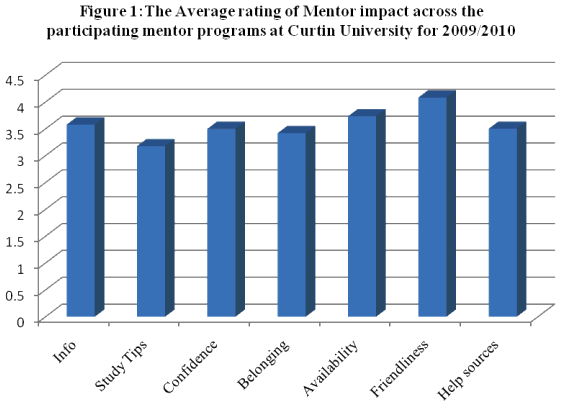
At the end each semester, mentees are asked to rate their own mentor on the statements below on a five point scale (from "Strongly Disagree" to "Strong Agree").
My Mentor:The data deriving from these scales from a large sample of 2391 mentees over 2009 and 2010 are shown in Figure 1 below. These data demonstrate high ratings on all the scales, indicating a significant and positive level of influence on the experience of beginning undergraduate students - with the further implication of positively influencing new student engagement.
- Provided me with useful information about the University.
- Helped me with study tips.
- Gave me confidence and reassurance in beginning University.
- Helped me feel I belong at Curtin University.
- Was always available if I needed help or advice
- Was friendly and approachable.
- Directed me to appropriate resources at Curtin.
A highly significant part of the evaluation data from Mentees demonstrates the impact of the program on student retention. Beginning students attribute a high impact on decisions to persist at Curtin. Mentees in 2009 and 2010 were asked - "If you were at any point considering withdrawing from the University, did your Mentor make any difference to your decision to continue at Curtin?" Whilst many students indicated that this question was not applicable to them, a substantial proportion did acknowledge the impact of the Mentor program on this issue. These results are shown in Table 2.
| Mentors influence on decision to continue at Curtin | % in 2009 | % in 2010 |
| 1. Yes | 14% | 4.4% |
| 2. No, mentor not involved | 15% | 8% |
| 3. N/A - never considered | 72% | 87.6% |
Whilst we cannot be sure whether these students would have seriously considered leaving the University, they most certainly attribute a very positive influence to their mentor.
There were also a substantial number of other potential initiatives identified in the plan, many of which have been acted upon by the areas responsible. Whilst this list is not inclusive of all these actions, some notable examples include:
Curtin's initial approach to this issue focused on retention rates as a specific issue. In some respects, this places the cart before the horse. Retention rates for commencing students are one outcome measure of having delivered a good first year experience. With the impending proposals from TEQSA to introduce measures of the quality of the first year experience, we would be wise to broaden our view more widely than just the retention rate.
Curtin Student Retention implementation Plan, viewed 5 January 2012, http://retention.curtin.edu.au/retentionplan/
Elliott, J.S., Beltman, S. & Lynch, E. (2011). "If you make a difference, you have changed someone's life": Outcomes from a university student mentor program , paper presented at the First Year in Higher Education Conference held in Fremantle, July 2011.
Elliott, J.S. & Lynch, E. (2010). Win, Win, Win: The gains for mentors, mentees and the university from Curtin's mentor program model, paper presented at the ANZSSA Conference held in Burradoo, December 2010.
Elliott, J.S., Murray, S., and Roy, S. (2010). What can we learn from students who are terminated from their studies?, paper presented at the National ISANA Conference, held in Melbourne, December 2010, and re-presented at the ANZSSA Conference held in Burradoo, December 2010.
Elliott, J.S., Roberts, B. & Guy, S. (2009). Protecting our Investment: An assessment of why domestic students at Curtin discontinue study and the potential for intervention, paper presented at the ANZSSA Biennial Conference, held in Brisbane, December 2009.
Elliott, J.S. (2007). Developing a Student Retention Plan, paper presented at the 16th Biennial ANZSSA conference, held in Auckland, December 2007. A revised version of the paper was also presented at the 17th Teaching and Learning Forum, held at Curtin University of Technology, January 2008. http://lsn.curtin.edu.au/tlf/tlf2008/abstracts.html#elliott
Elliott, J.S. (1994) Orientation and Transition Takes More Than a Week: What Universities Can Do About It, Proceedings of Teaching Learning Forum, Educational Development Unit, Edith Cowan University, Perth.
Good practice for safeguarding student Learning engagement in higher education institutions, Australian Learning and Teaching Council, viewed 5 January 2012 http://www.altc.edu.au/project-good-practice-safeguarding-student-learning-engagement-higher-education-institutions-2010
Hunter, M.S., Crome, B., Elliott, J.S., Ouakrime, M., Nyati-Ramahobo, L. & Stafford, C. (2009). New student programmes/student orientation. In Ludeman, R.B., Osfield K.J., Hidalgo, E.I., Oste, D. & Wang, H.S. Student Affairs and Services in Higher Education: Global Foundations, Issues and Best Practices, International Association of Student Affairs and Services (IASAS) in cooperation with: The United Nations Educational, Scientific and Cultural Organisation (UNESCO).
Learning and Teaching Performance Fund Issues paper, April 2004, Department of Education, Science and Training, viewed 5 January 2012, http://www.dest.gov.au/archive/highered/learning_teaching/documents/ltp_issues_paper.pdf
Queensland Student Success Program, viewed 5 January 2012, http://www.fye.qut.edu.au/transped/support.jsp
Retention Literature: a web resource maintained by the Student Transition and Retention Team, Curtin University, viewed 5 January 2012, http://retention.curtin.edu.au/external/
| Please cite as: Elliott, J. S. (2012). Does focusing on retention make a difference? The impact of Curtin's retention plan. In Creating an inclusive learning environment: Engagement, equity, and retention. Proceedings of the 21st Annual Teaching Learning Forum, 2-3 February 2012. Perth: Murdoch University. http://otl.curtin.edu.au/tlf/tlf2012/refereed/elliott.html |
Copyright 2011 Jim Elliott. The author assigns to the TL Forum and not for profit educational institutions a non-exclusive licence to reproduce this article for personal use or for institutional teaching and learning purposes, in any format, provided that the article is used and cited in accordance with the usual academic conventions.