
Su-Ann Koh, Kathy Sanders and Jan Meyer
The University of Western Australia
su-ann.koh@uwa.edu.au, kathy.sanders@uwa.edu.au, jan.meyer@uwa.edu.au
Professional practice
[ Refereed papers ]
| |
| Roles of active learning and tutor input in students' perception of learning
Su-Ann Koh, Kathy Sanders and Jan Meyer |
Category: Refereed Professional practice [ Refereed papers ] |
Research suggests that high student engagement is associated with increased learning. Student engagement generally arises as a result of active learning accompanied by good teaching. An effective classroom resource should therefore incorporate these factors in order to maximise student learning.Three resources relating to learning about human embryonic development were evaluated in a first-year Human Biology unit at The University of Western Australia, in terms of the extent to which they engaged students and assisted their understanding of embryology. The extent to which these effects were dependent on the presence of a tutor was also investigated. Resources were classified two ways: 1) 'active' vs 'passive' and 2) 'tutor-supported' vs 'student-directed' based on the level of student interaction and tutor involvement with the resource respectively. Two hundred and forty-five students completed a questionnaire which evaluated their perceptions of the individual resources. The questionnaire included questions relating to student interest and improvements in understanding and confidence as a result of interaction with the resource.
Student engagement, using interest as a proxy, was not associated with a self-perceived improvement in understanding. However, tutors significantly influenced student responses in terms of interest and self-reported improvement in understanding of embryology. The study demonstrates that student engagement is not always associated with increased self-perceived student learning, but it is likely to be moderated by the effectiveness of the tutor. It indicates that even with the use of self-directed resources in the classroom, the input of tutors plays a significant role in successful implementation.
Keywords: Student engagement, active learning, tutor influence, human biology resources
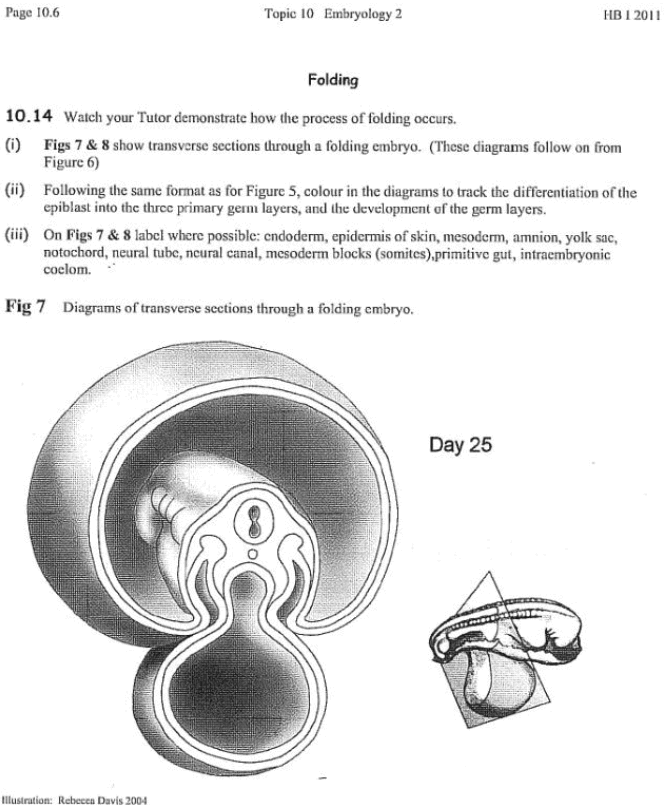
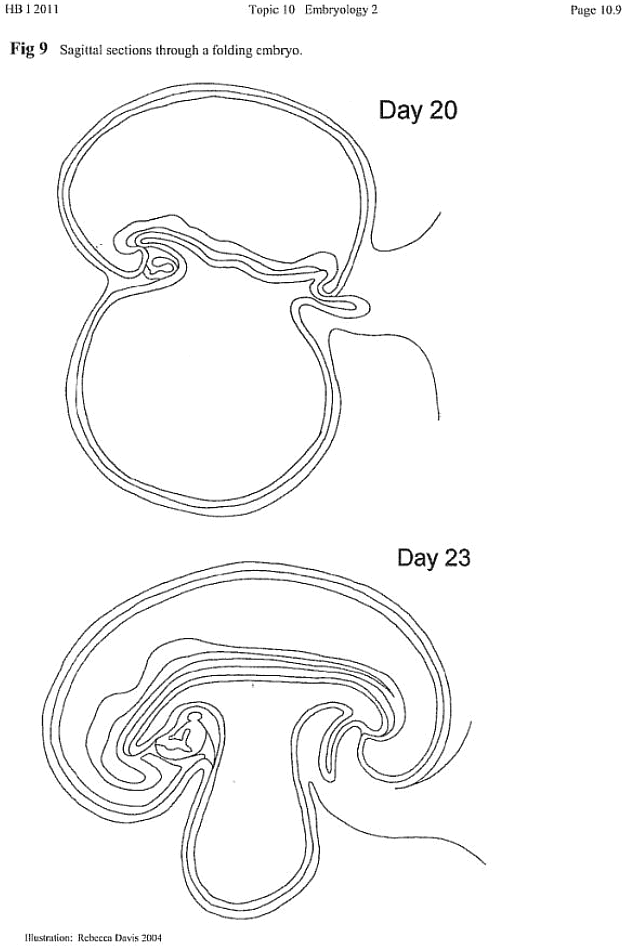
There was first a need to evaluate the three resources in terms of the extent to which they engaged the students and assisted their understanding of embryonic folding and whether these effects were dependent upon the presence of a tutor.
It was expected that students would perceive resources that they actively engaged in to be more valuable in improving their understanding of embryology. It was also predicted that resources that promoted "active learning" as opposed to "passive learning" would lead to an increase in self-perceived student understanding, since the literature suggests that "active learning" leads to increased student engagement and ultimately greater retention (Umbach & Wawrzynski 2005). It was also expected that the 'passive' activities would be most sensitive to variations in tutor attributes.
The three activities/resources investigated were presented within the context of a combined laboratory/tutorial session (hereafter referred to as a "lab") which all students are required to attend once a week for 1.5 hours. Each lab session revolved around several topics relating to human biology. Students attended the same session with the same tutor each week. In 2011, a total of 48 classes ran every week in 18 timeslots, with 2-3 sessions operating concurrently. Twenty three tutors were involved in 2011. One class was randomly selected to be included in the study at each time slot, resulting in 18 classes being surveyed. Students were surveyed the week after completing the embryology lab. In all cases, instructions and the questionnaire were administered by the primary investigator (as opposed to the class tutors). To avoid tutor bias, there was an attempt to avoid surveying multiple classes run by the same tutor. This was largely successful, with a single tutor having two classes surveyed. Each student answered questions relating to all three resources.
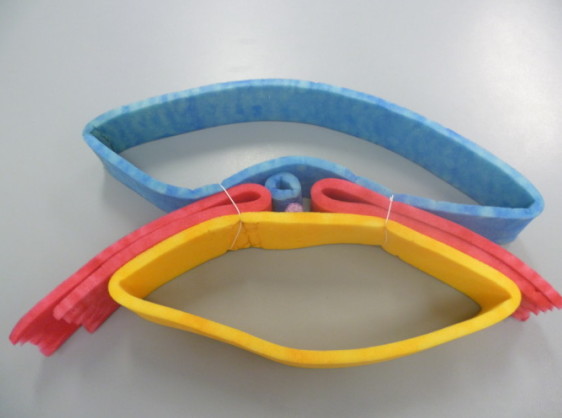
The level of tutor involvement required for each activity was also considered. The foam model was the most reliant on tutor support, followed by the online animation. In contrast, the colouring activity was relatively student-directed as while tutors were available to assist and answer any questions related to the activity, their involvement was not required for the activity to proceed.
All questionnaire information was non-identifying, but it was possible to identify which tutor each student had from the time at which they were collected. Responses were combined to reduce the Likert scale from four to two ("agree" and "disagree") to improve statistical reliability. Statistical analyses were carried out using Genstat 13.0. Chi-square testing of contingency tables was used to analyse overall responses to the resources, and to investigate if student responses varied according to their tutor. One-way analyses of variance (ANOVA) were used to analyse students' combined agreement rates to the three activities overall according to tutor characteristics, including tutor sex and occupational status. Due to a lack of comments from students, qualitative data was not included in analyses.
| Overall | "Active" vs "Passive" | Within "passive" - Foam vs Online | |
| Interest | chi2(2)=8.90, p=0.012 Foam>Colour>Online | ns | chi2(1)=8.73, p=0.003 Foam>Online |
| Easy to understand | ns | ns | chi2(1)=5.54, p=0.019 Online>Foam |
| Improved understanding | chi2(2)=7.67, p=0.022 Online>Colour>Foam | ns | chi2(1)=7.67,p=0.006 Online>Foam |
| Increased confidence | chi2(2)=6.29, p=0.043 Online>Colour>Foam | ns | chi2(2)=5.18, p=0.023 Online>Foam |
The students rated the three resources significantly differently in terms of how interesting they were. There was no difference in this respect between the "active" colouring task and the two "passive" tasks, but of the 'passive' tasks the foam model was rated as significantly more interesting than the online animation. Similarly, while there was no significant difference overall in how easy students thought the resources were to understand, the online animation was seen as significantly easier to follow, to better contribute to understanding and to better enhance confidence than the foam model.
| Foam model | Online animation | Colouring | |
| Interesting | chi2(16)=28.94, p=0.024 | ns | ns |
| Easy to understand | chi2(16)=48.94, p<0.001 | ns | ns |
| Improved understanding | chi2(16)=29.04, p=0.024 | chi2(16)=27.34, p=0.038 | chi2(16)=34.38, p=0.005 |
| Increased confidence | chi2(16)=28.00, p=0.032 | chi2(16)=26.92, p=0.042 | chi2(16)=25.93, p=0.055 |
| * Non-significant trend | |||
The sex of the tutor impacted on how both male and female students responded to the resources. Students with male tutors were more likely to say that an activity was interesting (p=0.007) and increased their confidence (p=0.008) compared to students with female tutors. There was also a tendency for students to find male tutors easier to follow (p=0.055). Their perception of whether activities increased their understanding of embryology was not affected by the sex of the tutor. Students with postgraduate or postdoctoral tutors were more likely to agree that an activity improved their understanding (p=0.005), increased their confidence (p=0.008), and was easy to follow (p=0.033) than those with tutors who were academics or other casual employees. Tutor status did not affect how interesting students found an activity (p=0.339).
The dissociation between student engagement (using self-reported student interest as a proxy) and self-reported student learning is surprising. Although the foam model was rated as more interesting than the online animation, the online animation was rated as being easier to follow, better at improving understanding, and increasing confidence. Current educational research promotes constructivism, the concept that students actively construct their own learning path, as the best way to enhance student learning (Nie & Lau 2010). Student engagement is generally associated with students being actively involved with their learning environments. Activities that promote greater interaction may therefore be more likely to successfully engage and enhance student learning. This, however, was not the case in our study. The dissociation between engagement and perceived learning was seen in responses to the "active" colouring activity, and the two "passive" resources. Moreover, the resources that student rated as being the most interesting and most valuable to improving their understanding were the "passive" resources.
One possible explanation for these findings is that there exists a discrepancy between what students think they know and what they actually know. Any increase in understanding embryology as a result of the resources may have been subconscious, and therefore not reflected in the students' self-reported answers to the questionnaire. It is also possible that the "passive" resources made the students feel more comfortable because these activities were not reliant on the students themselves to proceed, whereas the "active" resource may have caused discomfort by highlighting gaps in student knowledge. Increased comfort may therefore have been confused with increased learning.
Tutors may also help explain these results; the tutor plays a vital role in determining how students respond to an activity, and what they take away from it. Our results indicate the influence of tutors on student perceptions of their learning environment should not be underestimated, with student responses to the various resources varying significantly depending on their individual tutor. Responses to the passive activities were particularly variable by tutor. These resources required greater involvement of the tutor, suggesting that different tutors interact in different ways with the passive resources, with varying degrees of effectiveness.
The foam model, the resource that required the greatest level of tutor involvement, was logically the most highly variable by tutor. When overall responses were examined independent of tutors, the foam model was rated as being more interesting than the online animation, but did not contribute to their understanding and confidence as much as the online animation. It is possible that students found the foam model interesting because it is a medium that is not often used in classrooms, as opposed to the online animation and colouring activities, which are standard ways of communicating information to students (online activity, pen and paper activity). However, the foam model was seen to be unhelpful overall in improving self-perceived student understanding. The high variability in the ability of the foam model to improve understanding and confidence makes sense when tutors are taken into account. Tutors who are confident and understand how to manipulate the model themselves are more likely to successfully transmit this to their students, whereas tutors who are unsure of themselves may conduct an interesting demonstration, but without increasing students' learning experience.
Students with male tutors rated the activities overall as being easier to follow, and better at increasing understanding and confidence. It is plausible that male tutors are more likely to come across as authoritative figures that are confident with the material themselves. As mentioned above, this may transmit to students, increasing their own confidence in the subject.
It was interesting that students with postgraduate/postdoctoral tutors responded more positively to the resources than those with other sessional staff tutors, particularly in terms of improving understanding and confidence. The non-student tutors were not inexperienced - they compromised of academics and casual teaching staff who had previously taught the unit and/or other units in the department for several years. It is possible that postgraduate/postdoctoral tutors, having less experience with the course content, simplify concepts while they are learning them themselves in preparation for teaching. This simplification may result in greater clarity for the students. On the other hand, 'seasoned' tutors are more likely to have a deep understanding of the course content, and require less simplification for their own thought processes. This may result in their transmission of information to students being less effective. They may also be more likely to confuse students with "extra" unnecessary information compared to student-tutors who simply tell students what they need to know, and no more. The only measure that did not differ according to tutor status was student engagement (interest), indicating that these results are unlikely to be explained by students perceiving postgraduate/postdoctoral tutors as more relatable.
This study is not without limitations. We recognise that our indicators of student learning are subjective and simply tell us what students think they take away from an activity. It would be useful to follow this up with objective measures of student academic performance. Nevertheless, it is important to take into account how students feel about their university environment, particularly in first year as this has a great impact on the rest of their university experience. Our findings that student responses vary according to tutor should also be approached with caution. It would be useful to survey equal numbers of students who had male and female tutors, as only 2 of the 17 tutors included in the study were male. There is traditionally a large female-male ratio in the biological sciences, however, so this situation was difficult to avoid.
The introduction of the online animation into the Human Biology I classroom appears to be largely successful. Students rated it relatively highly in terms of increasing their understanding and confidence in embryology. However, there is room for improvement since it not did rate highly as being as interesting. Furthermore, the effectiveness of this resource in its current form is likely to be diminished if the online activity is converted into an entirely self-directed at-home activity. The foam model, was rated as interesting; this resource may have had a 'novelty' factor for students but was too variable by tutor to be useful overall to perceived student learning. In contrast, the use of the online animation during the lab may have lost any novelty for students due to it being a familiar medium, and because it had previously been shown in a lecture. One possible solution might be to combine elements from these two resources - for example, showing a video of a tutor demonstrating the foam model activity to students while allowing students to interact with the model itself at the same time during lab sessions.
First year students tend to be particularly difficult to teach since they are novices at university life (Rhoden & Dowling 2006). This study highlights the importance of training tutors to effectively deal this unique cohort. The substantial variation in student response by tutor indicates that differences between teaching styles exist. Some of this may simply be due to experience - as discussed above, experience may have a positive or negative effect. However, there are evidently still opportunities for improving both tutor training and the quality of classroom resources.
Nie, Y. & Lau, S. (2010). Differential relations of constructivist and didactic instruction to students' cognition, motivation, and achievement. Learning and Instruction, 20(5), 411-423. http://dx.doi.org/10.1016/j.learninstruc.2009.04.002
Rhoden, C. & Dowling, N. (2006). Why tutors matter: Realities of their role in transition. In Engaging students. Proceedings of the 9th Pacific Rim First Year in Higher Education Conference, 12-14 July 2006. Gold Coast: Griffith University. [viewed 1 November 2011]. http://www.fyhe.com.au/past_papers/2006/Papers/Rhoden.pdf
Umbach, P.D. & Wawrzynski, M.R. (2005). Faculty do Matter: The Role of College Faculty in Student Learning and Engagement. Research in Higher Education, 46(2), 153-184. http://dx.doi.org/10.1007/s11162-004-1598-1
| Please cite as: Koh, S.-A., Sanders, K. & Meyer, J. (2012). Roles of active learning and tutor input in students' perception of learning. In Creating an inclusive learning environment: Engagement, equity, and retention. Proceedings of the 21st Annual Teaching Learning Forum, 2-3 February 2012. Perth: Murdoch University. http://otl.curtin.edu.au/tlf/tlf2012/refereed/koh.html |
Copyright 2011 Su-Ann Koh, Kathy Sanders and Jan Meyer. The authors assign to the TL Forum and not for profit educational institutions a non-exclusive licence to reproduce this article for personal use or for institutional teaching and learning purposes, in any format, provided that the article is used and cited in accordance with the usual academic conventions.