
Category: Professional practice
Category: Professional practice |
| Teaching and Learning Forum 2013 [ Refereed papers ] |
Joginder Kaur Gill and Zed Rengel
The University of Western Australia
Email: gillj03@student.uwa.edu.au
Technological developments have not only been introduced to support traditional face to face education, but also to facilitate the spread of distance education programs and online learning. This paper contributes to the development of online lectures based on the foundations provided by learning theories (behaviourism, cognitivism, constructivism and connectivism). Using this approach, the author has developed an online lecture in the discipline of soil science on the topic 'crop residue management and phosphorus cycling'. Different aspects of designing an online lecture in terms of the content of lecture and its organisation, learner preparation, a couple of activities to engage students, and strategies to promote interaction have been discussed in detail. This lecture is designed for use in future and the feedback received by authors would be effectively utilised to improve upon this practice.
As teachers, we have broadened our presentation of soil from the traditional edaphic and pedagogical approaches to include a range of other aspects such as soil engineering, pollution and waste management and land use planning (Lockwood, 1997). Traditional soil science courses, especially with a hands-on laboratory component, used to be face to face events (Reuter, 2007). However, with the advances in Internet technologies and the impact of changing academic programs, many web-based applications have been developed in the discipline of soil science as well. These web-based applications are aimed at enhancing student comprehension and accommodating the multiple learning styles of students. An instructional multimedia program called 'Oz Soils' was developed at the University of New England and has been used by the students of an introductory soil science unit (Soil Science 211) as an additional learning aid (Lockwood, 1997). Eick (2000) developed a web-based clay mineralogy tutorial to assist students learning clay structures and cation exchange capacity. At the University of Florida, faculty have developed virtual field laboratories using 3-D imaging programs (Ramasundaram, 2004). Students were able to run a spectrometer using the Internet to analyse unknown chemicals (Scanlon, 2004). Stout (2004) designed a GIS and soil survey exercise to introduce students to GIS technology and the land use information available in digital soil surveys. Thus, e-learning tools such as video-recording of lectures, online lectures and computer-based trainings or tutorials should be developed to meet students' changed expectations and to create new possibilities for the use of electronic learning in education.
As the use of computer technology is becoming widespread in the college and university classrooms, e-learning tools such as video recordings of lectures, computer-based trainings, tutor-guided online discussions and virtual document sharing systems have become an integral part of the undergraduate and graduate programs worldwide (Mohr, 2012).
In the literature, different terminologies have been used for the explanation of online learning. The most commonly used terms are e-learning, Internet learning, distributed learning, networked learning, tele-learning, virtual learning, computer-assisted learning, web-based learning and distance teaching (Ally, 2008). More specifically, online learning can be defined as Òthe use of the Internet to access learning materials; to interact with the content, instructor, and other learners; and to obtain support during the learning process, in order to acquire knowledge, to construct personal meaning, and to grow from the learning experienceÓ (Ally, 2008).
In terms of teaching practices and student outcomes, results have indicated very small (Gunawardena, 2004; Zhao, 2005) or non-significant differences between face to face and online learning formats (Bata-Jones, 2004; Horspool, 2012; Summers, 2005; Swan, 2000; Topper, 2007). In fact, Kassop (2003) outlined ten ways, (student-centred learning, writing intensity, highly interactive discussions, geared to lifelong learning, enriched course material, on-demand interaction and support services, immediate feedback, flexibility, an intimate community of learners and faculty development and rejuvenation) in which online education either matches or surpasses face-to-face learning.
Relevant learning theories include behaviourism (Skinner, 1974), cognitivism, constructivism (Duffy, 1996) and connectivism (Siemens, 2004). Behaviourism, cognitivism and constructivism are the main, broad learning theories which most often inform instructional environments. However, they were developed in a time when learning was not impacted by technology (Siemens, 2004).
Cognitive psychology suggests that a teacher/ educator should use the strategies that promote perception and attention for online learners. It can be achieved by placing the important information in the centre of the screen for reading and by highlighting the critical information to focus learners' attention. Information should be chunked to prevent overload during processing in working memory. To facilitate efficient processing in working memory, the online material should present between five and nine items on the screen (Miller, 1956).
Conceptual models should be used to allow online learners to retrieve existing information from long-term memory to help make sense of the new information. Pre-instructional questions to set up the expectations or pre-requisite test questions can be used to activate the prior acquired knowledge of the learners (Ally, 2008).
A variety of learning strategies should be included in the online instruction to accommodate individual differences and learning styles (Cassidy, 2004). The information should be presented in different modes such as textual, verbal and visual, to facilitate processing and transferring to long-term memory (Ally, 2008).
Learners should be motivated to learn. The ARCS (Attention, Relevance, Confidence, Satisfaction) motivation model proposed by Keller is an appropriate one to follow to motivate students (Keller, 1983; Keller, 1988).
The implications for online learning include that learning should be an active and interactive process. Learners should be able to construct their own knowledge; they should be given time and opportunity to reflect and also they should be given some control of the learning process. Real-life examples should be included to make the learning material more meaningful (Ally, 2008).
Apart from that, the guidelines for the development of online learning material include that the learners must be allowed to connect with others around the world to share and review information. The learning material should be taken from different sources to reflect the networked world and diversity of thinking (Ally, 2008). Because of globalisation, information is not location-specific and the learners should be given the opportunity to research and locate new information. Learners must network with other students and experts to make sure that they are continually learning and updating their knowledge (Ally, 2008).
Therefore, for the development of effective online materials, strategies should be used to motivate learners, facilitate their deep learning, cater for individual differences, promote interaction, provide relevant feedback, facilitate contextual learning, and provide support throughout the learning process. As discussed above, there are different learning theories, but no one is used exclusively to design online learning materials. Instead all of these theories can contribute to the design of online learning materials. Behaviourist strategies can be used to teach the facts ('what'); cognitivist strategies to teach principles and processes ('how'); and constructivist strategies to introduce real-life and personal applications and contextual learning (Ally, 2008). In addition to this, connectivism principles can be used to guide the development of effective online materials.
The ARCS (Attention, Relevance, Confidence and Satisfaction) model proposed by Keller (1988) is used to motivate the learners. To capture the attention of learners, a small activity is included after introducing the topic and discussing the outcomes of the lecture. The learners are asked to think/make a note about the crop residue management strategies they are familiar with, and the underlying reasons for the popularity of those management strategies.
The learners are informed about the relevance of the lecture in the broader context, for example the implications of different crop residue management strategies in term of immobilisation/mineralisation of nutrients or losses of nutrients with burning of crop residues and thus related pollution problems, etc. Examples from all over the world are included to show them the bigger picture of the context.
Strategies are followed to develop the confidence of learners by structuring the lecture from simple to complex. The lecture starts from simple information regarding what crop residues are, what are their different uses, how much residues are produced and then carried on to more complex information regarding effects of different management strategies on soil properties and phosphorus content in the soil. To support learners, feedback will be provided on their queries and during the follow-up discussion of their own experience with crop management.
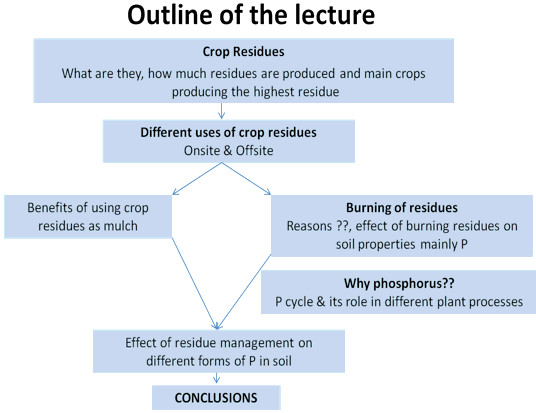
Figure 1: A conceptual map used at the start of lecture to present a detailed outline
A self-assessment is provided at the start of the lesson to allow learners to check whether they are ready for the lecture, i.e. they have the pre-requisite knowledge. Also, it will help the learners to build on their prior knowledge and thus will help to bridge the gap between what learners already know and what they need to know.
A follow-up discussion exercise has also been included in the lecture, in which learners are asked to share their own experience of management of crop residues. This discussion exercise will be an asynchronous discussion using the discussion forum after the delivery of lecture. This will not only help to promote high-level knowledge and application in learners, but also personalise the content in terms of real life applications.
Four aspects of a teaching/learning environment which foster deep learning include: 1) the environment is enjoyable and students are motivated to learn, 2) students engage in a variety of activities and sensory experiences related to the learning tasks, 3) there is interaction between the students and a responsive expert and interaction between peers, 4) the content is well-structured rather than piecemeal, with an emphasis on connections and relationships between different facets of the knowledge base (Biggs, 1991, as cited in Lockwood, 1997).
I have tried to accommodate all of these aspects while preparing this lecture. A couple of learner activities (self-evaluating questionnaire and follow-up discussion exercise) are included in the lecture to engage students. To promote peer interaction and expert-learner interaction, the follow up discussion exercise has been incorporated. The ARCS model proposed by Keller (1988) to motivate the learners and other strategies like organisation of lecture content from simple to complex and use of conceptual maps to make connections are used in the lecture. All these efforts are done to make the teaching and learning experience enjoyable for the learners.
This online lecture was developed for use in the future and is based on the assumption that the students do have the pre-requisite knowledge regarding phosphorus cycling in soil, some aspects of management of crop residues, and that their level of knowledge may be varied, thereby affecting their learning. Reflective practice and student feedback are the important aspects to determine the success of a teaching or learning practice.
Bata-Jones, B. & Avery, M. D. (2004). Teaching pharmacology to graduate nursing students: Evaluation and comparison of web-based and face-to-face methods. Journal of Nursing Education, 43(4), 185-189.
Biggs, J. B. (1991). Good learning: What is it? How can it be fostered? In J. B. Biggs (Ed.), Teaching for learning. Hawthorne: Australian Council for Educational Research.
Cassidy, S. (2004). Learning styles: An overview of theories, models, and measures. Educational Psychology, 24(4), 419-444. http://dx.doi.org/10.1080/0144341042000228834
Churchman, G. J. (2010). The philosophical status of soil science. Geoderma, 157, 214-221.
Connolly, T. M., MacArthur, E., Stansfield, M. & McLellan, E. (2007). A quasi-experimental study of three online learning courses in computing. Computers & Education, 49(2), 345-349. http://dx.doi.org/10.1016/j.compedu.2005.09.001
Dag, F. & Gecer, A. (2009). Relations between online learning and learning styles. Procedia - Social and Behavioral Sciences, 1(1), 862-871. http://dx.doi.org/10.1016/j.sbspro.2009.01.155
Daugherty, M. & Funke, B. L. (1998). University faculty and student perceptions of web-based instruction. The Journal of Distance Education, 13(1), 21-39. http://www.jofde.ca/index.php/jde/article/view/134/411
Duffy, T. M. & Cunningham, D. J. (1996). Constructivism: Implications for the design and delivery of instruction. In D. H. Jonassen (Ed.), Handbook of research for educational communications and technology (pp. 170-198). New York: Simon & Schuster Macmillan.
Eick, M. J. & Burgholzer, R. W. (2000). Design and implementation of inter-active online tutorials for introductory soil science courses. Journal of Natural Resources and Life Sciences Education, 29, 149-154. https://www.agronomy.org/files/jnrlse/issues/2000/e00-08.pdf
Field, D. J., Koppi, A. J., Jarrett, L. E., Abbott, L. K., Cattle, S. R., Grant, C. D., McBratney, A. B., Menzies, N. W. & Weatherley, A. J. (2011). Soil science teaching principles. Geoderma, 167-168, 9-14. http://dx.doi.org/10.1016/j.geoderma.2011.09.017
Flannery, T. (2010). Here on Earth: An argument for hope. Melbourne: Text Publishing Co.
Fowler, D. (2005). Are on-site courses are as effective as online? Online Classroom, March. Magna Publications Inc., Madison, WI. http://www.vcu.edu/cte/resources/newsletters_archive/OC0503.PDF
Glance, D. & Sinclair-Jones, M. (2012). UWA joins Stanford University to offer free online courses. University News, 3 October. http://www.news.uwa.edu.au/201210035050/international/uwa-joins-stanford-university-offer-free-online-courses
Gunawardena, C. N. & McIssac, M. S. (2004). Distance education. In D. H. Jonassen (Ed.), Handbook of research on educational communications and technology (pp. 355-395). Mahwah, NJ: Lawrence Erlbaum.
Hartemink, A. E. & McBratney, A. (2008). A soil science renaissance. Geoderma, 148(2), 123-129. http://dx.doi.org/10.1016/j.geoderma.2008.10.006
Horspool, A. & Lange, C. (2012). Applying the scholarship of teaching and learning: student perceptions, behaviours and success online and face-to-face. Assessment & Evaluation in Higher Education, 37(1), 73-88. http://dx.doi.org/10.1080/02602938.2010.496532
Kassop, M. (2003). Ten ways online education matches, or surpasses, face-to-face learning. The Technology Source, May/June. http://technologysource.org/article/ten_ways_online_education_matches_or_surpasses_facetoface_learning/
Keller, J. M. (1983). Motivational design of instruction. In C. M. Reigeluth (Ed.), Instructional design theories and instruction: An overview of their current status (pp. 383-429). Hillsdale, NJ: Lawrence Erlbaum.
Keller, J. M. & Suzuki, K. (1988). Use of ARCS motivation model in courseware design. In D. H. Jonassen (Ed.), Instructional design for micro-computer courseware (pp. 401-434). Hillsdale, NJ: Lawrence Erlbaum.
Lieblein, E. (2000). Critical factors for successful delivery of online programs. The Internet and Higher Education, 3(3), 161-174. http://dx.doi.org/10.1016/S1096-7516(01)00036-7
Lockwood, P. & Daniel, H. (1997). Computer-assisted teaching in soil science. Sciences of Soils, Rel. 2, http://www.hintze-online.com/sos/1997/Articles/Art5
Miller, G. A. (1956). The magical number seven, plus or minus two: Some limits on our capacity for processing information. Physiological Review, 63, 81-97. [verified 19 Jan 2013] http://www.musanim.com/miller1956/
Mohr, A. T., Holtbrugge, D. & Berg, N. (2012). Learning style preferences and the perceived usefulness of e-learning. Teaching in Higher Education, 17(3), 309-322. http://dx.doi.org/10.1080/13562517.2011.640999
Moisey, S. D. & Hughes, J. A. (2008). Supporting the online learner. In T. Anderson (Ed.), The theory and practice of online learning (2nd ed., pp. 419-439). Edmonton, Canada: Athabasca University Press. http://www.aupress.ca/index.php/books/120146
Mullen, G. E. & Tallent-Runnels, M. K. (2006). Student outcomes and perceptions of instructors' demands and support in online and traditional classrooms. The Internet and Higher Education, 9(4), 257-266. http://dx.doi.org/10.1016/j.iheduc.2006.08.005
Murphy, K. L. & Cifuentes, L. (2001). Using web tools, collaborating, and learning online. Distance Education, 22(2), 285-305. http://dx.doi.org/10.1080/0158791010220207
O'Malley, J. (1999). Students' perceptions of distance learning, online learning, and the traditional classroom. Online Journal of Distance Learning Administration, 2(4), 1-9. http://www.westga.edu/~distance/omalley24.html
Ramasundaram, V., Grunwald, S., Mangeot, A., Comerford, M. B. & Bliss, C. M. (2004). Development of an environmental virtual field laboratory. Computers & Education, 45(1), 21-34. http://dx.doi.org/10.1016/j.compedu.2004.03.002
Reuter, R. J. (2007). Introductory soils online: An effective way to get online students in the field. Journal of Natural Resources and Life Sciences Education, 36(1), 139-146. http://dx.doi.org/10.2134/jnrlse2007.361139x
Rovai, A. P., Ponton, M. K., Derrick, M. G. & Davis, J. M. (2006). Student evaluation of teaching in the virtual and traditional classrooms: A comparative analysis. The Internet and Higher Education, 9(1), 23-25. http://dx.doi.org/10.1016/j.iheduc.2005.11.002
Ruellan, A. (1997). In Discussion of: J. Bouma, the role of quantitative approaches when interacting with stakeholders. Geoderma, 78(1-2), 13-15. http://dx.doi.org/10.1016/S0016-7061(97)00015-3
Scanlon, E., Cowell, C., Cooper, M. & Di Paolo, T. (2004). Remote experiments, re-visioning and re-thinking science learning. Computers & Education, 43(1-2), 153-163. http://dx.doi.org/10.1016/j.compedu.2003.12.010
Siemens, G. (2004). Connectivism : A learning theory for the digital age. elearnspace, 12 December. http://www.elearnspace.org/Articles/connectivism.htm
Skinner, B. F. (1974). About behaviorism. New York: Knopf.
Stout, H. M. & Lee, B. D. (2004). Land use planning exercise using digital geographic information systems and digital soil surveys. Journal of Natural Resources and Life Sciences Education, 33, 11-15.
Summers, J. J., Waigandt, A. & Whittaker, T. A. (2005). A comparison of student achievement and satisfaction in an online versus a traditional face-to-face statistics class. Innovative Higher Education, 29(3), 233-250. http://dx.doi.org/10.1007/s10755-005-1938-x
Sun, P., Tsai, R. J., Finger, J., Chen, Y. & Yeh, D. (2008). What drives a succesful e-learning? An empirical investigation of the critical factors influencing learner satisfaction. Computers & Education, 50(4), 1183-1202. http://dx.doi.org/10.1016/j.compedu.2006.11.007
Swan, K. (2001). Virtual interaction: Design factors affecting student satisfaction and perceived learning in asynchronous online courses. Distance Education, 22(2), 306-331. http://dx.doi.org/10.1080/0158791010220208
Swan, M. K. & Jackman, D. H. (2000). Comparing the success of students enrolled in distance education courses vs. face-to-face classrooms. Journal of Technology Studies, 26(1), 58-63. http://scholar.lib.vt.edu/ejournals/JOTS/Winter-Spring-2000/pdf/swan.pdf
Topper, A. (2007). Are they the same? Comparing the instructional quality of online and face-to-face graduate education courses. Assessment & Evaluation in Higher Education, 32(6), 681-691. http://dx.doi.org/10.1080/02602930601117233
Wuensch, K. L., Aziz, S., Ozan, E., Kishore, M. & Tabrizi, M. H. (2008). Pedagogical characteristics of online and face-to-face classes. International Journal on ELearning, 7(3), 523-532. http://www.highbeam.com/doc/1P3-1552846461.html
Young, A. & Norgard, C. (2006). Assessing the quality of online courses from the students' perspective. The Internet and Higher Education, 9(2), 107-115. http://dx.doi.org/10.1016/j.iheduc.2006.03.001
Zhao, Y., Lei, J., Yan, B., Lai, C. & Tan, H. S. (2005). What makes the difference? A practical analysis of research on the effectiveness of distance education. Teachers College Record, 107(8), 1836-1884. http://www.tcrecord.org/content.asp?contentid=12098
| Please cite as: Gill, J. K. & Rengel, Z. (2013). Designing an online lecture in the discipline of soil science. In Design, develop, evaluate: The core of the learning environment. Proceedings of the 22nd Annual Teaching Learning Forum, 7-8 February 2013. Perth: Murdoch University. http://otl.curtin.edu.au/professional_development/conferences/tlf/tlf2013/refereed/gill.html |
Copyright 2013 Joginder Kaur Gill and Zed Rengel. The authors assign to the TL Forum and not for profit educational institutions a non-exclusive licence to reproduce this article for personal use or for institutional teaching and learning purposes, in any format, provided that the article is used and cited in accordance with the usual academic conventions.