
Category: Professional practice
Category: Professional practice |
| Teaching and Learning Forum 2013 [ Refereed papers ] |
Alexandra Ludewig and Iris Ludewig-Rohwer
The University of Western Australia
Email: alexandra.ludewig@uwa.edu.au, 20405939@student.uwa.edu.au
Online role-plays have been celebrated for providing an environment which allows for high quality learning. Innovative approaches have been embraced in foreign language studies, especially in countries where a great distance to the target country needs to be overcome, not only to expose students to the target language but also to provide them with a forum to apply and extend their newly-acquired language skills in creative applications outside the face-to-face classroom. This paper explores the design, application and evaluation of one of these innovative teaching and assessment strategies: an online role-play in German Studies at UWA. Complex educational objectives, as classified by Bloom and many others since, were the starting point for our design. However, despite all the ideal ingredients being included in the role-play, our evaluation transpired to be a corrective of sorts. It was intended to re-affirm that students appreciate the best-practice learning strategies which have guided the design and development of this role-play. Student feedback gained through student surveys, vocabulary tests, classroom observations, as well as quantitative tracking of contributions has been utilised to analyse the level of student engagement and their reflections on their learning in this role-play. Our findings suggest that even an ideally designed web-based role-play will not necessarily lead to a more effective way of learning, at least not from the students' perspective.
It is challenging to optimise learning conditions for students of foreign languages in a university learning environment that is situated many thousands of miles away from the real-life target culture. This has inspired a team of language instructors and researchers at UWA to spend considerable time and effort on designing a variety of engaging and viable learning activities and environments. The student-centred aim was to allow for the interactive exploration and practice of newly acquired knowledge and skills within and outside the classroom. One solution has taken the form of online simulations and blended role-play scenarios, which have been utilised in various forms over the past decade.
The team has been curious to discover whether their efforts to extend the time students can spend on tasks, and thereby to increase the opportunities for them to communicate in the target language, have been taken up and appreciated. The team was also keen to ascertain whether these innovations have led to the desired student learning outcomes. The following case study of the latest cycle of such an online simulation offered to 47 students at intermediate to advanced levels will serve to illustrate a certain disjuncture between theory and practice, that is: Bloom's Taxonomy and something that has been experienced in part to be "blooming taxing".
At UWA, the German units at intermediate and advanced levels are structured in such a way that students with greatly varying language backgrounds are taught together. Students have three compulsory face-to-face contact hours per week: one hour in a large-group interactive lecture and two hours in small-group language classes. In addition, one face-to-face conversation class per week is offered as an optional extra (which is attended by around 80% of students). In order to extend the time spent on-task, assessment exercises have been redesigned in such a way that they are potentially open-ended, student self-directed and of such a complexity that they offer students seemingly infinite possibilities to immerse themselves for additional hours.
Given that any student cohort is diverse, such an offer is bound to attract varying responses. Time-constraints experienced by some students, irrespective of whether they are full-time or part-time, mature-age or school leavers, will affect any individual's motivation for studying. However, personal attributes such as confidence or hesitance, extroversion or reserve will also have an impact on learning preferences. In order to provide all students with as much freedom and flexibility as they need for the extra hours of commitment per week, online provision has become the learning extension of choice. To this end, we have designed a tool and an environment which is engaging, allows for active learning, encourages learning to achieve academically challenging outcomes, provides room to safely explore and practise language and experience culture at all unit levels, while also offering flexibility, choice and student satisfaction.
Guided by the literature on the subject, the team has remained mindful of all the hallmarks of "ideal" teaching approaches when devising learning and assessment tasks, namely those which encourage students to engage in self-directed and peer-assisted learning, involve experiential and real-world learning, incorporate resource-based and problem-based learning, include reflective practice and critical self-awareness, utilise open learning and alternative delivery mechanisms and also allow for freedom of choice and individual learning style preferences (cf. Candy, 1991, 1994). In particular, with regard to the foreign language classroom and the use of technology, past research has suggested that well-scaffolded online environments can provide effective and efficient opportunities to overcome the lack of exposure to the target language outside the classroom and to extend the limited opportunities to use a foreign language in everyday life (Pais Marden, 2008). For over a decade online role-play simulations have been celebrated by educators as providing an environment which allows for reflective deep and meaningful learning (Wills, 2012). Wills et al. (2011) suggest that role-based e-learning "provides opportunities to address all the principles of quality learning design" (p.12). By promoting communication and encouraging creativity, role-plays and simulations have also been shown to help develop the skills of students and to allow them to learn about each other in a safe environment (Pivec et al., 2003; Geurts et al. 2007).
Despite positive endorsement of educational role-plays, Wills et al. (2009) argue that face-to-face role-play is only a short-term teaching tool, and that it is therefore not likely to cater for a research-intensive approach to learning. Indeed, many role-plays suggested by course books in foreign language teaching tend to be of a short-term nature, allowing little time for research and preparation (cf. Schönherr et al., 2011; Schütze-Nöhmke et al., 2011). Once this type of role-play has started, spontaneous interaction is required, inviting a comparison with impromptu theatre or "process drama", as it is referred to by Liu (2002). Yet the type of online role-play analysed in this study is by its nature more akin to a simulation than to process drama. Only after in-depth research are participants expected to (re)act and deal with events in a historically appropriate fashion. The course of events is largely pre-determined by history (cf. Dunn and O'Toole, 2009) and by carefully scaffolded learning outcomes.
In our study, we were specifically guided by the high-quality learning principles outlined by Boud and Prosser (2002). They, as well as others, have repeatedly proven that an ideal learning activity needs to "engage learners", "acknowledge learning context", "challenge learners" and "provide practice" (p.241). Furthermore, they suggest that role-based learning considers the four components of all learning identified by Siemens and Tittenberger (2009), whereby a learning design needs to allow for "social", "situated", "reflective" and "multi-faceted" learning (p.9).
Working with these principles and translating them into assessment tasks has guided past efforts by the authors of this study, who have since devised several different scenarios and associated teaching modes, ranging from face-to-face role-plays and computer-facilitated simulations to blended online and face-to-face simulations. As the findings from their large-scale evaluation study have shown (2012), it is especially those approaches that blend technology and face-to-face interaction which may in fact lead to profound high-quality learning outcomes. Past research has demonstrated how face-to-face or in-class role-plays allow for collaborative, problem-based, student-centred learning (Ludewig & Ludewig-Rohwer, 2012). However, the authors also caution that face-to-face role-plays are by their very nature bound to time and location and do not offer complete flexibility to the student, only partially. In this they agree with Freeman and Capper (1999), who saw the benefits of web-based platforms for role-play scenarios in increased (not total) freedom and ease of participation, as they allow for more flexibility with regard to time and place.
Specifically in the context of foreign-language acquisition, online interaction adds another welcome advantage; a certain anonymity provided by a secret identity, which liberates some students, who, in such a setting, are less afraid to contribute when any mistakes are made incognito. Bell (2002) suggests that anonymity might be of advantage, especially for the participation of non-native speakers. This argument was a particularly persuasive factor in supporting the use of secret-identities in the UWA role-plays, which are conducted with foreign language students who are all at different levels in their learning. As part of a multifaceted learning design, a secret identity has been shown to facilitate experimentation with the language in the students' text-based postings (Ludewig & Ludewig-Rohwer, 2012). In addition, compared to face-to-face role-play in class, which requires interaction on the spot, asynchronous web-based interaction allows for responses which students have had time to reflect upon, with regard to language and content.
As a result of these benefits, online role-plays have become an integral part of teaching and assessing students within the intermediate and advanced units in German Studies at UWA. Nevertheless, while the evaluation of the design principles in the web-based role-plays conducted in the past has proved that they have been effective in engaging students, a one-to-one causality of assessment type and high quality learning has thus far been an unproven claim. This study originally set out to prove this link by trying to close this last step of the endorsement logic. However, our findings have not supported this axiom; rather, they point towards a disjuncture between theory and practice, as the data analysis of this study suggests that the number of students benefitting from this specific learning tool is much lower than anticipated.
| Week 1: | introduction to the role-play; |
| Week 2: | allocation of roles; |
| Week 3: | introduction to simulation builder, research of character; |
| Weeks 4 to 7: | interaction with other students; |
| Week 8: | role-play party. |
In order to answer the question "How is the pedagogy behind role-plays perceived by students?", we obtained both qualitative and quantitative data from a variety of sources:
The analysis of the data, following in part a narrative enquiry, arrived at the insight that, while the majority of students enjoyed participating in the role-play, they would - if now given the choice - opt for other assessment types, as they were dissatisfied with the ratio of time-input versus perceived learning output. The discussion of this disjuncture between theory and practice will form the main part of this paper. It contrasts the ideal set-up of role-play simulations and their desired learning outcomes (as outlined in the theory and endorsed by practical applications) with student perceptions. More specifically, it will show how this ideal of employing innovative, engaging, challenging and open-ended tasks clashed with the real, most importantly with the students' satisfaction with, and appreciation of, the tasks. It will thus provide a corrective context for best-practice principles as outlined in the existing literature by adding the voices of students and staff, who have moved from theory to practice, and then on to reflection.
| Intermediate | Intermediate | Advanced | Advanced | Advanced | |
| Number of students | 20 | 16 | 3 | 2 | 6 |
| Anticipated language level | Comparable to Level A1/A2 of the CEF* | Comparable to Level A1/A2 of the CEF* | Comparable to Level A2/B1 of the CEF* | Comparable to Level A2/B1 of the CEF* | Comparable to Level A2/B1 of the CEF* |
| Year(s) of study/ semesters completed | 1st year/ 1 semester | 2nd year / 3 semesters | 1st year/ 1 semester | 2nd year/ 3 semesters | 3rd year/ 5 semesters |
| Language background | Completed tertiary entrance examination in German | Former students of beginner level | Native speaker background or equivalent | Completed intermediate level | Completed intermediate level |
| * CEF: Common European Framework | |||||
Instructions given to students at the outset of the unit were as follows:
Role-play: "Feind ist, wer anders denkt."
In this online role-play you will be provided with the opportunity to follow/experience the challenges of life in the GDR and FRG during the Cold War. The characters and scenarios are based on real events. The role-play will be run over a period of 6 weeks. The assessment consists of four steps.Step 1 -- CV and Diary entry (5%)
Familiarise yourself with your character and step back in time. Who are you? What is your life like at this time? What are your goals and dreams? How do you feel about your country? Write a CV true to the time in which you live. Also provide a short diary entry (150 words) which will be published in the role-play. Please add a list of significant vocabulary (20+ words). You will be marked on your authenticity, vocabulary and grammar used. (200 words)Step 2 -- Respond to events (20%)
In the course of events (weeks 3 to 7) you will be confronted with scenarios to which you must react in character. These tasks will always require communication with other FRG and GDR citizens and include activities such as preparing your escape, interviewing a suspect, or spying on other citizens. In the latter case, the administrator might prompt your actions using a secret identity. You will meet online twice a week at agreed times with all players, but are encouraged to log on to the role-play whenever you can. Check the news and discussion boards, comment on news, act upon news or postings, respond and show initiative.The marking is based on the authenticity of your character and on your enthusiasm and communication skills rather than on perfect language. Nevertheless, you need to address other characters using the correct register - "Du" (first name) or "Sie" (last name). All communication will be monitored and you will receive feedback on how to improve your language.
Step 3 -- "Wo sind sie heute?" (10%)
Please write a report about your character's life to date, using either the first or third person (about 250 words), with evidence of research embedded, and add a list of vocabulary which was essential for your character during the last 4 weeks.Step 4 -- Presentation / Costume Party: (5%)
The role-play costume party will be held in class in week 8. Please dress up as and present yourself as your character and bring an item for auction which is / was dear to your character. (Ludewig, 2012, p.6)
A common tool to analyse learning objectives was developed by Bloom et al. (1956). Bloom's Taxonomy of educational objectives is a "classification of the student behaviours which represent the intended outcomes of the educational process." (p.12). It classifies all intended educational objectives into six categories, organised in a hierarchy from the simplest to the most complex intended student behaviour, with each lower level educational objective being a component of a higher level, hence more complex, educational objective. The categories 'Knowledge', 'Comprehension', 'Application', 'Analysis', 'Synthesis' and 'Evaluation' are further divided into subclasses.
Modern approaches to learning assume that the higher the level of complexity, the more sustainable is the learning initiated in learners and associate higher order thinking skills with the upper three levels of Bloom's taxonomy (Hopson et al., 2002).
The role-play aims to address learning objectives at the three upper levels of Blooms' Taxonomy. Language-specific outcomes informing the conceptualisation of the role-play are related to communicative competencies, including:
| Role-play Step 1 | Write CV and Diary entry (200 words) | Reading and writing German; language learning and communication strategies; research skills. |
| Role-play Start - Step 2 | Interaction, responding to events (2 postings, twice a week) | Reading and writing German; language learning and communication strategies; research skills. |
| Role-play Step 3 | Write: Where are they today? (250 words) | Reading and writing German; increased awareness of language use and improved competency in both English and German, research skills. |
| Role-play Step 4 | Presentation at role-play party | Listening to and speaking German; increased awareness of intercultural understandings; language learning and communication strategies. Reading and writing German; language learning and communication strategies; research skills. |
While many forms of assessment at university level, particularly in language learning, still encourage 'reproduction' rather than 'transformation' of the learned material, and test students' ability to recall rather than to apply what they have learned in new and creative settings, the online simulation role-play has deliberately incorporated assessment practices which require further extension of knowledge and not simply the application of familiar material.
In the simulation scenario the participants play the parts of powerful German people with high profiles. In their roles, they travel through time for four weeks, starting in 1966, with the events leading up to political unrest and suppression in East and West Germany. News items are updated twice a week, with each day referring to a specific day or month of historical significance. Participants are divided into two groups: they are either West or East Germans and cannot communicate across the border, but can read each others' newspapers (BILD-Zeitung, the mass tabloid popular in the West, and Neues Deutschland, the East German daily paper which unquestionably toed the party line). Both media outlets report in the main on the same events, yet from very different perspectives, thus sensitising the students to the competing points of views during the Cold War period. To ensure speedy development, everyone is required to log-in at least twice a week to participate in synchronous online meetings, with every meeting referring to a specific task and year.
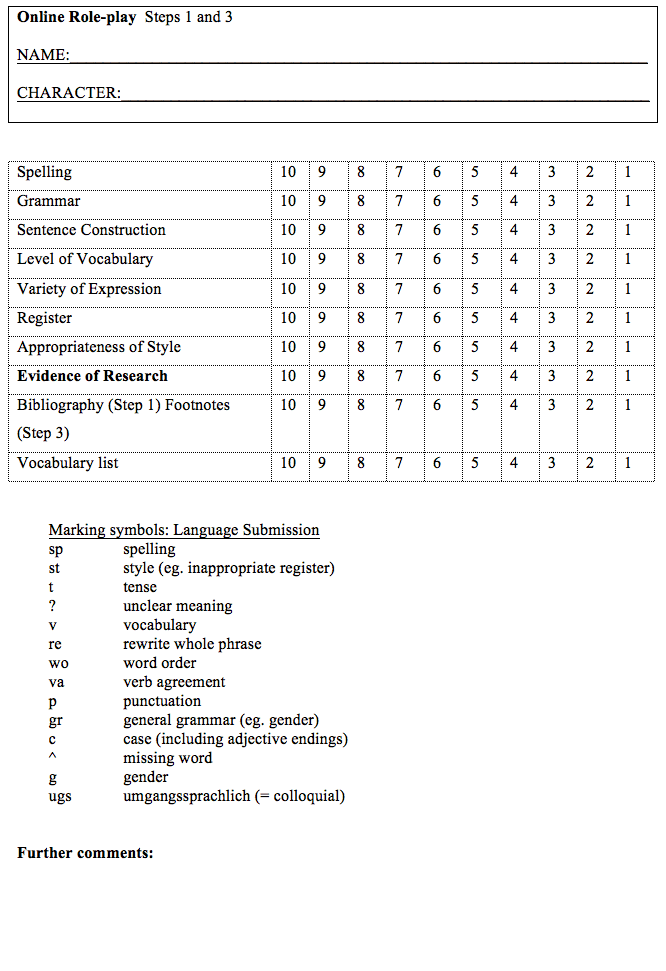
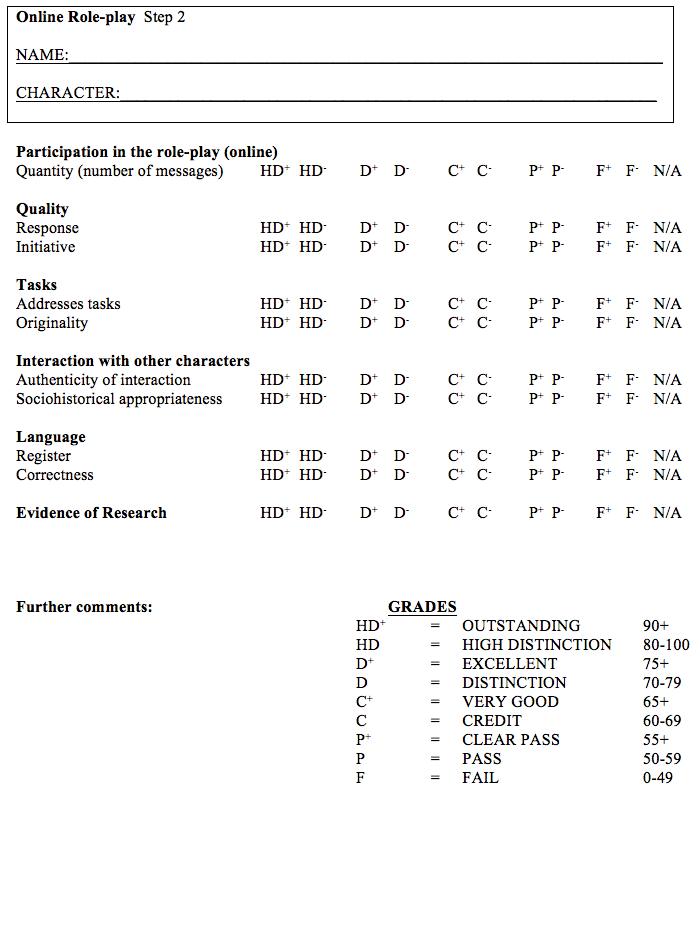
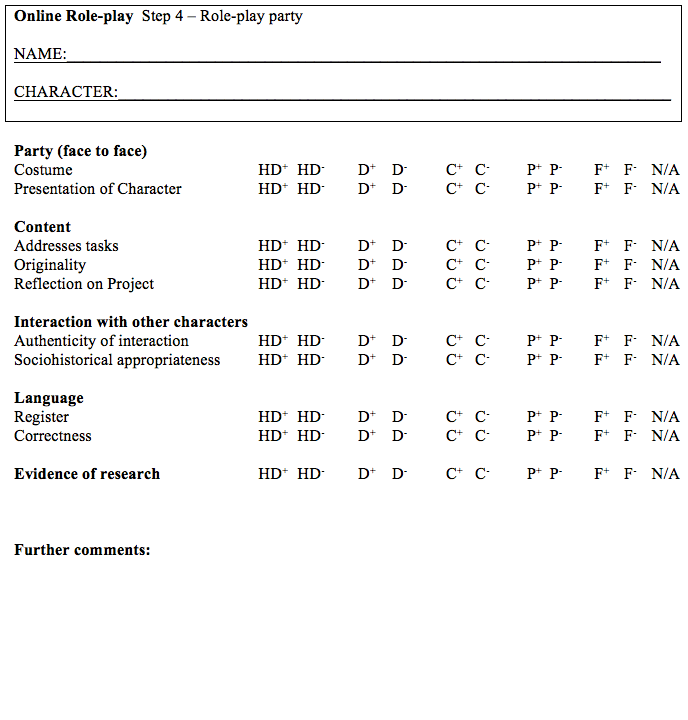
Information on assessment tasks is available on the online learning environment LMS (assessment sheets and checklists, see Appendix) and via announcements within the simulation, while students are given further reminders through external emails and during lectures. The participant researcher (in the role of administrator) publishes individual tasks (such as organisation of a terrorist plot, or political response to an event) within the role-play. Tasks and news are posted 24 hours before the next meeting.
The overall assessment mark constitutes 40% of the unit mark (5% diary entry and CV, 20% participation and interaction, 10% reflective statement "Where are you today?", and 5% presentation at costume party [face-to-face]).
While any student self-assessment must be taken with a grain of salt, the fact that their self-assessment before the role-play was used primarily to compare it to their individual self-assessment after the role-play provided the desired insight with regard to the students' perception of their own learning, especially in relation to time-input.
Their initial self-assessment, compared to that undertaken at the end of the role-play sequence, was in turn contrasted with data obtained from their role-play contributions in the target language, from grammar and vocabulary tests conducted every fortnight in their face-to-face language classes, as well as from general classroom observation. Looking at the quantitative findings:
By using text-based interaction online, students may have used new vocabulary in their written submissions, but did not seem to transfer that knowledge to their long-term memory. The online setting may have tempted many to treat the material as something "online" and "remote", not realising that they should learn the new material for out of context recall. As such, neither face-to-face class-interaction nor fortnightly vocabulary tests could confirm the students' self-proclaimed feelings about their improvements.
As a result, for 18/42 students the open-endedness of the task was daunting, as they did not have the time to dedicate hours and hours to the role-play, and were conscious that this type of learning and assessment would interfere with their time-management. Their need for clear boundaries ("How long do you expect me to be online?", "How many words do I need to write?"), as well as instant feedback (to the effect that something was done to a satisfactory level, corresponding to grade x or y) to alleviate any concern about passing or failing a task, detracted from the immersion. Indeed, the way the students perceived the online environment showed that some learners took to the medium and the concept of a largely self-directed simulation more easily than others. Those students who were both linguistically confident and competent, as well as technologically savvy, were at an advantage from the very beginning (cf. Liu, 2002). The role-play (which had been specifically designed to allow for several different learner types and abilities) ended up favouring the "usual suspects", i.e. those students whose abilities were already advanced and who displayed the predispositions of the ideal student type: an enquiring mind, information literacy, a sense of personal agency and a repertoire of learning skills (cf. Candy et al., 1994). Others, who took longer to warm to the technology and online learning community, and found it difficult to overcome personal and interpersonal aspects of this new and anonymous group membership, had reservations and did not take the same level of control of their own learning as many of the stronger performers.
The fact that the medium for the assessment was more akin to social networking and private engagements than to academic essay writing may have also resulted in two - rather worrying - trends; on the one hand, tardy citation and referencing practices bordering on unethical uses of sources, and on the other hand, the use of unacademic sources, such as relying on Wikipedia to research an identity. As such, the transparent involvement of experiential and real-world learning was short-circuited and far removed from the deep learning anticipated by the team of researchers.
This could be explained by the fact that students reported that they were "getting used to the software", that tutor feedback to students increased the pressure to post responses, and that clearer assessment instructions had been given in response to the feedback gained from the interim survey. However, it was - as students revealed in conversation with other tutors in the unit - most directly linked to wanting to obtain a certain grade rather than a desire to further their knowledge.
Half of the students posted more than the recommended two postings per online meeting, with 66 marking the highest number of contributions and 5 the lowest number. As such, a certain peer pressure effect came to bear; realising others were posting more frequently resulted in many students wanting to improve their participation mark. This spurt of activity was short-lived, however, with many students - once in receipt of a grade and feedback - dropped to the minimum input levels again. In summing up their impressions at the end of the role-play, the majority of students (25/42) claimed that they had enjoyed the role-play. However, when asked for a reason why they did or did not participate during the last week of the role-play, 16 out of 42 participants replied that they participated because it was compulsory and part of the assessment. Only 10 explained that they had participated out of enjoyment. The reasons for not participating were mainly attributed to time constraints. Despite following the design setup for an efficient and engaging role-play, student engagement seems to have been stimulated by its assessment value.
While, all students participating in this assessment ultimately gained experience in setting their own goals and boundaries, researching topics, and generally learning on their own, not all appreciated this learning environment to the same degree. The "staged withdrawal" of the teaching staff (participant teachers) as an authoritative and guiding voice, which was deliberately designed to facilitate a student-centred and self-directed learning experience, was viewed by some students as an abdication of responsibility on the instructors' part. Students were largely critical of this deliberate strategy to encourage deeper learning, student ownership of the task, its process and ultimate outcome, as well as of the deliberate shift from judging performance to enjoying the learning experience.
A disjuncture between theory and practice became more and more apparent:
Bearing in mind the enormous investment by the teaching staff which is required for such a rich teaching and learning environment, the fact that students would have achieved the goals they set for themselves, i.e. pass the unit with x or y grade and for a vast minority with minimum input of time and effort, is certainly a balance to be kept in mind for future initiatives and research into applications of idealistic teaching and learning paradigms.
Bloom, B. S., Engelhart, M. D., Furst, E. J., Hill, W. H. & Krathwohl, D. R. (1956). Taxonomy of educational objectives: Handbook I: Cognitive domain. New York: David McKay.
Boud, D. & Prosser, M. (2002). Appraising new technologies for learning: A framework for development. Educational Media International, 39(3-4), 237-245. http://dx.doi.org/10.1080/09523980210166026
Candy, P. C. (1991). Self-direction for lifelong learning: A comprehensive guide to theory and practice. San Francisco: Jossey-Bass.
Candy, P. C., Crebert, R. G. & O'Leary, J. (1994). Developing lifelong learners through undergraduate education. Canberra: Australian Government Pub. Service. [verified 13 Jan 2013] http://vital.new.voced.edu.au/vital/access/services/Download/ngv:22704/SOURCE2
Dunn, J. & O'Toole, J. (2009). When worlds collude: Exploring the relationship between the actual, the dramatic and the virtual. In M. Anderson, J. Carroll & D. Cameron (Eds.), Drama education with digital technology, (pp. 20-37). London and New York: Continuum International Publishing Group.
Freed, B. (1995). What makes us think that students who study abroad become fluent? In B. Freed (Ed.), Second language acquisition in a study abroad context (pp.123-148). Amsterdam: John Benjamins Publishing Co.
Freeman, M. A. & J. M. Capper (1999). Exploiting the web for education: An anonymous asynchronous role simulation. Australian Journal of Educational Technology, 15(1), 95-116. http://www.ascilite.org.au/ajet/ajet15/freeman.html
Geurts, J. L., Duke, R. D. & Vermeulen, P. A. (2007). Policy gaming for strategy and change. Long Range Planning, 40(6), 535-558. http://dx.doi.org/10.1016/j.lrp.2007.07.004
Hopson, M. H., Simms, R. L. & Knezek, G. A. (2002). Using a technology-enriched environment to improve higher-order thinking skills. Journal of Research on Technology in Education, 34(2), 109-119. http://www.iste.org/Store/Product?ID=1872
Liu, J. (2002). Process drama in second- and foreign-language classrooms. In G. Bräuer (Ed.), Body and language: Intercultural learning through drama. (pp. 51-70.) Westport, Connecticut & London: Ablex Publishing.
Ludewig, A. (2012). German Studies 4 - Studies in contemporary German. Unit outline. Perth: University of Western Australia.
Ludewig, A. & Ludewig-Rohwer, I. (2012). "We are the people!" Empowering students in German Studies. In C. Nygaard, N. Courtney & E. Leigh (Eds.), Simulations, games and role play in university education (pp. 257-276). Oxfordshire: Libri Publishing.
McLaughlan, R. G. & Kirkpatrick, D. (2004). Online roleplay: Design for active learning. European Journal of Engineering Education, 29(4), 477-490. http://dx.doi.org/10.1080/03043790410001716293
Pais Marden, M. (2008). The travel project: designing and implementing an online community of learners using design based research. Paper presented at Emerging Technologies Conference, 2008, Wollongong. http://ro.uow.edu.au/etc08/19 [viewed 11 Oct 2012].
Pivec, M., Dziabenko, O. & Schinnerl, I. (2003). Aspects of game-based learning. In Proceedings of I-KNOW'03, 2-4 July 2003. Graz, Austria (pp. 216-225). http://i-know.tugraz.at/wp-content/uploads/2008/11/32_aspects-of.pdf [viewed 2 Nov 2012].
Schönherr, T., Jan, E. & Dallapiazza, R. M. (2011). Tangram aktuell 1. Kursbuch und Arbeitsbuch. Lektion 5-8, Ismaning: Hueber.
Schütze-Nöhmke, U. et al. (2011). Themen aktuell 1. Kursbuch und Arbeitsbuch. Lektion 1-5. Ismaning: Hueber.
Siemens, G. & Tittenberger, P. (2009). Handbook of emerging technologies for learning. Manitoba, Canada: University of Manitoba. http://techcommittee.wikis.msad52.org/file/view/HETL.pdf [viewed 1 Nov 2012].
Synalski, T. P. (2009). Language learning: Myths and facts. Antimoon.com. http://www.antimoon.com/other/myths.htm [viewed 1 Nov 2012].
Van Ments, M. (1989). The effective use of role-play: A handbook for teachers and trainers. London: Kogan Page, New York: Nichols Pub.
Wills, S., Leigh, E. & Ip, A. (2011). The power of role-based e-learning. New York: Routledge.
Wills, S. (2012). The simulation triad. In C. Nygaard, N. Courtney & E. Leigh (Eds.), Simulations, games and role play in university education (pp. 257-276). Oxfordshire: Libri Publishing.
| Please cite as: Ludewig, A. & Ludewig-Rohwer, I. (2013). Does web-based role-play establish a high-quality learning environment? Design versus evaluation. In Design, develop, evaluate: The core of the learning environment. Proceedings of the 22nd Annual Teaching Learning Forum, 7-8 February 2013. Perth: Murdoch University. http://otl.curtin.edu.au/professional_development/conferences/tlf/tlf2013/refereed/ludewig.html |
Copyright 2013 Alexandra Ludewig and Iris Ludewig-Rohwer. The authors assign to the TL Forum and not for profit educational institutions a non-exclusive licence to reproduce this article for personal use or for institutional teaching and learning purposes, in any format, provided that the article is used and cited in accordance with the usual academic conventions.