
Category: Research
Category: Research |
| Teaching and Learning Forum 2013 [ Refereed papers ] |
Rowena H. Scott and Eddie van Etten
Edith Cowan University
Email: r.scott@ecu.edu.au, e.van_etten@ecu.edu.au
This research paper introduces the concept and practice of tertiary sciences students doing environmental volunteering, otherwise known as conservation volunteering, as a core part of their course. First year Natural Sciences students at Edith Cowan University do five days environmental volunteer work with community groups as practicum, currently known as Workplace Integrated Learning (WIL). Initial research data displays the number of volunteer hours done by students in various types of activities, locations and organisations. Qualitative comments demonstrate students' attitudes about their volunteering. Definitions and classifications of volunteering and WIL from current literature are discussed as part of the curriculum design review process. Initial data from host organisations and students suggests that volunteering, and environmental volunteering in particular, can be a useful mechanism to enhance employability skills. Students learn about potential careers and the environment industry's reliance on volunteers. Students learn and practise specific skills (e.g. animal handling) and contribute to communities and the environment.
This research paper provides an innovative example of incorporating WIL into the student experience. Two purposes of this paper are to describe environmental volunteering by Natural Sciences students as part of their core first year practicum while focusing on student outcomes and to position their experience against current definitions and models of work integrated learning, service learning (Cooper, Orrell, & Bowden, 2010; Groenewald, Drysdale, Chiupka, & Johnston, 2011), work-based learning (Boud & Solomon, 2001; Costley, 2007), non-work integrated learning (Harvey, Geall, & Moon, 1998) and volunteering. Many benefits of WIL and volunteering are highlighted and pertinent issues are discussed integrating discipline theory and knowledge with the professional environment.
There are several classifications of WIL. For example, three models of WIL in Cooper et al.'s (2010) classification are professional programs, service learning and cooperative learning. Other theoretical frameworks include the six characteristics of work-based learning that Boud et al. (2001) advocate, non-work integrated learning (Harvey, et al., 1998), seven key dimensions and three models of work integrated learning (Cooper, et al., 2010). The Taxonomy of WIL (TWIL) is a recent classification of WIL which has four categories: community and service-focussed employment, required professional practice, field and industry based work experience and other WIL opportunities (Groenewald, et al., 2011). Another recent definition is an inclusive classification, stating that: "work-based learning logically refers to all and any learning that is situated in the workplace or arises directly out of workplace concerns" (Lester & Costley, 2010, p.562). Smith et al. (2009) agree, defining WIL as learning which is embedded in the experience of work whether paid or unpaid, full-time or part-time, formally endorsed as part of a university course or extra-curricular and complementary or totally independent of studies, which is made meaningful for a student when reflected upon as part of career development.
WIL is an authentic socio-cultural experience; learning is embedded and embodied in the contexts of the learners and their work environment (Choy & Delahaye, 2009). Students apply generic and specific knowledge and practical skills from on-campus or on-line learning to a workplace setting and ideally they then apply knowledge and skills from the workplace setting to university learning. The interdependency of knowing and doing provide the epistemological base for work-based learning which is rooted in pragmatism (Lester & Costley, 2010), highlighting the rationale for WIL to be incorporated throughout higher education courses. Academics who view their teaching primarily as preparing students to become capable professionals who are competent to practice in their profession may see students' ability to apply knowledge to practice in practicum as a key indicator of quality university based curricula (McAllister et al., 2011).
Volunteering can be an important way for young people to develop confidence and skills offering a clear pathway to social and economic participation in the future (Australian Government, 2011). Schools and universities have introduced volunteering programs for students to develop a sense of social responsibility, connectedness and leadership as well as to develop employability skills (Australian Government, 2011). Higher education student volunteering has caught the imagination of policy makers and practitioners in recent years (Holdsworth & Quinn, 2010). While recent initiatives to promote student volunteering in the UK have been welcomed, relatively little has been documented about its use and role in higher education and its assumed benefits (Holdsworth & Quinn, 2010).
Although there is no agreed definition of volunteering, the three criteria of free will, non-pecuniary motivation and benefit to others can be applied to an action to assess whether it is volunteerism (Hockenos, 2011). Another description or definition differs: all volunteering involves freely giving time to help others or support a cause yet some people may be reimbursed for the cost of volunteering (Australian Government, 2011). Volunteering may be viewed broadly to include tertiary students volunteering as part of their course, particularly in the field of environmental volunteering.
This paper proposes that the example of environmental volunteering described does fit the definition of volunteering. The paper also presents some preliminary and mainly anecdotal assessments of the benefits of such volunteering to both student and the organisations involved, with the results of formal evaluations by students and supervisors (being done for the first time this semester) the subject of future paper(s). This example would be classified as a form of volunteering by some descriptions but not according to the Australian Bureau of Statistics (ABS). A volunteer is defined as someone who willingly gave unpaid help in the form of time, service or skills through an organisation or group. Unpaid work under some form of compulsion, for example as part of study commitments, is excluded from ABS measures (Australian Bureau of Statistics, 2010). The students described in this paper do not gain university credit but must complete the unit in order to graduate. Assessment for the university unit described is evidence of participation as Pass/Fail and listed on academic transcripts as part of the course. Pre- and post-reflections have been added in 2012. So this is an interesting example to question whether their experience should be called volunteering, WIL or both and how curriculum design may be improved.
One commonly held misconception is that young people do not volunteer (Hockenos, 2011). Roughly thirty percent of the Australian population aged 25-34 volunteered in 2010 with 27% in 18-24 year age bracket (Australian Bureau of Statistics, 2011), less than the national average of 36% (Australian Government, 2011). People of 35-44 and 65-74 years were more likely to volunteer than those in younger and older age groups (Australian Bureau of Statistics, 2010) with people aged 45-54 years reporting the highest rate of volunteering (Australian Bureau of Statistics, 2011). In Western Australia (WA), 75.6 % of volunteers are motivated to continue to volunteer by giving something back to the community and 82.5% of 18-24 year olds are motivated to continue to volunteer by having fun (Volunteering WA, 2011).
Student volunteering makes a relatively small contribution to the voluntary sector in terms of number of participants and scope but it reinforces an ideal of self-reliance and relates to the development of employability skills (Holdsworth & Quinn, 2010). However, data on tertiary student volunteering is not readily available. Volunteering has the potential to foster a form of moral engagement that recognises the need to take responsibility for others but not necessarily as the 'privileged server' to the 'unprivileged recipient' (Holdsworth & Quinn, 2010). Students are becoming more aware of the need to extend their curriculum vitae and this future benefit for their own career prospects is motivating some to undertake volunteering (Holdsworth & Quinn, 2010). Recruitment for volunteering positions may require selection processes including applications (including a curriculum vitae and statements addressing selection criteria) and interview. So the application process provides students with worthwhile experiences during the recruitment process before the actual experience of volunteering, including the potential of not being accepted.
Volunteering as unpaid work or service which contributes to the work of a formal organisation and is managed by a workplace model differs from volunteering as activism or as leisure according to Rochester's three perspectives (K. A. Smith & Cordery, 2010). While international conservation volunteering may not be a panacea to save threatened biodiversity (Lorimer, 2009) long running projects can be halted without volunteers. So volunteering in its various forms continues to be important to environmental projects.
Edith Cowan University is engaging with NGOs and other community-based environmental stewardship organisations (community groups) to encourage tertiary students to become involved in their local environmental issues and projects in practical ways. Environmental volunteers are generally not strongly motivated by reasons that one might expect from the general volunteering literature (Wahl, 2010). So data collection about these tertiary students' motivation will make a useful comparison with the literature (this is ongoing).
While the trend in higher education is for increasing student volunteering and involvement in community activities, there has been little research on volunteers' motivations and the effects of the experience on volunteers, especially in the context of conservation and environment (Bruyere & Rappe, 2007). Significant attitudinal and behavioural differences were identified between environmental and non-environmental volunteers including a strong regional attachment building loyalty to a local area (Randle & Dolnicar, 2006), although participation in conservation volunteering may not necessarily change deep-seated perceptions and attitudes towards nature (Halpenny & Cassie, 2003). Behavioural change as evidenced by the propensity to engage in environmental volunteering, along with attitudes to the environment, remained stable from 2003 to 2009 in surveys of 14,000 people in England and Wales (Anderson, Lee, Pryce, & Taal, 2010). Volunteering may provide quantifiable benefits like increasing work skills that may lead to a better paying job (Alonso & Liu, 2012). Volunteers make a remarkable sacrifice trading the opportunity cost of engaging in other activities in exchange for the common good (Alonso & Liu, 2012). Though student volunteers are less likely than other volunteers to help plan or coordinate services, students are not used exclusively for routine tasks (Edwards, Mooney, & Heald, 2001).
The benefits of attracting volunteers to the organisation are generally tangible and have received research attention. Community volunteer work and involvement is especially crucial in rural areas where human and financial resources are limited (Alonso & Liu, 2012). Although environmental volunteer organisations are experiencing changes in their culture, structure and funding arrangements which make the tasks of functioning and attracting volunteers increasingly difficult, many are increasingly reliant on volunteers (Dolnicar, Irvine & Lazarevski, 2008) with some dependent on volunteers for particular skills. Greater recognition of environmental volunteers as co-learners and co-producers of ideas about ways to intervene in ecosystems and their rehabilitation is called for (Buizer, Kurz, & Ruthrof, 2012), especially when tertiary sciences students are the volunteers (Haigh, 2006).
SCI1120 is a core (compulsory) component of all undergraduate degrees in biological sciences, marine and freshwater biology, conservation and wildlife biology, environmental management and environmental science in the School of Natural Sciences at ECU. This unit has been running since 2007 and evolved from other work experience practica and programs which were core components in the environmental management degree for over twenty years. In 2007, it was decided to formally divide these activities into two units: a first year practicum aimed at volunteering and a third year unit focussed on formal work experience, a move strongly supported by the course consultative committee. At the completion of their volunteering, employers or supervisors give a written letter or a standard certificate as evidence of their volunteering efforts. SCI1120 is marked on a pass/fail basis and is not for credit, but is a required unit in the course. Starting this year, students must write a succinct reflective evaluation (answering specific questions). Students are given considerable flexibility and scope in the type of volunteering and choice the organisations they help. A website and noticeboard promoting suitable organisations and volunteer programs is maintained by the coordinator of the practicum and students use this and/or their own contacts to organise a placement suited to their and the organisation, often based on availability. Many students volunteer at more than one organisation. Students have the whole academic year to complete their volunteering.
Another intended purpose for these students' university study is for them to learn about the structures of various environmental groups, their sources of and reliance on funding, and their links to government and other organisations, and to understand how these fit within the broader environmental and conservation industries. NGOs play an important role in the conservation of biodiversity and in promoting the sustainable use of natural resources, ranging from advocacy to 'hands on' action, and they rely heavily on volunteers to perform these functions, often with a strong links to local communities (Brightsmith, Stronza, & Holle, 2008; Haigh, 2006). Many government agencies (including independent statutory authorities such as zoos and botanical gardens) also rely on volunteers to implement certain programs and activities related to conservation and environmental management. Hence volunteers play a pivotal role in the wider industry in which students seek work in upon graduation. The practicum therefore contributes to students' understanding of the social and human dimensions of environmental management - how solving environmental problems is not only about understanding the science and technical aspects, but also how people and organisations work together to solve these problems.
Many students have grasped the idea of volunteering from school and are familiar with the fundamental concept of volunteering being more than direct personal benefit, but also helping others and contributing to a bigger cause. The degree to which these altruistic objectives of the practicum are being met is difficult to gauge at this stage, but we hope to learn more about this from students' personal reflections and formal evaluations which have commenced this year.
SCI1120 students are required to do at least 5 days which translates to 35-40 volunteer hours per student over the calendar year. On average, students do more hours than the minimum required which demonstrates a degree of commitment to volunteering and the organisations they work for. For instance, in 2010 each student averaged 60 hours of volunteering, with several students doing more than one placement. One student did 120 volunteer hours with the community group of Lord Howe Island weed eradication program. Another student did 300 volunteer hours with RSPCA in 2010 and two students did 100 volunteer hours for Department of Environment and Conservation (DEC) at Monkey Mia with dolphins and one student did 100 volunteer hours in mining with Rio Tinto.
Letters from organisations generally give very positive feedback that they have made worthwhile contributions with a good attitude. Anecdotal evidence also suggests that the majority of students have a good attitude and had an enjoyable time. Organisations that rely on volunteers sometimes ask for more volunteers suggesting their experience has been positive.
If students are more interested in genetics and molecular biology, they try to find work in laboratories. Indeed, it is the laboratory-style biology students who have the most trouble finding suitable placements and tend not to choose community groups. In such cases, students may undertake activities that are more like work experience than volunteering. Although there is considerable flexibility in the type of experience, and this can be tailored to students' courses and aspirations, the emphasis is on volunteering with the unit outline stating that students should be working with a community group.
In 2010, 44 SCI1120 students did a total of 2659 volunteer hours across 49 placements. Most volunteered to do bush care and ecosystem restoration or wildlife care and rehabilitation (Table 1 and Figure 1).
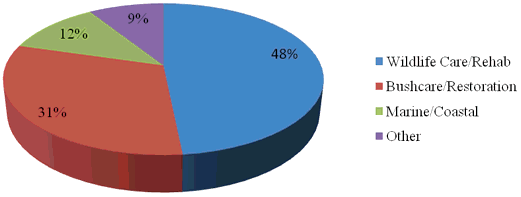
Figure 1: Types of volunteer activities done by SCI1120 students in 2010 (by number of hours)
| Types of volunteer activities | Number of hours | Number of placements | Examples of activities |
| Wildlife Care and Rehabilitation | 1287 | 19 | Animal care and rehabilitation, assisting research, animal monitoring (e.g. turtles, birds) |
| Bushcare/ Restoration | 827 | 18 | Weed control, track maintenance, planting, survey |
| Marine/Coastal | 305 | 7 | Dune rehabilitation, assisting research projects, aquaculture |
| Other | 240 | 5 | |
| Total | 2659 | 49 |
| Types of organisations | Number of hours | Number of placements | Main organisations |
| NGO | 1297 | 22 | Conservation Volunteers (11), Kanyana Wildlife Sanctuary (4), other sanctuaries, RSPCA |
| State Government | 526 | 8 | DEC |
| Commercial/ Industrial | 336 | 6 | Environmental Consultancies, plant nurseries |
| Community Group | 260 | 5 | Friends' groups, catchment groups |
| Research organisation | 135 | 5 | ECU, other university |
| Local Government | 60 | 2 | City of Wanneroo, City of Stirling |
| Other | 45 | 1 | |
| Total | 2659 | 48 |
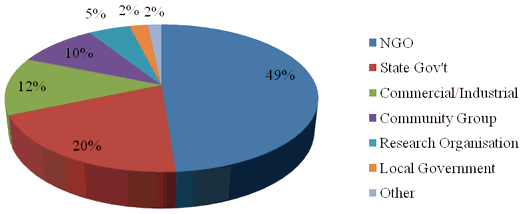
Figure 2: Types of organisations where ECU students volunteered in 2010 (number of hours)
Older students view the practicum more strategically than the younger students for practical work orientated to getting a paid job. Younger students see it more like volunteering with a community-based organisation. Most commonly students work with organisations that specialise in the supply of volunteers for particular projects for local government and other organisations, particularly in environmental management and conservation. For example, Conservation Volunteers Australia (CVA) are well organised: have activities almost every day as well as week-long programs in various parts of the country and focus on hands-on, restoration type work such as weed control and track maintenance. Some students tap into local community groups doing active bushland management. Volunteers are often attracted to charismatic mega-fauna (Campbell & Smith, 2005) and volunteering for wildlife sanctuaries and zoos is popular across all courses. Some wildlife sanctuaries that deal with injured animals have too many volunteers and only take students who are keen and committed to a long-term investment of themselves and their time.
Others types of organisations where students have volunteered include: 1) international organisations specialising in providing volunteers for research and conservation projects, such as Earthwatch, Projects Abroad and Raleigh International (for which there is often an associated fee and may be considered a type of volunteer tourism; (Cousins, 2007; Haigh, 2006); 2) government departments and agencies with formal volunteering programs (e.g. Kings Park and Botanic Gardens, Perth Zoo, Department of Environment and Conservation's Nearer to Nature Program); 3) environmental activist and campaigning groups (e.g. The Wilderness Society, Friends of the Earth); 4) community-based conservation groups (e.g. 'Friends' groups involved in managing local bushland reserves; and 5) universities where students assist with research projects (including helping post-graduates students). The School of Natural Sciences, specifically the coordinator of the practicum, has also organised and run ecological restoration activities for students, including propagation and planting in local bushland and elsewhere in conjunction with other organisations (e.g. dune restoration with Town of Mosman Park).
| Location | Number of hours | Number of placements | |
| Perth and surrounds | 1297 | 22 | |
| Regional WA | 526 | 8 | Monkey Mia/Shark Bay, Pilbara, SW |
| Overseas | 336 | 6 | India, Thailand, Africa, Lord Howe |
| Total | 2659 | 49 |
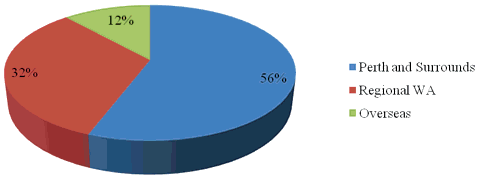
Figure 3: Geographic location where ECU students volunteered in 2010 (number of hours)
Most of the 100 to 120 or so students each year consider the experience highly valuable, though their anecdotal comments have often been vague. Most Natural Sciences students have recently completed their schooling though there are a few mature age students. In 2012, data gathered from students determined what learning outcomes they think they achieved and what they gained from the volunteering experience. Data gathering is incomplete, however, students' responses to date demonstrate the value of their reflective evaluation and provide some positive insights into students' attitudes towards their environmental volunteering experience. For example, one student stated that she gained
A good insight into the role and scope of work of conservation establishment - contacts with people in industry & clarification of the direction I want to focus on after study.She responded that she achieved the learning outcome of:
Confidence in participating in conservation activities in a professional context including networking and making contacts.She stated that she
developed skills in plant propagation and nursery work, seed collection and field based operations and report writing.In the survey, she was asked what she learnt about herself. Her response was:
Comfortable with broadening my knowledge and experience within new environments, good at relating to new people and picking up new skills - not very comfortable at being exposed to quite negative, bitchy staff politics - need to work on coping mechanisms for that.She wrote that she learnt about her course discipline area:
Conservation work has such a broad scope in terms of the amount and type of field work available, as well as more office based reporting roles. Very diverse industry.She stated that her most memorable experience was:
Field based seed collecting near the coast - absolutely stunning place to be 'working'.When asked if she planned to any other volunteering, she replied:
Yes, particularly during uni breaks as it provides great insight and experience to focus my endeavours for the future and can lead to further opportunities.When asked if she had any recommendations for other students doing this unit, she replied:
Embrace the opportunity as all experience is valuable whether it has been 'good' experience or not. You can learn something from everyone you meet and it may not be about who you know, but who knows you.When asked what other benefits the volunteering will give her, she replied:
A sense of confidence in what I have to offer to future employers and that I am on the right track in terms of really enjoying the career path I have chosen.
Specifically, the practicum makes an important contribution to environmental volunteering in terms of providing substantial volunteer hours to an industry and organisations which are increasingly reliant on volunteers to reach their specific operational objectives, as well as to achieve broader sustainability and biodiversity conservation goals. There is also anecdotal evidence of considerable benefits to the students involved, although we hope to further explore and report on such benefits when the current formal evaluations by students and supervisors are completed.
Anderson, C., Lee, D., Pryce, G. & Taal, M. (2010). Factors affecting environmental attitudes and volunteering in England and Wales. http://eprints.gla.ac.uk/44226/
Australian Bureau of Statistics (2010). Voluntary Work, Australia, 2010. Canberra: Australian Bureau of Statistics. http://www.abs.gov.au/ausstats/abs@.nsf/productsbytopic/124E5675AD3AED8CCA256A71000019C5?OpenDocument
Australian Bureau of Statistics (2011). General Social Survey: Summary Results, Australia, 2010. Canberra: Australian Bureau of Statistics. http://www.abs.gov.au/ausstats/abs@.nsf/productsbytitle/C6BF68E57D3A308CCA256E21007686F8?OpenDocument
Australian Government (2011). National Volunteering Strategy. Canberra: Commonwealth of Australia. http://www.notforprofit.gov.au/sites/default/files/files/National%20Volunteering%20Strategy.pdf
Boud, D. & Solomon, N. (Eds.) (2001). Work-based learning: A new higher education? Buckingham UK: The Society for Research into Higher Education & Open University Press.
Brightsmith, D. J., Stronza, A. & Holle, K. (2008). Ecotourism, conservation biology and volunteer tourism: A mutually beneficial triumvirate. Biological Conservation, 141(11), 2832-2842. http://dx.doi.org/10.1016/j.biocon.2008.08.020
Bruyere, B. & Rappe, S. (2007). Identifying the motivations of environmental volunteers. Journal of Environmental Planning and Management, 50(4), 503-516. http://dx.doi.org/10.1080/09640560701402034
Buizer, M., Kurz, T. & Ruthrof, K. (2012). Understanding restoration volunteering in a context of environmental change: In pursuit of novel ecosystems or historical analogues? Human Ecology, 40(1), 153-160. http://dx.doi.org/10.1007/s10745-011-9445-4
Campbell, L. M. & Smith, C. (2005). Volunteering for sea turtles? Characteristics and motives of volunteers working with the Caribbean Conservation Corporation in Tortuguero, Costa Rica. Mast, 3(2) and 4(1), 169-193. [verified 28 Jan 2013] http://www.seaturtle.org/PDF/CampbellLM_2005_MAST.pdf
Choy, S. C. & Delahaye, B. L. (2009). University-industry partnership for pedagogy: Some principles for practice. Paper presented at the 16th World Association for Cooperative Education Conference, 23-26 June, Vancouver, Canada. http://waceinc.org/papers/vancouver/Australia/Choy,%20Delahaye.pdf
Cooper, L., Orrell, J. & Bowden, M. (2010). Work integrated learning: A guide to effective practice. UK: Routledge.
Costley, C. (2007). Work-based learning: Assessment and evaluation in higher education. Assessment & Evaluation in Higher Education, 32(1), 1-9. http://dx.doi.org/10.1080/02602930600848184
Cousins, J. A. (2007). The role of UK-based conservation tourism operators. Tourism Management, 28(4), 1020-1030. http://dx.doi.org/10.1016/j.tourman.2006.08.011
Danson, M. (2010). Volunteering and the recession: What role for the volunteer? Paper presented at Volunteering counts: A research conference on voluntary action, Chancellor Hotel Conference Centre, Manchester. http://www.vds.org.uk/Portals/0/documents/Mike%20Danson%20Abstract.pdf
Darwen, J. & Rannard, A. G. (2011). Student volunteering in England: A critical moment. Education + Training, 62(4), 489-501. http://dx.doi.org/10.1108/00400911111115717
Devereux, P. (2008). International volunteering for development and sustainability: Outdated paternalism or a radical response to globalisation? Development in Practice, 18(3), 357-370. http://dx.doi.org/10.1080/09614520802030409
Edith Cowan University (2010). Engagement in teaching and learning programs at ECU. [not found 28 Jan 2013] http://www.ecu.edu.au/learning-and-development/ECU-Curriculum-Engagement-WIL-Explanations.html
Edwards, B., Mooney, L. & Heald, C. (2001). Who is being served? The impact of student volunteering on local community organizations. Nonprofit and Voluntary Sector Quarterly, 30(3), 444-461. http://dx.doi.org/10.1177/0899764001303003
Groenewald, T., Drysdale, M., Chiupka, C. & Johnston, N. (2011). Towards a definition and models of practice for cooperative and work-integrated education. In R. K. Coll & K. E. Zegwaard (Eds.), International handbook for cooperative and work-integrated education (2nd ed., pp. 17-24). Hamilton, New Zealand: World Association for Cooperative Education.
Haigh, M. J. (2006). Promoting environmental education for sustainable development: The value of links between higher education and non-governmental organizations (NGOs). Journal of Geography in Higher Education, 30(2), 327-349. http://dx.doi.org/10.1080/03098260600717422
Harvey, L., Geall, V. & Moon, S. (1998). Work experience: Expanding opportunities for undergraduates. Birmingham: Centre for Research into Quality, University of Central England.
Hockenos, P. (Ed.) (2011). State of the World's Volunteerism Report: Universal values for global well-being. Denmark: United Nations Volunteers. http://www.unv.org/fileadmin/docdb/pdf/2011/SWVR/English/SWVR2011_full.pdf
Holdsworth, C. & Quinn, J. (2010). Student volunteering in English higher education. Studies in Higher Education, 35(1), 113-127. http://dx.doi.org/10.1080/03075070903019856
Lester, S. & Costley, C. (2010). Work-based learning at higher education level: Value, practice and critique. Studies in Higher Education, 35(5), 561-575. http://dx.doi.org/10.1080/03075070903216635
Little, B., Moon, S., Pierce, D., Harvey, L. & Marlow-Hayne, N. (2001). Nature and extent of undergraduates' work experience. England: Centre for Higher Education Research and Information. http://asetonline.org/PDFs/Nature%20and%20Extent%20of%20Work%20Experience.pdf
Lorimer, J. (2009). International conservation volunteering from the UK: What does it contribute? Oryx, 43(3), 352-360. http://dx.doi.org/10.1017/S0030605309990512
Lorimer, J. (2010). International conservation 'volunteering' and the geographies of global environmental citizenship. Political Geography, 29(6), 311-322. http://dx.doi.org/10.1016/j.polgeo.2010.06.004
Martin, A., Fleming, J., Ferkins, L., Wiersma, C. & Coll, R. (2010). Facilitating and integrating learning with sport studies cooperative education: Exploring the pedagogies employed by students, academics and workplace supervisors. Journal of Hospitality, Leisure, Sport and Tourism Education, 9(1), 24-38. http://dx.doi.org/10.3794/johlste.91.239
McAllister, S., Lincoln, M., Ferguson, A., Davidson, B., Hill, A., Davenport, R., et al. (2011). The benchmarking COMPASS® database: A confidential interactive web based strategy to benchmark learning outcomes. Paper presented at the Australian Universities Quality Forum: Demonstrating Quality, Melbourne, VIC, Australia. http://www.auqa.edu.au/files/auqf/paper/paper_e13.pdf
Patrick, C.-J., Peach, D., Pocknee, C., Webb, F., Fletcher, M. & Pretto, G. (2008). The WIL [Work Integrated Learning] report: A national scoping study [Australian Learning and Teaching Council (ALTC) Final Report]. http://www.olt.gov.au/resources?text=wil
Randle, M. J. & Dolnicar, S. (2006). Environmental volunteers: Are they driven by altruism and a strong feeling of regional identity? Paper presented at the Australasian Non-profit and Social Marketing Conference, Newcastle, Australia. http://ro.uow.edu.au/commpapers/88/
Smith, J. E., Meijer, G. & Kielly-Coleman, N. (2010). Assurance of learning: The role of work integrated learning and industry partners. In M. Campbell (Ed.), Work Integrated Learning: Responding to Challenges (pp. 409-419). Perth WA,: Australian Collaborative Education Network (ACEN) Incorporated, Curtin University of Technology. http://eprints.qut.edu.au/41402/
Smith, K. A. & Cordery, C. (2010). What works? A systematic review of research and evaluation literature on encouragement and support of volunteering. Wellington, New Zealand: Victoria University of Wellington. http://www.communitymatters.govt.nz/vwluResources/publications-lottery-WhatWorksVolunteering/$file/publications-lottery-WhatWorksVolunteering.pdf
Victoria University (2012). Learning in the workplace and community. http://www.vu.edu.au/industry-and-community/learning-in-the-workplace-and-community
Volunteering WA (2011). 2011 State of Volunteering in WA Report. Perth: Volunteering WA. http://www.volunteeringwa.org.au/news/2011-state-of-volunteering-in-wa-report-key-findings.aspx
Wahl, V. (2010). Why people help: Motivations and barriers for stewardship volunteering. PhD, University of British Columbia, Vancouver, Canada. http://hdl.handle.net/2429/21215
| Please cite as: Scott, R. H. & van Etten, E. (2013). Environmental and conservation volunteering as workplace integrated learning. In Design, develop, evaluate: The core of the learning environment. Proceedings of the 22nd Annual Teaching Learning Forum, 7-8 February 2013. Perth: Murdoch University. http://otl.curtin.edu.au/professional_development/conferences/tlf/tlf2013/refereed/.html |
Copyright 2013 Rowena H. Scott and Eddie van Etten. The authors assign to the TL Forum and not for profit educational institutions a non-exclusive licence to reproduce this article for personal use or for institutional teaching and learning purposes, in any format, provided that the article is used and cited in accordance with the usual academic conventions.