
Category: Research
Category: Research |
| Teaching and Learning Forum 2013 [ Refereed papers ] |
Katharina Wolf and Catherine Archer
Curtin University
Email: k.wolf@curtin.edu.au, c.archer@curtin.edu.au
Almost four decades ago internationally renowned academic and author on business and management Henry Mintzberg (1976) argued that the ability to manage and even embrace "ambiguity" and complex environments is a key to a successful career in business. This level of complexity has not decreased in today's business environments. However, ambiguity is not only difficult to teach in a traditional classroom environment, uncertainty and lack of structure are also not particularly popular with students.This paper provides insight into the benefits and associated challenges of an international communications challenge, run across five continents in cooperation with twelve universities in twelve different countries. The authors conclude that experiential learning opportunities like this real life client project may not necessarily be popular amongst the wider student cohort. However, they provide a number of benefits, in particular in the context of capstone units that set out to prepare business students for a diverse career in an increasingly global, multicultural and complex field.
This paper details the challenges and benefits associated with an international communications challenge that forced students to leave the relative safety of the classroom and the local study environment. Whilst not all students felt comfortable with the associated level of uncertainty and 'risk', we argue that those who embraced the opportunity gained skills and insights that extended well beyond the opportunities provided in the traditional classroom environment. They were thereby able to better prepare themselves for a career in an increasingly versatile, global and multi-cultural industry.
In Australia, work integrated learning is now being recognised as integral to the curriculum as Australian universities come under increasing pressure to produce work-ready graduates (Green, Quin, & Luca, 2005). Work integrated learning has been defined as
Learning which is embedded in the experience of work: which may work which is paid or unpaid; or full-time or part-time; or formally endorsed as part of a university course; or extra-curricular and complementary of studies; or totally independent of studies; in the past, present, or future; and which is made meaningful for a student when reflected upon in terms of personal learning and development occurring as part of a career development learning experience or course-related process. (Smith et al., 2009, p. 8)Moreover, employability upon graduation is a critical factor for students - and their parents - in selecting where to study (Green, et al., 2005). In dynamic environments, employability depends on the ability to adapt. So, industry, parents, students, governments and regulatory bodies are demanding that universities produce students with generic, versatile workplace skills, as well as traditional discipline specific skills (Bates, 2004; Green, et al., 2005; Kerr, 2005). Such versatility, is necessary for today's graduates as research predicts that they will change their jobs 8-12 times during their working lives, in addition to 3-4 complete career changes (Khare, 2007). Furthermore, the fast changing nature of jobs and technology means many of today's students may work in jobs that do not yet exist (Jukes & McCain, 2001), further emphasising the need for versatile, transferable skills. Accordingly, Rundle-Thiele et al. (2005) argue that higher education institutions should focus on students' acquisition of lifelong skills rather than demonstration of knowledge. Hence, the inclusion of work integrated learning into university courses improves graduate employability because it enhances the acquisition of industry relevant skills (Reeders, 2000).
Indeed, work integrated learning has been seen as an imperative part of the university experience, with major Australian reports on the topic in recent years focusing on maximising its contribution (see for example Patrick et al., 2008; Smith, et al., 2009). Accreditation by industry bodies of courses often requires universities to have some form of work integrated learning in the curriculum. For example, the Public Relations Institute of Australia's (PRIA) course accreditation process emphasises the importance of work integrated learning and industry integration throughout the public relations curriculum. In its guidelines for universities the PRIA states:
The PRIA encourages the use of experiential learning strategies and recommends engagement with industry professionals throughout the public relations degree. This could include opportunities for guest lectures from industry professionals, real world assessment tasks sourced from industry, case studies, work experience and internships to name a few. Applicants for accreditation are required to outline how engagement is represented in their degrees (Public Relations Institute of Australia, 2009).
The pedagogy around work integrated learning (WIL) is based on experiential learning theory and can be best described by Kolb's (1984) learning cycle (Weisz & Smith, 2005), which in particular emphasises the value of observation and reflection as part of the learning experience. Experiential learning theory defines learning as "the process whereby knowledge is created through the transformation of experience" (Kolb, 1984, p. 41). Kolb & Kolb (2005) describe the creation of learning spaces for the enhancement of experiential leaning including: respect for learners and their experience; starting learning with the learner's experience of the subject matter; creating and holding a hospitable place for learning; making space for conversational learning; making space for development and expertise; making space for acting and reflecting; making space for feeling and thinking and making space for learners to take charge of their own learning. Experiential learning, when done well, leads to deep learning. Deep learning involves paying attention to underlying meaning and is focused on the use of analytic skills, cross-referencing, imaginative reconstruction and independent thinking. Surface learning, in contrast, is associated with rote-learning and simple description (Warburton, 2003).
By positioning the learner as an active participant in the learning process, the 'teacher' acts increasingly in a facilitator role, encouraging students to build on prior knowledge and to explore the learning context and associated challenges. Hence, the key to learning, particular to deep level learning, rests on the students' ability to reflect on the learning experience, to integrate this experience with their academic knowledge and to conceptualise their learning so that they ultimately bring together their work and their academic experiences to solve problems in unfamiliar environments. However, the environments students are traditionally exposed do not tend to be 'radically' unfamiliar. Guest speakers, industry case studies and real life client scenarios are all highly valuable learning tools that are deeply embedded in the public relations program; however, they tend to occur in the relative safety and familiarly of the classroom. Industry placements may force students to explore a different setting and company cultures; yet, the assessment criteria tends to be set by university staff, hence resembles a marking system and expectations students are already familiar with.
This paper provides insight into an international learning project that forced students to not only leave the relative safety of the classroom, but also the familiarity of their cultural environment. By working in truly international, cross cultural teams, students could no longer rely on the cultural and learning context they had become well acquainted with. Such a high level of unfamiliarity was not popular with all students and required a time of adjustment. This paper provides insight into first hand feedback from students who embraced the ambiguity, complexity and unfamiliar nature of an international communication challenge, ultimately emphasising the benefits in terms of increasing cultural awareness and management skills over subject specific content.
The GlobCom Project is run and coordinated via the GlobCom Foundation, an initiative of Germany based Dr Volker Stoltz. Its aim is to create a platform for intercultural cooperation amongst students and lectures in the field of communication / public relations, including GlobCom alumni. Dr Stoltz, a former Chief Executive for the global communications agency Weber Shandwick, began the GlobCom project due to the dearth of skills he observed in practitioners working internationally and the increasing demand of global companies and agencies for professionals with international and intercultural experiences. The GlobCom project was designed to train students as part of a multicultural team in real international situations.
GlobCom sees students compete in global virtual teams, each of which represents all twelve participating universities. In these teams they produce a public relations "pitch" document in response to a client brief, prepared in one of the participating countries. Previous clients have included Zeiss and Airbus. The 2012 GlobCom client was AGEDI, the Abu Dhabi Global Environmental Data Initiative. Perth-based PR International students had the option to actively participate in the GlobCom Project as part of one of the eight global teams. However, those Perth-based students who felt uncomfortable about the risks and challenges associated with working in a virtual team had the opportunity to work in local teams. If they chose to work locally, this made them ineligible to travel to the GlobCom finals and symposium at the end of the semester.
All teams received the same client brief and had to develop and submit a PR solution as a PowerPoint presentation, like in a real life pitch situation. How the final pitch document was developed and which tools team members would use to effectively collaborate was left to each global team, although support and mentoring was provided by the teaching team. Each team was expected to elect a team leader and a local team leader was elected at country level. The international team members are selected at random and in Australia's case the members of each team self-selected to be part of a group within the team. Each university incorporates GlobCom slightly differently into the existing curriculum. For Curtin University students the GlobCom project forms the major assessment for the under-graduate PR International unit (30%) and the unit includes content on cross-cultural communication. However, lecturers have no control or knowledge of the content of other university participants' courses. Those students who had the time and resources were invited to travel to Abu Dhabi to deliver a live "pitch" to the client as part of a two day conference and for the chance to meet their international team members face to face.
GlobCom offers students a truly global, experiential learning experience, which encourages students to draw on their existing knowledge, whilst remaining open to new ideas, concepts and approaches to public relations from their international team members. Consequently, GlobCom enabled PR International to move beyond the relative safety provided in earlier public relations units, by encouraging students to embrace the complexities associated with working in multi-cultural teams across a wide range of time zones. It challenged students to address a client brief that originated in an unfamiliar cultural context; not written by local teaching staff but a real life international client. This arguably further increased the common ambiguity of real life cases, which are recognised to develop students as self-directed learners and problem solvers; adding a level of "realism" (Razzouk, Seitz, & Rizkallah, 2003). Finally, the experience forced students to solve technological challenges in a timely and effective manner, with minimal interference by teaching staff. As part of this learning cycle, Australian students were asked to reflect and feedback on their participation in GlobCom. Throughout the semester students were assessed based on the level of critical reflection in video diaries, which were uploaded to the unit's learning portal. Students indicated that the major learning outcome was not subject specific knowledge, but instead a new appreciation for the challenges and opportunities associated with working in multi-cultural teams. Their feedback will be explored in more detail in the following section.
The research questions posed in this paper are:
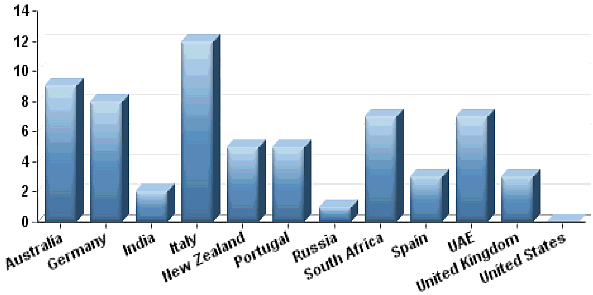
Figure 1: Respondents to the survey broken down by country
A total of 74% of respondents had attended the 2013 GlobCom symposium in Abu Dhabi (representing 45% of total attendees). Hence, the assumption can be made that as they invested time and money to travel to the UAE they were arguably highly involved and active. This high level of engagement may have positively influenced the survey results.
GlobCom was a very hard project, it was rewarding but it was definitely difficult working within a cross cultural team of such magnitude. GlobCom helped me socially, not academically. (female, aged 20, Australia).As indicated earlier, each of the twelve participating universities integrated the GlobCom communications challenge into the existing curriculum. As a result, each institution's involvement has been largely depended on the initiative taken by the academic staff member that is teaching the unit identified as "most suitable" to incorporate a global communications assignment. Hence, the level of public relations knowledge and advancement of the degree vary from country to country. Students from one university came predominantly from a marketing background and consequently commented on how much they had learned from their peers about public relations. However, teams equally included postgraduate students and final year public relations majors, who commented on the perceived lack of "previously assumed" knowledge amongst some of the participants. Furthermore, public relations is a relatively young discipline and highly dependent on the cultural context it is working in. Similarly, the physical location of the public relations degree may influence how it is taught and interpreted. For example, Curtin University's public relations degree is one of only two degrees in the country that is based in the business school. More commonly, the subject tends to be located within humanities or the arts. Therefore, the way PR is positioned and taught may vary from one country to another, adding an additional level of complexity for participants:I have learned so much while participating in GlobCom2012, everything wouldn't fit in one page. I have learned to work with people from different cultures, improved my diplomatic skills, enhanced my time management skills, and grasped the key approaches to developing a PR campaign. (female, aged 24, UK).
It was confusing doing this project in the international pr [sic] unit (not for me but for other students across the world), their input was confusing because it came from a completely different background, I do understand that is the whole pointÉ. (female, aged 19, Australia)Despite adding a level of frustration for some participants, the need to work with students who have different skill sets reflects the "real world" of communications practice. Practitioners are recognising the need for integration and cooperation across the previously often separate but related disciplines of public relations, marketing and advertising. For example, in a recent Public Relations Institute of Australia column, a senior practitioner acknowledged that his "successes (and mistakes) in dealing with the digital age have helped [him] to conclude that the future of PR lies in full integration of the communication disciplines of PR, Marketing, and Advertising" (Mercer, 2012).
The feedback survey was deliberately constructed as to not prompt students' responses regarding expected learning outcomes. The teaching team was interested in their personal observations and reflections. With exception of students from the previously mentioned marketing course, survey respondents highlighted management and business skills as key learning outcomes of the GlobCom experience, including team work and time management.
I learnt the most about team dynamics and the importance of good communication and organisation. (female, aged 18, Spain)Due to the geographically dispersed nature of team members, Australian participants commonly joined meetings between 2 and 3am, which ensured minimum disruption for the majority of participants, but was not highly popular with all students. Different time zones also meant being mindful of other team members' schedules, planning ahead and anticipating issues or potential follow up questions. However, respondents recognised that geographical and time differences are playing an increasingly prominent role in today's public relations industry and that the exposure and 'management' of such a global challenge would add valuable experience to their Curriculum Vitae.How to manage time zones and conduct meeting. Working in team with whom you never even seen before was tough but thanks to social network and advanced technology it made our lives easy. (male, aged 20, Italy)
I learned to work in a team and to accommodate [sic] various people from different countries and time zones. I also learned new tools or communication programs to communicate with. (female, aged 21, New Zealand)
Technology played a particularly prominent role in this context, encouraging students to try out new tools and platforms to overcome the difficulty of organising a face to face meeting or phone conference that suited all team members:
How technology and working in global virtual teams can assist in breaking cultural barriers! How, even though we come from different parts of the world, we all share in common goals and similar academic challenges and successes! (female, aged 24, UK)Although students were introduced to a number of tools such as Wikis, the GlobCom portal and associated team sites as well as chat software, most teams tried out a range of communication tools before settling for a small number that best suited the preference of their team. Typically, teams would use real time chat software, such as Skype, plus emails and regular communication via Facebook, which emerged as the common denominator amongst students from all countries.
Listening skills and conflict resolution played a very prominent role in the GlobCom 'challenge':
I learn a new way to work with other people that although they study almost the same as you, you have some differents [sic] way to do the things and you have to get an agreement of wich [sic] way to develop the things. (male, aged 19, Germany)However, cultural awareness, tolerance and sensitivity were emphasised the most, as arguably expected (or at least desired) by participating universities:It was nice to learn that though people from different countries, coming from different cultures differ on a lot of aspects, can come to a consenses [sic] when the matter is discussed and explained to everyone. (female, aged 21, South Africa)
I learnt that PR is very much a global industry/function and I witnessed first-hand the importance of being culturally aware for the successful implementation of any PR plan. I also learnt how to interact with people from entirely different backgrounds and I had a lot of fun while doing so. (female, aged 23, UK)Comments like these emphasise the value of an international communications challenge in particular as part of an international public relations unit. As business environments become increasingly multi-cultural and globalised, so does public relations. As 'intermediaries' and advisors PR consultants will be expected to prepare clients and businesses for potential challenges and provide guidance in regards to cultural differences, expectations and etiquette.Its [sic] one thing to read about international PR but to see it in action is another thing all together. Symposium as highlights, in teams coming together (female, aged 24, Australia)
The improvement of language skills was particularly emphasised as an associated benefit of the GlobCom Project by participants from non-English speaking backgrounds.
As rewarding as students may have found the collaboration with team members from different cultures, the need to accommodate different time zones, language issues and cultural barriers were listed as the main challenge associated with the project. Another issue was the physical size (up to 16 members) of the international project teams. In an effort to incorporate representatives from all participating universities in each team, the actual group sizes increased dramatically, which resulted in a number of logistical difficulties.
However, every single one of these challenges was also covered under perceived benefits. "Attitude" emerged as a key ingredient to turn competition challenges into real life learning outcomes and competitive advantages as part of the communication challenge:
My team mates were very easy to get along with and as such we worked together to ensure tasks were completed as effectively and efficiently as possible. This positive team ethos overcame cultural, time and any work issues. (Female, aged 21, South Africa)As common in most Australian universities, Curtin University is utilising end of semester teaching feedback as a key performance indicator (KPI) for teaching staff. Students are continuously prompted to comment on their learning experience in each unit, including recommendations on how the unit design, content and teaching quality could be further improved for future students. From experience both authors know that initiatives like GlobCom are likely to have a negative impact on end of semester feedback. GlobCom is run on a voluntary basis, which means associated project work adds to each academic's personal workload. Consequently, there may be slight delays in signing students up, clarifying information or even in getting the final client proposal approved. As students experienced themselves, working across different time zones adds another layer of complexity and potential delays. Hence, GlobCom does put pressure on local teaching staff and demands a large amount of attention and resources. Students who are solely focused on their end result in the form of a mark (as opposed to the learning experience and mark independent acquirement of skills) dislike the ambiguity and perceived level of 'risk' associated with learning opportunities such as GlobCom. Having to adapt to a briefing document that was written in the United Arab Emirates and not by their local lecturer, having to rely on team members they will not be able to physically meet and having to rely on overseas based IT support to provide them with access to the GlobCom portal are all factors that add an additional layers of stress, particularly in the form of having to risk a lower assignment mark than originally anticipated. This concern and dissatisfaction is reflected in the end of semester unit assessment, which is usually sought before students had sufficient time to critically reflect on the actual learning outcomes and how the newly acquired skills may improve their future career chances and abilities. However, the authors argue that the "risk" of a low evaluation score is counteracted by the quality of the learning experience gained.Working across cultures can be very hard or it can be very easy. It depends on your mind set. (Male, aged 20, Spain)
I learnt that while some times working in such a large, diverse and geographically dispersed group was challenging (attending meetings at early hours of the morning - getting your ideas through and heard) overall the mix of differnt [sic] people and their ideas and skills made the end result of our report better than it ever could have been if done alone. So while at times difficult I learnt that the end result is definitely worth working through those hard times for. (female, aged 21, Australia)From a facilitator perspective it was highly rewarding to observe how international project teams bonded during their face to face meeting in Abu Dhabi. However, even those students who did not have the time or financial means to travel to the finals reported on how the GlobCom experience had aided them in establishing a range of valuable contacts. For example, one Australian student had already organised to meet her Italian and German counterparts during a post-graduation trip planned for later in the year. As in business, contacts are everything in public relations. Those students who approached GlobCom, including its associated challenges, with the right attitude were able to use the experience to their strategic advantage.The opportunity to go to Abu Dhabi was amazing. I learnt so much at the summit and throughout the assignment. I learnt about the differences between cultures and how they action PR practices, as well as how to communicate effectively over a large distance and through only online forums. Its [sic] one thing to read about international PR but to see it in action is another thing all together. (male, aged 20, Germany)
From an academic perspective: Like most experiential learning experiences, real life client projects are not a 'safe' option, both from a logistical but also from a career perspective, particularly if future promotions rely on quantitative student feedback. An international client experience, such as GlobCom, adds an additional level of complexity. However, driven by a passion for teaching, the authors believe that the quality of the students' learning experience, as outlined in students' own words above, outweighs the associated risks, including a potential negative impact on the quantitative assessment of the unit. It furthermore enables staff to benchmark their degree program against international standards and to explore research opportunities with international colleagues. We feel that sometimes it is not the most popular teaching and learning choices that provide the greatest long-term benefit to students.
Green, L., Quin, R. & Luca, J. (2005). Developing a multi-input critical competencies and skills assessment tool which adds value to casual, temporary and volunteer work experiences. Paper presented at Enhancing Student Employability: Higher Education and Workforce Development. Ninth Quality in Higher Education International Seminar in collaboration with ESECT and The Independent. Birmingham 27-28 January. http://www.qualityresearchinternational.com/esecttools/eseconferencepapers/greenl.doc
Jukes, I. & McCain, T. (2001). New schools for a new age. Unpublished manuscript.
Kerr, G. F. & Proud, W. (2005). Hiring graduates: Perspectives from advertising and public relations employers. In ANZMAC 2005: Broadening the boundaries: Conference proceedings, 5-7 December 2005, Fremantle, Western Australia. http://eprints.qut.edu.au/25715/1/25715_kerr_2006001276.pdf
Khare, S. (2007, 16 April 2007). Career directions for the Generation Y - the newcomers to the workplace. [viewed 12 Mar 2008; now at http://careerbright.com/2007/04] http://careerbright.blogspot.com/2007/04/career-directions-for-generation-y.html
Kolb, A. Y. & Kolb, D. A. (2005). Learning styles and learning spaces: Enhancing experiential learning in higher education. Academy of Management Learning & Education, 4(2), 193-212. http://www.jstor.org/stable/40214287
Kolb, D. A. (1984). Experiential learning: Experience as the source of learning and development. Englewood Cliffs, NJ: Prentice-Hall.
Mercer, D. (2012). PR needs integration - not isolation. PRIA Blog. [viewed 3 Nov 2012] http://www.pria.com.au/priablog/pr-needs-integration-not-isolation
Mintzberg, H. (1976). Planning on the left side and managing on the right. Harvard Business Review, 54(4), 49-58. http://hbr.org/1976/07/planning-on-the-left-side-and-managing-on-the-right/ar/1
Parsons, A. L. & Lepkowska-White, E. (2009). Group projects using clients versus not using clients: Do students perceive any differences? Journal of Marketing Education, 31(2), 154. http://dx.doi.org/10.1177/0273475309334169
Patrick, C. J., Peach, D., Pocknee, C., Webb, F., Fletcher, M. & Pretto, G. (2008). The WIL (Work Integrated Learning) report: A national scoping study [Final Report]. Queensland University of Technology. http://eprints.qut.edu.au/44065/
Public Relations Institute of Australia (2009). Guidelines for the accreditation of degrees in public relations at Australian tertiary institutions. Sydney: PRIA. http://www.pria.com.au/documents/item/4390
Razzouk, N. Y., Seitz, V. & Rizkallah, E. (2003). Learning by doing: Using experiential projects in the undergraduate marketing strategy course. Marketing Education Review, 13(2), 35-42. http://www.marketingeducationreview.com/mer/toc_abstracts/toc_abstracts.asp
Reeders, E. (2000). Scholarly practice in work-based learning: Fitting the glass slipper. Higher Education Research & Development, 19(2), 205-220. http://dx.doi.org/10.1080/072943600445655
Rundle-Thiele, S., Bennett, R. & Dann, S. (2005). The successful preparation and development of future marketing professionals: A recommended methodological framework. Journal for Advancement of Marketing Education, 7, 27-35. http://eprints.qut.edu.au/10750/1/a10750.pdf
Smith, M., Brooks, S., Lichtenberg, A., McIlveen, P., Torjul, P. & Tyler, J. (2009). Career development learning: Maximising the contribution of work-integrated learning to the student experience. Australian Learning & Teaching Council project final report: University of Wollongong, Careers Central, Academic Services Division. http://www.olt.gov.au/system/files/resources/GI7-642%20career%20development%20learning%20final%20report.pdf
Warburton, K. (2003). Deep learning and education for sustainability. International Journal of Sustainability in Higher Education, 4(1), 44-56. http://dx.doi.org/10.1108/14676370310455332
Weisz, M. & Smith, S. (2005). Critical changes for successful cooperative education. In Higher education in a changing world. Proceedings of the 28th HERDSA Annual Conference, Sydney, 3-6 July, pp 605-616. http://www.herdsa.org.au/wp-content/uploads/conference/2005/papers/weisz.pdf
Wolf, K. (2010). What's in it for me? - Re-discovering the 'client' in client-centered learning. Asia-Pacific Journal of Cooperative Education, 11(3), 115-124. http://www.apjce.org/files/APJCE_11_3_125_135.pdf
| Please cite as: Wolf, K. & Archer, C. (2013). Managing ambiguity: A critical reflection on a truly global learning experience. In Design, develop, evaluate: The core of the learning environment. Proceedings of the 22nd Annual Teaching Learning Forum, 7-8 February 2013. Perth: Murdoch University. http://otl.curtin.edu.au/professional_development/conferences/tlf/tlf2013/refereed/wolf.html |
Copyright 2013 Katharina Wolf and Catherine Archer. The authors assign to the TL Forum and not for profit educational institutions a non-exclusive licence to reproduce this article for personal use or for institutional teaching and learning purposes, in any format, provided that the article is used and cited in accordance with the usual academic conventions.