
Category: Professional practice
Category: Professional practice |
| Teaching and Learning Forum 2014 [ Refereed papers ] |
Kim Flintoff
Curtin University
Peter Mellow
University of Melbourne
Kerensa Pickett Clark
Aoraki Polytechnic, NZ
Email: K.Flintoff@curtin.edu.au
The concept of digital curation has evolved from its original use. While the digital preservation of artifacts is still the primary domain of digital curation, due to Web 2.0/social media applications it has allowed anyone to easily create a topic centered library online to share with the world. Assets found online can now be quickly collated into a visually appealing web site using freely available tools. This descriptive paper explores the potential use of digital curation within three tertiary institutions.
Digital curation tools have allowed anyone to become a creator and a curator, allowing a person with a focused interest in a specific topic to find and collect artifacts on the Internet to share with their target audience. Curators add a level of quality control around a topic. They can filter a lot of the less important content and allow quality material to surface to the top. Many of the new digital creation tools allow for the end user to further filter and refine the collection, and to quickly and easily add items to their own collection.
A curator's comment adds context to the found artifact sharing experience and ideas for potential applications giving readers a frame of reference that they might apply in their situation. Readers can also comment on posts by curators allowing a collaborative experience to develop. Digital curation has the potential to enhance education in many areas. "Curation is an act of creating new meaning by combining existing content with new perspective" (Minocha and Petre, 2012).
Digital curation sits very firmly in the context of "participatory culture" (Jenkins et al, 2009) where average users are enabled, by technology, to have the capability to "archive, annotate, appropriate, and recirculate media content in powerful new ways." (Jenkins et al, 2009) Wresting authority and power from the established estates of media, government and the academy, individual internet users and communities of practice, are able to construct new articulations of knowledge and frame existing knowledge in ways that serve their own needs, rather than a pervasive hegemony. In this way the new modes of engagement provide a platform for resistance, for critical reappraisal, reflection and ownership of knowledge at both personal and community levels. Professional learning networks are empowered to construct and refine their own interests and collections of resources in strikingly simple, timely and effective ways because of the levelling ability of the new technologies for curation.
There is an emerging trend in feed reader applications, such as Flipboard (Figure 1), which now allows users to curate magazines that can be shared with other users of the same application. This social extension opens up opportunities for educators to create magazines within apps that focus on specific topics, and can accommodate social interaction through a comment system.
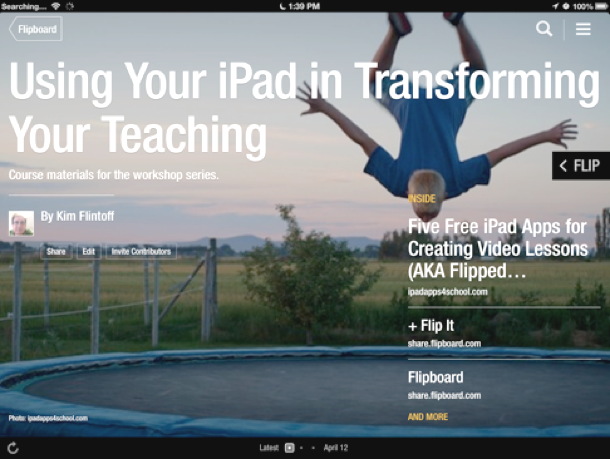
Figure 1: Flipboard magazine formatting using the iPad.
There are many curation tools available and educators need to identify tools that accommodate the teaching and learning goals of the process. Common attributes of a good curation tool are those that allow you to:
Curator's thoughts and comments can be added to any post as well as some level of customisation of images and text included in the post. Scoop.it adds a link and attribute to the original artefact. Visitors can add comments or 'scoop' the article to their collection if it is relevant. This creates an environment of cooperation and collaboration. In an educational setting this can be a powerful example of crowd sourcing knowledge.
There is a growing trend with curation tools to facilitate collaborative curation where teams of curators can work together to build and refine a collection around a topic. This creates opportunities for these tools to be utilised as the technology component of rich engaging learning activities and focussed activity within professional learning networks. The crowd-sourcing component spreads the load to some degree, although it is common for a few key individuals to drive the entire process when a collection is a group undertaking.
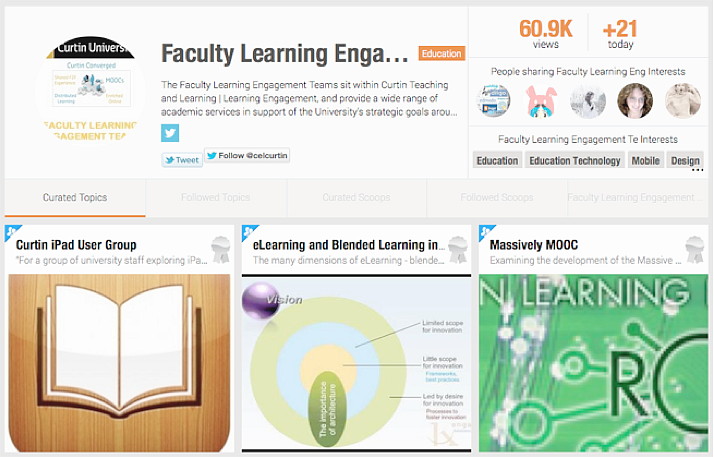
Figure 2: Scoop.it topics overview page
This project was originally designed to be an additional resource for Curtin University staff to use to explore new learning activities and technologies. Staff can quickly see the most recent thoughts around topical issues and quickly get a perspective of the landscape in these emerging areas. Staff are encouraged to keep up to date with new developments in learning and teaching and reading selected articles in a curation feed is one way to easily do this. Many curation tools allow the development of newsletter and structured visualisations that can be used in "push" strategies; selected/filtered subsets of a curated collection can be isolated and targeted towards the specific needs of an organisation's professional development activities.
It also documents the curators' work as a measurable outcome. An added bonus means that the openness of the resource made it available to any educator in the world. Cooperative curation can be a productive team activity that contributes to the institutions professional development and is a good example of intra-institution collaboration. At the University of Melbourne (http://www.scoop.it/u/Learning_Environments), guest curators from different areas of the University are invited to join specific topics of interest to get an institutional perspective on a subject. Curation can also facilitate cross-institution collaboration. When one of the Curtin curating team took up a post at another University they were allowed to keep their curation rights on the Curtin site and a year later are still actively contributing to a range of topics.
One topic in the collection was dedicated to a special interest group that had formed at Curtin around the use of iPads. The topic allowed users to build a collection of resources that spread from, tutorials and tips guides around the use of the iPad, to recommendations for apps from the App Store, links to published reports about iPad implementation in higher education settings, and more general materials relating to operating system updates.
At Curtin, staff in Teaching and Learning have recently begun applying the Minocha and Petre (2012) approach to developing a collaboratively constructed and shared professional reading resource around the university's transformation agenda. Staff are able to identify relevant reading material and use the "curator's insight" feature of Scoop.it to succinctly summarise the material down to its key points, thereby reducing the overall reading requirement across all staff and allowing a more focused level of engagement by staff across different parts of the Teaching and Learning portfolio. It has been witnessed that keyword tagging is still a somewhat ignored feature, and potentially the most valuable feature for creating focused subsets of the overall curated collection.
Scoop.it caters for educational use by allowing up to 30 co-curators per topic and 20 topics. This could be used for small groups of students as a shared activity to develop and manage a topic specific to their area of study, and can accommodate up to 600 co-curators across the topics. For example, within a nursing unit, one group of students could be looking for relevant scientific articles around the cardiovascular system while another group is responsible for finding articles for the digestive system.
The eLearning Advisory team at Curtin devised an approach to curation for use in a common core first year Health Sciences unit. While the unit is still to embark on implementation, the structured activity is worth considering as a template for a range of activities that generally relate to "information literacy" and "information fluency". During August 2012, the curators of the Digital Curation in Higher Education topic (http://www.scoop.it/t/curation-in-higher-education) identified an article entitled "Doctors are the new search engine" (Berek-Lewis, 2012) where it was suggested that doctors might be able to use curation strategies to provide quality information to their patients. An expansion of this suggestion was identified as a rich, authentic opportunity to address issues around information literacy and appropriate technology use with undergraduate Health Science students. The task challenges students to create a focussed topic around a specific aspect of their disciplinary knowledge. They are asked to imagine they are now practitioners and to think of the curation strategy as a way to educate their clients about quality information sources. Using a tool like Scoop.it they were to identify and critique sites that relate to their chosen topic. This can include identifying sites that provide misinformation as well as high quality sources. The task is useful on many levels in that:
Tutors on this program propose that Scoop.it developed into a valuable tool for encouraging critical thinking and analysis skills, enabling students to collectively argue the merits of artifacts being offered for curation, as well as being cognisant of the work they co-authored being offered for open curation. Tutors were aware of initial resistance from students perhaps due to the unfamiliarity with the concept and expectation of curation. "Once they (the students) embraced the idea of collaboration in crafting a digital resource, they bought into the scope it offered. In fact they eagerly anticipated our weekly reviews to see comments from other curators and this inculcated a sense of ownership for the topic, encouraged teamwork and professionalism, and opened their eyes to the value of collaborative research" (Clark, 2013)
Sport and Fitness students at Aoraki Polytechnic are "hands-on learners" (Clark, 2013), and tutorsargue that digital curation is a modality in teaching and learning technologies, which can pack a big punch in a less-formal setting that these particular students may engage more deeply with. They suggest "this is ideal for Gen-Y learners, who are dialed into social-media modalities. Scoop.it can offer a collaborative and co-operative informal research experience that is presented in a manner not unfamiliar to them due to the social-media interfaces they are currently in-tune with (Clark, 2013).
Digital curation is a social media tool that can be applied in multiple ways within education. It facilitates cooperation and collaboration within an institution and between institutions. It has potential for use in an educational context throughout the lifespan of both teachers and learners, from early childhood education, through to higher academic and research-based contexts. Curators can be thought leaders and change agents with their insightful selection of artifacts.
Clark, K (2013). Personal communication.
De Rossi, L. C. & Good, R. (2010). The 15 basic traits of a news / content curation system. http://www.masternewmedia.org/real-time-news-curation-the-complete-guide-part-6-the-tools-universe/#ixzz2Voik0DTw
Intel (2013). What happens in an Internet Minute? Intel Corporation. http://www.intel.com/content/www/us/en/communications/internet-minute-infographic.html
Jenkins, H., Purushotma, R., Weigel, M., Clinton, K. & Robinson, A. J. (2009). Confronting the challenges of participatory culture: Media education for the 21st Century. A report for the MacArthur Foundation. Boston: MIT Press. http://mitpress.mit.edu/sites/default/files/titles/free_download/9780262513623_Confronting_the_Challenges.pdf
Johnson, L. (2013). Why Scoopit is becoming an indispensable learning tool. TeachThought. http://www.teachthought.com/technology/why-scoopit-is-becoming-an-indispensable-learning-tool
Mellow, P. (2012). FIFO - Fly in fly out workers and press perception. Scoop.it. http://www.scoop.it/t/fifo-fly-in-fly-out-workers-and-press-perception
Mihailidis, P. & Cohen, J. N. (2013). Exploring curation as a core competency in digital and media literacy education. Journal of Interactive Media in Education, 2013/02. [viewed 8 Oct 2013] http://jime.open.ac.uk/article/2013-02/html
Minocha, S. & Petre, M. (2012). Vitae Innovate - Handbook of social media for researchers and supervisors - digital technologies for research dialogues. The Open University. http://www.vitae.ac.uk/policy-practice/567271/Handbook-of-social-media-for-researchers-and-supervisors.html
Zhong, C., Shah, S., Sundaravadivelan, K. & Sastry, N. (2013). Sharing the loves: Understanding the how and why of online content curation. ICWSM 2013 (The International AAAI Conference on Weblogs and Social Media) Conference Proceedings. Boston. http://www.inf.kcl.ac.uk/staff/nrs/pubs/icwsm13.pdf
| Please cite as: Flintoff, K., Mellow, P. & Clark, K. P. (2014). Digital curation: Opportunities for learning, teaching, research and professional development. In Transformative, innovative and engaging. Proceedings of the 23rd Annual Teaching Learning Forum, 30-31 January 2014. Perth: The University of Western Australia. http://ctl.curtin.edu.au/professional_development/conferences/tlf/tlf2014/refereed/flintoff.html |
© Copyright 2014 Kim Flintoff, Peter Mellow and Kerensa Pickett Clark. The authors assign to the TL Forum and not for profit educational institutions a non-exclusive licence to reproduce this article for personal use or for institutional teaching and learning purposes, in any format, provided that the article is used and cited in accordance with the usual academic conventions.