
Category: Research
Category: Research |
| Teaching and Learning Forum 2014 [ Refereed papers ] |
Torsten Reiners, Hanna Teräs, Vanessa Chang
Curtin University
Lincoln C. Wood
Auckland University of Technology
Sue Gregory
University of New England
David Gibson, Natasha Petter, Marko Teräs
Curtin University
Email: t.reiners@curtin.edu.au, hanna.teras@curtin.edu.au, v.chang@curtin.edu.au, lincoln.wood@aut.ac.nz, sgregor4@une.edu.au, david.c.gibson@curtin.edu.au, n.petter@curtin.edu.au, m.teras@curtin.edu.au
This paper is about the role of authenticity and emotion to aid learning in immersive virtual environments; in particular the occupational health and safety in the operations and supply chain industry. With the introduction of relatively low cost head-mounted displays such as the Oculus Rift, it is now feasible to introduce environments that are more immersive and authentic; and allow for further experiments on induced and experienced emotions. This article describes an experimental design to evaluate how different levels of authenticity, immersion, and emotion affect learning retention, and how they relate to each other. The container terminal scenario prepares students for site visits, showing the health and safety risks by simulating the consequences of accidents and mistakes in a work place that may cause injury or death.
The proliferation of information and media technology have created nearly ubiquitous virtual spaces where there seems to be constant acquisition of knowledge, skills development, or gaining new experiences. Both experts and amateurs provide endless streams of do-it-yourself instructions to 'hack your life' while bloggers create a knowledge base of unimaginable dimensions. This all provides educators, trainers, and self-paced learners with a rich source of material to supplement their traditional educational modules. Yet, passive online learning designs constrain the experience as they often lack practical application and, therefore, hinder the development of embodied coordination and cognition skills needed for deeper understanding (Baum, 2004; Pfeifer & Bongard, 2007). Passively following a cook on YouTube as she demonstrates molecular cooking may be informative but will not compensate for real-world training and experience of being beside a master chef; the apprentice misses learning from their own failures and receiving critical assessments from independent real-world evaluators. The drawbacks of such passive learning become especially precarious when activities do not relate in a simple way to one's tastes or aesthetic preferences but instead involve serious concerns about occupational health and safety. It is also worth recalling that the production of many of the passive forms of online training (e.g. videos, computer-based instruction) is usually a well-orchestrated process, including multiple experts and observers to guarantee focus and simplicity of message and a model of ideal conditions for safety and performance. Moreover, the final composition seen by viewers is the outcome of multiple retakes and attempts; and is not realistic about the required amount of training and practice that is never seen. This is in a sharp contrast with engagement in real-life activities where there is often only a single opportunity to get it right.
Developing confidence in their own expertise and skill set via sophisticated training, which introduces, aides practice and provides feedback that improves performance through multiple trials, is crucial to the success of learners (Bransford, Brown, & Cocking, 2000). While universities and other educational institutions are able to provide theoretical and, to some extent, practical applications for learning, these often remain limited in authenticity; for example, taking place in classrooms instead of real world environments. It is often not feasible to consider every potential environment, scenario, and other workplace aspects that may be encountered later. Here, the use of re-training modules and skills refresher programs can close the gap as they provide a targeted and efficient assurance of knowledge and expertise as well as induction to new environments. The importance of such programs can be quantified by 337 deadly work-related, traumatic injuries in 2009-2010, in Australia (Safe Work Australia, 2012). One concern is that employees have on average 20% less skill than required for their job (Australian Chamber of Commerce and Industry, 2010) and therewith cause the existing employability gap between university outputs and industry requirements, non-completion of apprenticeships, or health and safety concerns. Similar concerns include the proportion of graduates with the wrong skills (e.g., 40%; Ferguson, 2012); the way that more highly-educated workers often lack practical skills (Jackson, 2009); and the low quality of graduates, relative to organisational expectations (Australian Chamber of Commerce and Industry, 2010). All of these industry-based concerns indicate an immense and pressing need for effective retraining programs and the ability to help staff rapidly adapt to new environments.
These concerns highlight the shortcomings of passive learning. In contrast, many educators have moved towards active learning methods that develop understanding and comprehension through having students' complete tasks and activities, normally within the classroom environment (Wood & Reefke, 2010). However, many of these activities still lack authenticity and lack the real working environment; engaging students with activities and structuring 'gamified' experiences can often be used earlier in educational programs but may later be supplemented by the study tour (Wood & Reiners, 2012). The use of study tours has become an increasingly important in contemporary tertiary education (Reiners et al., 2012). Study tours "bridge the gap between business theory and practice" (Porth, 1997, p. 198), allowing students to connect abstract models and written descriptions with their real-world representations; i.e., comprehending the need for variations and adaptations to compensate for differences in existing business processes. Understandably, study tours might extend the experience for the learner, yet there are significant drawbacks: they offer a limited 'peek' into several 'slices' or 'chapters' of the scenario and the perspective is usually that of an external visitor, limited to predefined walk-ways in defined (safe) areas without access to deeper knowledge or data about the location. Furthermore, site or study tours are limited to certain programs due to high costs (i.e., financial resources and time requirements), access challenges (i.e., confidentiality, safety, and clearance), being able to attend (i.e., disabilities or distance from the location), and maintenance of appropriate learning objectives in well-designed and coordinated visits (Hanna, 2000).
The obvious alternative to study tours and on-site training, where learners are brought on-site, is to instead bring the site to the learner while providing similar experiences, that is, virtual training experience that sufficiently replicate the important features of the real-world environment. Research is beginning to show that the impacts of virtual learning experiences can be as powerful as those experienced in real settings (Blascovich & Bailenson, 2011). Virtual performance spaces for learning and assessment are a relatively new area of research, but show promise for scalable, authentic practice areas with potential for automated assessment and advanced learning analytics (Ifenthaler, Eseryel, & Ge, 2012). Virtual worlds can achieve a moderate level of authenticity while being integrated in the classroom; educators and learning experience designers are yet to explore and understand the untapped potential applications and the contribution that they can make in emerging pedagogical models. We consider an increase in authenticity and perception of higher immersion crucial; i.e., to connect the learner with the business or real world and demonstrate the implementation of theories.
The following section depicts virtual spaces while implementing authentic and immersive scenarios that create learning experiences. We describe an experimental design that places the learner in the role of an occupational health and safety inspector on a container terminal. The design uses a variety of experimental settings, audio-visual technology, and levels of preparations. 3D simulations, partaking in realistic, diverse, versatile, and dynamic activities can be used to effectively emulate real-life situations (Ferry, et al., 2006). Our proposed structured and collaborative scenarios are developed to emulate real-world situations that are challenging to address in a formal learning situation (e.g., accidents), allowing for a range of emotion-induced experiences. The core of this paper is about the experimental design. We describe the activities for the participants in more detail and elaborate the recorded data as well as how these can be used to support the analysis of the learning experiment for advanced automated formative feedback and the computer-supported translation of experience and knowledge in a new, enhanced, learning setting. We provide preliminary results indicating the efficacy of the recently released visualisation technology, demonstrating the importance of extending the immersion of the learner by introducing personal visual spaces. However, the inclusion of other data streams (e.g. from learning analytics) is an ongoing project in its early stages of development; thus, we will limit the discussion to providing a formal description of what we consider as relevant for inclusion in the experiments and how the data for each individual learning experiment is being analysed. We conclude the paper by summarising our findings thus far, and describe a way forward.
Authentic learning is the interface between 'true to life' tasks, activities, and practices and their replicated counterparts in virtual environments or classrooms, such that learners are forced to engage and react in a similar manner as they would in a "real" situation. (Dalgarno et al., under review, and see Blascovich & Bailenson, 2011) for a series of studies that demonstrate that reactions to virtual experiences are the same as reactions to real experiences). Authentic learning puts the learning into a context where the learner can make contextual mistakes without real life consequences (Brookes & Moseley, 2012) yet while being supported in understanding and imprinting the right behaviour under realistic conditions (Herrington, Reeves, & Oliver, 2010). Truly authentic learning can be costly, dangerous, or administratively difficult to arrange (Reiners & Wood, 2013). However, to be authentic, learning does not have to take place in the actual workplace setting. What is important is that the learning situation requires students to employ similar cognitive processes and behaviours as they would in the real-world context. (Herrington, Reeves & Oliver, 2010). In fact, field tours and site visits often do not qualify as examples of authentic learning - although the setting is real, students usually only get a predefined tour and a glimpse of the site, instead of being provided the opportunity to engage in authentic tasks of any kind. Therefore, using technology to create authentic learning environments can be more beneficial for student learning and skills acquisition. Simulations provide a very powerful way of supporting authentic learning. However, simply using technology does not create an authentic learning scenario, but thought must be put into implementing a pedagogically sound authentic learning design. (Teräs & Herrington, forthcoming). Moreover, the technology should not interfere with the authentic learning in such a way that it does not reflect the reality anymore. If the movement of boxes is mapped into the virtual space it is important to use the same means of transport and handling procedures as in real life; even while in a virtual reality space we have the possibility to use teleportation devices or zero-gravity beams. If the handling of an object with the operator's hands is required, technologies like data gloves or Sixsense motion trackers are an option to track the physical movements of participants so that the virtual avatar responds appropriately. The limitations of haptic feedback (e.g., vibrations and shocks) and input (e.g., keyboard or mouse for motion) are challenged by wearable technology. These emerging technologies are capable of transferring the observed motions of the user into the virtual environment and allow a perceived solidification of virtual objects. Technology can detach the user from reality, matching the virtual movement with the input device; e.g., eschewing the use of keyboard and mouse and recognising the corresponding hand movements using VR haptic gloves or camera systems like Kinect. True and accurate 3D representations and 'natural' controls can also heighten learner engagement with the activity while increasing the authenticity of the learning experience, delivering significantly more value.
Emotion is essentially intertwined with experience whether affective or cognitive. Media such as books and films can induce moderate levels of emotion such as amusement and sadness (Mauss, Levenson, McCarter, Wilhelm, & Gross, 2005). Immersion can be used for inducing emotions such as when using the Velten (1968) procedure. Virtual environments have also been shown to be an effective medium (Baños et al., 2008; Riva et al., 2007) and immersive CAVE environments have demonstrated fear responses using virtual pits (M. Slater, Khanna, Mortensen, & Yu, 2009; Usoh, Catena, Arman, & Slater, 2000) or treating anxiety disorders (Juan & Pérez, 2010; Krijn, Emmelkamp, Olafsson, & Biemond, 2004; North, North, & Coble, 1998). Whilst other aspects such as narrative may also induce emotion within virtual environments (Gorini, Capideville, De Leo, Mantovani, & Riva, 2011), relatively low cost Head-Mounted Displays (HMD) such as the Oculus Rift (http://www.oculusvr.com/) may make many of the advantages of the more expensive and immersive CAVE environments more widely available and more able to be used within the wider educational context. This is valuable as variables that are difficult to control or duplicate in real-world settings are amenable to control in virtual realities due to the unique affordances of the digital world. We can deliberately modify the environment to induce specific situations including real-world emotional states such as stress or anxiety to evaluate the effectiveness of education and training in real-world situations. This ability to trigger emotional feelings by stimuli within the virtual environment becomes relevant as we discuss below the relation of emotionally laden learning and the speed and depth of retainment (Bennett, 2010; Pekrun, 2006). These affordances are especially noteworthy in gamified 3D spaces, where the control of goals, performance boundaries, and emotional characteristics are key aspects. The gathering of data from small learning modules allows understanding of individual learning behaviours and customising the learning experience. We thus intend to explore the design facets of creating emotionally compelling situations in safe virtual workplace settings, where we can employ one's physical, emotional and cognitive responses for specific situations and variety in the degree of physicality, emotionality, and cognitive complexity of the problems.
Authenticity, immersion, and emotion are interesting by themselves; the challenging part is to merge them in one space. We target an environment that is not predefined and linear such as a book or film, but reacts to the input of the learner by presenting them with appropriate reactions. Such a process creates improved transferability as the participants increasingly take the scenario for real. As stated by Arsenault (2005), the first step is the elimination of barriers that might cause distractions in the experience. Just as poor reading or language skills would limit a reader's immersion in a scenario outlined in a book, it is crucial to match the quality of input and output devices to the experience. For the experiment scenario below, simply displaying everything on monitors may work, but the sense of immersion will not be aided by the encroachment of reality such as the sense of the living room to your left side, the cat on the couch next to you, and the noise of children playing in the background. While using monitors, even looking around the virtual environment is in-authentic; it does not involve the neck muscles but the cursor keys instead. Combining various technologies to support immersion can result in improved authenticity and therefore, stronger emotions. We use the Oculus Rift HMD that projects the appropriate view based on where the users' head is turned and updates the image according to head movements. Such an approach may even surpass the use of CAVEs and other expensive equipment and enable educators to more readily enhance their practices with more engaging and immersive tasks. Adding headphones with surround sound and noise cancellation would further eliminate the external audible environment; e.g., the telephone conversation from the person in the next cubical in the office.
This can create a truly intense experience that allows participants to take scenarios more seriously, increasing the authenticity of learning tasks. Is it required to have a realistic representation of the virtual space? Regarding the authenticity, a process can be highly authentic, but in a non-realistic setting. Our first experiments indicate that simulations can be authentic and immersive despite the low resolution and fidelity if the perception is focused on other sensory impressions (Bastiaens et al., under review). For example, the Oculus Rift provided an extended depth that participants approached edges with more caution and also considered the resolution and quality of the visualisation as irrelevant, despite the fact that the resolution and quality of the image of the Oculus Rift was significantly surpassed by the monitor used in comparative scenarios in a preliminary experiment (Reiners et al., under review).
| Learning | Training | Waiting | Evaluation | Post measures | |
| Group 1 | yes | - | yes | yes | interview/survey |
| Group 2 | yes | yes | yes | yes | interview/survey |
| Group 3 | yes | yes | yes | interview/survey | |
| Group 4 | yes | interview/survey |
The primary learning objective of the experiment relates to the identification and comprehension of occupational safety and health risks within a container stack on a terminal. Figure 1 shows the layout of the scenario and indicates the location of the eight potential safety and health risks designed for this experiment. The scenario is small and can be fully explored; artificial boundaries are used to restrict learners' freedom to relevant areas. This is feasible and represents the focus of the inspector during the investigation. The following list explains the risks (numbering refers to Figure 1) in greater detail, focusing on how the participants can identify hazards and report them.
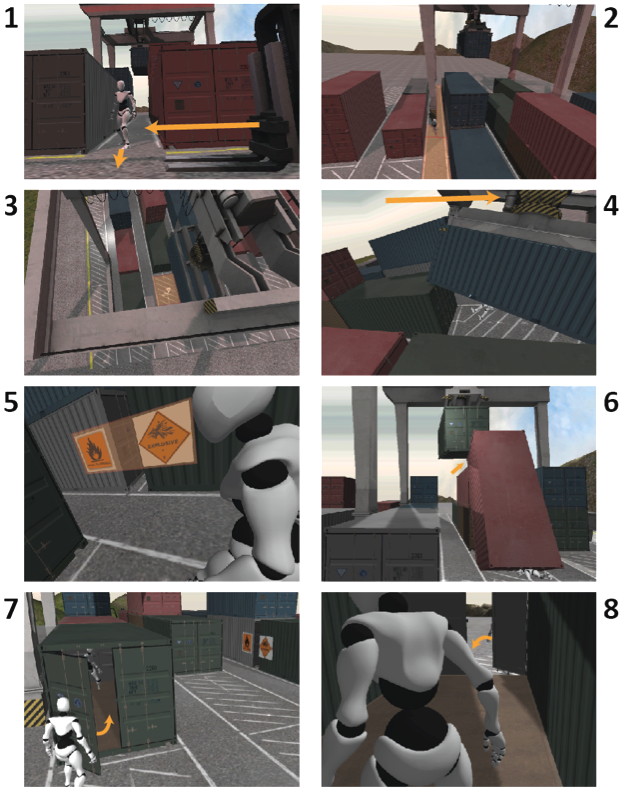
Figure 1: Visualisation of the different situations on the terminal. (1) hit by emerging vehicle; (2) hit by crane in aisle; (3) crushed under container; (4) faulty material; (5) dangerous goods; (6) error by humans; (7) endangering a colleague; (8) being trapped
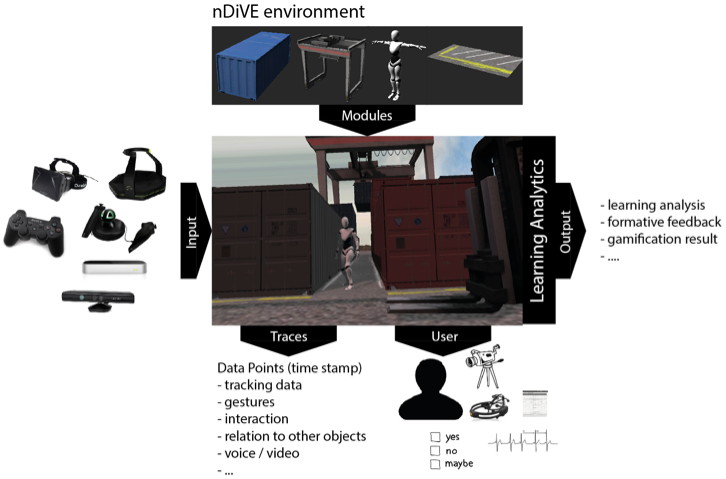
Figure 2: Input and output of the experiments
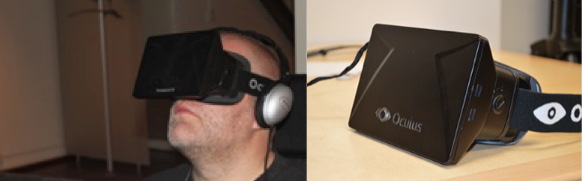
Figure 3: Oculus Rift used by one of the authors
The assumption in this experiment is that the participants are not experienced with the scenarios being presented to them and most likely never set foot in any similar situation. We provide a short tutorial explaining the main controls, input devices, components, and processes. We support different control options as it is important that the participant feels comfortable. Next to specialised input devices like Sixsense Motion control and Kinect, we also offer the traditional mouse and keyboard option; however, the output device is determined by the experimental design (Table 1). The experiment is not about training or evaluating experts doing occupational health and safety inspections; rather, the focus is on how people in general react to the space depending on the use of different media formats, the usability and interactivity of the scenario and an understanding if there is a common sense or general capability to identify dangerous situations. These factors are all relevant on site visits with students.
This paper covers the experimental design including the input and resulting output to derive a formative feedback for the participant and a first evaluation of whether this context is feasible for inducing and detecting emotions. The experiments are planned to run over a 2-3 month period as we include the evaluation of learning retention based on the used input and output device. However, preliminary studies focusing on the use of the head-mounted display have been undertaken to better understand how this affects the degree of immersion and authenticity compared to using 3D virtual worlds on a 2D monitor.
In these preliminary studies (reported elsewhere; see Reiners et al., under review) a small number of participants (n=13, 6 male, 7 female, wide cross section of all working adult age categories) partook in an experiment using the Oculus Rift. On a five-point Likert-type scale (from 1=no to 5=extensive), the participants indicated their gaming (M=2.85, SD=1.46) and virtual world (M=2.23, SD=1.23) experience (the correlation is 0.39). All participants had heard of head-mounted devices but had not yet used them. The range of scenarios covered Second Life (2D monitor), a 3D environment without fast motions (Oculus Rift), two scenarios with fast movements without control (roller coaster and helicopter flight using the Oculus Rift), and some scenarios were the participant took over control (racing simulation, 2D monitor and Oculus Rift). More details on the experimental setting and the analysis can be found in Reiners et al. (under review). Importantly, these experiments with the Oculus Rift confirmed our expectations about the intensity of experience and the effects on the participants. The observation of the participants revealed a strong immersion as we could infer as they matched their physical movements to the avatar's movements; this was not the case when they used a 2D monitor. Participants felt present in the scenario that they either almost lost their balance or had to stop the experiment as it was too intensive. The physical reactions based on observation and interview afterwards includes the following (n=12):
The participants can see a strong potential for applications using the Oculus Rift (or future HMDs of similar quality) in education, training, entertainment, and tourism (order indicates the relevance stated by participants). The same scenario experienced using a monitor fails to have such an immersive effect; the restricted 2D window into the virtual environment causes too many conflicts with the perception. Nine participants (70%) investigated scenarios with more care and seriousness when using the HMD; despite the knowledge that it is a game-like environment and they were not in imminent danger. Seventy-seven percent believe that using the Oculus Rift for an induction to an industry site (e.g., demonstrating possible incidents that can occur on this site that may lead to injury) would create greater awareness and thus more care while being in the real environment. The majority of participants mentioned that it would add value to the classroom. These preliminary results indicate that the aforementioned technologies will enable safe, secure, and sensible classroom visits to "real enough" environments and scenarios, mediated by virtuality. This creates an interesting potential to create more fluid transitions from safe learning environments to real ones, and the research group will continue studying this in future publications. As the title of the paper suggests, fear of dying is an important learning experience in a simulation as participants are immersed in authentic learning scenarios where they are able to learn the real consequences of their actions.
Australian Chamber of Commerce and Industry (2010). Employers' commitment to training: Key findings from the ACCI National Workplace Skills Survey 2010. http://www.acci.asn.au/Files/Employer-s-Commitment-To-Training-Key-Finding-From
Baños, R. M. Botella, C., Rubió, I., Quero, S., García-Palacios, A., Alcañiz, M. (2008). Presence and emotions in virtual environments: The influence of stereoscopy. CyberPsychology & Behavior, 11(1), 1-8. http://dx.doi.org/10.1089/cpb.2007.9936
Bastiaens, T., Wood, L. C. & Reiners, T. (under review). New landscapes and new eyes: The role of virtual world design for supply chain education. Ubiquitous Learning: An International Journal.
Baum, E. (2004). What is thought? Cambridge, MA: MIT Press
Bennett, R. E. (2010). Cognitively based assessment of, for, and as learning (CBAL): A preliminary theory of action for summative and formative assessment. Measurement: Interdisciplinary Research & Perspective, 8(2-3), 70-91. http://dx.doi.org/10.1080/15366367.2010.508686
Blascovich, J. & Bailenson, J. (2011). Infinite reality. New York: Harper-Collins.
Bransford, J., Brown, A. & Cocking, R. (2000). How people learn: Brain, mind, experience and school. Washington: DC: National Academy Press. http://www.nap.edu/openbook.php?isbn=0309070368
Brookes, S. & Moseley, A. (2012). Authentic contextual games for learning. In N. Whitton & A. Moseley (Eds.), Using games to enhance learning and teaching: A beginner's guide (pp. 91-107). New York: Routledge.
Brown, E. & Cairns, P. (n.d.). A grounded investigation of game immersion. In CHI'04 extended abstracts on Human factors in computing systems (pp. 1297-1300). ACM Press.
Coleridge, S. T. (1984). Biographia literaria: Or biographical sketches of my literary life and opinions (Vol. 75). Bollingen Foundation. https://archive.org/stream/biographialitera00colerich#page/n7/mode/2up
Dalgarno, B., Gregory, S., Knox, V. & Reiners, T. (under review). Practising teaching using virtual classroom role plays.
Dede, C. (2009). Immersive interfaces for engagement and learning. Science, 323(5910), 66-69. http://dx.doi.org/10.1126/science.1167311
Ermi, L. & Mäyrä, F. (2005). Fundamental components of the gameplay experience: Analysing immersion. In Proceedings of DiGRA 2005 Conference: Changing Views - Worlds in Play. http://people.uta.fi/~tlilma/gameplay_experience.pdf
Ferguson, T. (2007). "Poor" graduate skills turn off recruiters. http://www.management.silicon.com/careers/0,39024671,39167405,00.htm
Ferry, B., Kervin, L., Cambourne, B., Turbill, J., Puglisi, S., Jonassen, D. & Hedberg, J. (2004). Online classroom simulation: The next wave for pre-service teacher education? In Beyond the comfort zone: Proceedings of the 21st ASCILITE Conference (pp. 294-302). http://www.ascilite.org.au/conferences/perth04/procs/ferry.html
Gorini, A., Capideville, C. S., De Leo, G., Mantovani, F. & Riva, G. (2011). The role of immersion and narrative in mediated presence: The virtual hospital experience. CyberPsychology, Behavior & Social Networking, 14(3), 99-105. http://dx.doi.org/10.1089/cyber.2010.0100
Hanna, M. D. (2000). Touring a supply chain with students: Pedagogical and practical considerations. Production and Operations Management, 9(2), 203-211. http://dx.doi.org/10.1111/j.1937-5956.2000.tb00334.x
Herrington, J., Reeves, T. C. & Oliver, R. (2010). A guide to authentic e-learning. New York: Routledge.
Ifenthaler, D., Eseryel, D. & Ge, X. (Eds.) (2012). Assessment in game-based learning. New York: Springer.
Ifenthaler, D., Eseryel, D. & Ge, X. (2012). Assessment in game-based learning. In D. Ifenthaler, D. Eseryel & X. Ge (Eds.), Assessment in game-based learning (p. 461). Springer.
Jackson, D. (2010). An international profile of industry-relevant competencies and skill gaps in modern graduates. International Journal of Management Education, 8(3), 29-58. http://connection.ebscohost.com/c/articles/50137908/international-profile-industry-relevant-competencies-skill-gaps-modern-graduates
Jennett, C. (2008). Measuring and defining the experience of immersion in games. International Journal of Human-Computer Studies, 66(9), 641-661. http://dx.doi.org/10.1016/j.ijhcs.2008.04.004
Jennett, C., Cox, A. L., Cairns, P., Dhoparee, S., Epps, A., Tijs, T. & Walton, A. (2008). Measuring and defining the experience of immersion in games. International Journal of Human-Computer Studies, 66(9), 641-661. http://dx.doi.org/10.1016/j.ijhcs.2008.04.004
Juan, M. C. & Pérez, D. (2010). Using augmented and virtual reality for the development of acrophobic scenarios. Comparison of the levels of presence and anxiety. Computers & Graphics, 34(6), 756-766.
Kalawsky, R. S. (1996). Exploiting virtual reality techniques in education and training: Technological issues. Loughborough University of Technology: Advanced VR Research Centre. http://www.agocg.ac.uk/reports/virtual/vrtech/toc.htm
Krijn, M., Emmelkamp, P. M., Olafsson, R. P. & Biemond, R. (2004). Virtual reality exposure therapy of anxiety disorders: A review. Clinical Psychology Review, 24(3), 259-281.
Lee, K. M. (2004). Presence, explicated. Communication Theory, 14(1), 27-50. http://dx.doi.org/10.1111/j.1468-2885.2004.tb00302.x
Lessiter, J., Freeman, M., Keogh, E. & Davidoff, J. (2001). A cross-media presence questionnaire: The ITC-sense of presence inventory. Presence: Teleoperators & Virtual Environments, 10(3), 282-297. http://eprints.gold.ac.uk/483/2/PSY_Freeman_2001a.pdf
Mauss, I. B., Levenson, R. W., McCarter, L., Wilhelm, F. H. & Gross, J. J. (2005). The tie that binds? Coherence among emotion experience, behavior, and physiology. Emotion, 5(2), 175. http://spl.stanford.edu/pdfs/mauss_et_al_coherence_2005.pdf
North, M. M., North, S. M. & Coble, J. R. (1998). Virtual reality therapy: An effective treatment for phobias. Studies in health technology and informatics, 58, 112-119. http://www.iospress.nl/book/medicine-meets-virtual-reality-2/
Pekrun, R. (2006). The control-value theory of achievement emotions: Assumptions, corollaries, and implications for educational research and practice. Educational Psychology Review, 18(4), 315-341. http://link.springer.com/article/10.1007%2Fs10648-006-9029-9#page-2
Pfeifer, R. & Bongard, J. (2007). How the body shapes the way we think: A new view of intelligence. Cambridge, MA: MIT Press.
Porth, S. J. (1997). Management education goes international: A model for designing and teaching a study tour course. Journal of Management Education, 21(2), 190-199. http://dx.doi.org/10.1177/105256299702100204
Reiners, T. & Wood, L. C. (2013). Immersive virtual environments to facilitate authentic education in Logistics and supply chain management. In Y. Kats (Ed.), Learning management systems and instructional design: Metrics, standards, and applications (pp. 323-343). Hershey, PA: IGI Global. http://dx.doi.org/10.4018/978-1-4666-3930-0.ch017
Reiners, T., Wood, L. C., Chang, V., Guetl, C., Herrington, J., Teräs, H. & Gregory, S. (2012). Operationalising gamification in an educational authentic environment. In P. Kommers, T. Issa & P. Isaías (Eds.), IADIS International Conference on Internet Technologies & Society 2012 (pp. 93-100). Perth, Australia: IADIS. http://researchrepository.murdoch.edu.au/13958/1/reiners_et_al_2012-Postprint-Operationalising_gamification_in_an_educational_authentic_environment.pdf
Reiners, T., Wood, L. C. & Dron, J. (2014). From chaos towards sense: A learner-centric narrative virtual learning space. In J. Bishop (Ed.), Gamification for human factors integration: Social, educational, and psychological issues. Hershey, PA: IGI Global. http://dx.doi.org/10.4018/978-1-4666-5071-8.ch015
Reiners, T., Wood, L. C. & Gregory, S. (under review). Experimental study on technology-induced authentic immersion in virtual worlds.
Riva, G., Mantovani, F., Capideville, C. S., Preziosa, A., Morganti, F., Villani, D., Gaggioli, A., Botella, C. & Alcañiz, M. (2007). Affective interactions using virtual reality: The link between presence and emotions. CyberPsychology & Behavior, 10(1), 45-56. http://dx.doi.org/10.1089/cpb.2006.9993
Safe Work Australia (2012). The cost of work-related injury and illness for Australian employers, workers and the community: 2008-09. http://www.safeworkaustralia.gov.au/sites/SWA/AboutSafeWorkAustralia/
WhatWeDo/Publications/Documents/178/CostsofWorkRelatedInjuryAndDisease_Mar2009.pdf
Schubert, T. W. (2009). A new conception of spatial presence: Once again, with feeling. Communication Theory, 19(2), 161-187. http://www.igroup.org/schubert/papers/schubert_comtheory_2009.pdf
Slater, M. (2009). Place illusion and plausibility can lead to realistic behaviour in immersive virtual environments. Philosophical Transactions B, 364(1535), 35-49. http://dx.doi.org/10.1098/rstb.2009.0138
Slater, M., Khanna, P., Mortensen, J. & Yu, I. (2009). Visual realism enhances realistic response in an immersive virtual environment. IEEE Computer Graphics and Applications, 29(3), 76-84. http://citeseerx.ist.psu.edu/viewdoc/download?doi=10.1.1.165.6113&rep=rep1&type=pdf
Slater, M. & Steed, A. (2000). A virtual presence counter. Presence: Teleoperators & Virtual Environments, 9(5), 413-434. http://dx.doi.org/10.1162/105474600566925
Teräs, H. & Herrington, J. (forthcoming). Neither the frying pan nor the fire: In search of a balanced authentic e-learning design through and educational design research process. International Review of Research in Open and Distance Learning.
Usoh, M., Catena, E., Arman, S. & Slater, M. (2000). Using presence questionnaires in reality. Presence: Teleoperators & Virtual Environments, 9(5), 497-503. http://www-dept.cs.ucl.ac.uk/staff/m.slater/Papers/questionnaire-paper.pdf
Velten, E. (1968). A laboratory task for induction of mood states. Behaviour Research and Therapy, 6(4), 473-482.
Wirth, W., Hartmann, T., Böcking, S., Vorderer, P., Klimmt, C., Schramm, H., Saari, T., Laarni, J., Ravaja, N., Gouveia, F. R., Biocca, F., Sacau, A., Jäncke, L., Baumgartner, T. & Jäncke, P. (2007). A process model of the formation of spatial presence experiences. Media Psychology, 9(3), 493-525. http://dx.doi.org/10.1080/15213260701283079
Witmer, B. G. & Singer, M. J. (1998). Measuring presence in virtual environments: A Presence Questionnaire. Presence: Teleoperators & Virtual Environments, 7(3), 225-240. http://vislab.cs.vt.edu/~quek/Classes/Aware+EmbodiedInteraction/PAPERS/WitS98-Presence.pdf
Wood, L. C. & Reefke, H. (2010). Working with a diverse class: Reflections on the role of team teaching, teaching tools and technological support. In H. Huai, P. Kommers & P. Isaías (Eds.), IADIS International Conference on International Higher Education (IHE 2010) (pp. 72-79). Perth, Australia: IADIS Press. http://www.academia.edu/3391591/Working_with_
a_diverse_class_Reflections_on_the_role_of_team_teaching_teaching_tools_and_technological_support
Wood, L. C. & Reiners, T. (2012). Gamification in logistics and supply chain education: Extending active learning. In P. Kommers, T. Issa & P. Isaías (Eds.), IADIS International Conference on Internet Technologies & Society 2012 (pp. 101-108). Perth, Australia: IADIS Press. http://www.academia.edu/2552559/
Gamification_in_logistics_and_supply_chain_education_extending_active_learning
| Please cite as: Reiners, T., Teräs, H., Chang, V., Wood, L. C., Gregory, S., Gibson, D., Petter , N. & Teräs, M. (2014). Authentic, immersive, and emotional experience in virtual learning environments: The fear of dying as an important learning experience in a simulation. In Transformative, innovative and engaging. Proceedings of the 23rd Annual Teaching Learning Forum, 30-31 January 2014. Perth: The University of Western Australia. http://ctl.curtin.edu.au/professional_development/conferences/tlf/tlf2014/refereed/reiners.html |
© Copyright 2014 Torsten Reiners, Hanna Teräs, Vanessa Chang, Lincoln C. Wood, Sue Gregory, David Gibson, Natasha Petter and Marko Teräs. The authors assign to the TL Forum and not for profit educational institutions a non-exclusive licence to reproduce this article for personal use or for institutional teaching and learning purposes, in any format, provided that the article is used and cited in accordance with the usual academic conventions.