
|
Part 2
Our childhood games
Hidey: surely International favourite childhood game.
Hopscotch: even the simplest pattern requires precision and balance only gained after much practice. Some mysterious date triggers the season for this and other ground games such as
Marbles: both boys and girls played, the skilful sporting bulging bags of marbles won in fair play. I remember keeping a Tom Bowler beauty until my own boys were old enough to play.
Knucklebones (Fives): plastics were unknown so the required 5 bones had to be saved over several lamb or mutton baked dinners when the shank yielded its knuckle. Like marbles, knucklebones were carried in a bag which accompanied its owner everywhere on school days and sometimes on Saturdays; one such Saturday I remember very well.
My friend Elsie Parsons and I were among a group of girls who were to attend a Girls' Friendly Society (C of E) festival at Claremont. Leaving Mundaring by the 10 am train, we had some time to fill in before the commencement of the function and streamed into a cinema in Perth filling, together with two elderly lady carers, two empty rows with two left over. We two found seats further to the front and enjoyed the film until 'lights up'. When we looked around for our friends they had disappeared without trace. Not to worry - Elsie knew her way around the city if I didn't and presently, armed with a bag of 2 buns and a bag of knucklebones, we made our way to the Supreme Court Gardens where we contentedly enjoyed our buns and our bones beneath a massive oak tree.
The Town Hall clock told us when to make our way to the Perth Railway Station to board the home bound train. Oh, those two poor ladies; how they rushed on to the station in an agony of trepidation and fell upon the two lost lambs, relief overcoming recrimination.
Skipping: a clean new rope with red handles was a prized Christmas present. A skipping competition in the school ground finally left two only contestants, Phyl Spiers and myself. I tripped at 1000 skips, leaving her the winner.
Alas, first year High School at Midland put an end to all outdoor childish games. So crowded with buildings was the yard that no sport was possible. How I missed Mundaring and my early childhood.
Party Games included Drop the Hanky, Musical Chairs and Statues, when everyone paraded around to music. When the music stopped one must 'freeze in the position at the time. Any movement meant 'out', until only one person (the winner) was left.
Rainy Day Games included dominoes, snakes and ladders, ludo etc and simple card games. My father was a keen chess player but we girls either didn't want to learn or it was considered only boys' stuff. Draughts, however was simple and popular.
I vaguely remember slopping around in Mother's shoes. Presumable suitable OS garments accompanied them.
The main dressing up occasions, however, were:-
Weeks of practice went into the Cantata, those with the best voices starring as Fairy Queen and Prince Charming or whatever the script demanded. At Midland the Cantata or Musicale was a much more involved, ambitious affair, the headmaster himself conducting the singing. Thankfully, I had evolved into, one year, a Japanese maiden in blue and yellow crepe kimono, the next, a courtly lady dancing a stately minuet.
No cat or dog to cuddle but sleek hens to stroke as I collected eggs from the nest and fluffy chicken balls to cup in the hand enjoying their softness and cheeky chirping. Then there was the delight in watching the frisky antics of snowy kids whose mother goats supplied rich, creamy milk.
Abundance of bird life gave us endless pleasure; early morning carolling of magpies and attendant pee-wee, joyful laughter of kookaburras; raucous chatter of wattle birds.
Emergence of spring each year brought beautiful mating calls of butcher birds, golden and rufus whistlers, the melting melody of the grey thrush, melancholy notes of pallid cuckoo and the lovely grey black faced cuckoo shrike. Looked forward to each year in late spring, a small flock of rainbow birds -or bee eaters - flew south to build their underground nests in a suitable open paddock, flashing their gorgeous colours in graceful swooping flight as they expertly caught their prey on the wing.
Then there was a great variety of honeyeaters, sweet whistlers who visited all year long; and everyone's favourites, the splendid blue wren with his demure wife and family and the robin red breast.
A blue kingfisher was occasionally spotted and once a spotted quail ran quickly by.
Silver eyes and parrots sadly were considered pests and ruined many a fruit crop.
The Western warbler - aptly named 'Sleepy Dick' for its monotonous, though tuneful song was rarely spotted but frequently heard from its tree top perch.
Grey fantails flirted their tails and their endless, on the wing, quest for insects especially flies. Willie wagtails enjoyed riding on an animal's back, picking off flies and possibly vermin.
Years later I discovered the tiny mistletoe bird which builds the smallest nest of all birds - a flimsy affair of cobwebs and fluffy seeds. A handsome little fellow sporting a gleaming blue-black and scarlet throat, chest and abdomen, he and a species of mistletoe peculiar to wattles conspire to slowly sap the life of the host tree. Starting from a small seed (or seeds) carried by the bird and deposited on a wattle branch by means of sticky droppings, the mistletoe rapidly spreads, displaying very attractive trusses of tomato-red flowers, meanwhile strangling its hapless host.
Foxes and feral cats were unknown in our district during my childhood. Possums were common, bandicoots, echidnas and the murderous chudich (spotted native cat) sometimes seen. The chudich - a feared fowl yard plunderer - once was responsible for the death of 90 pullets that were penned in overnight. Somehow the spotted killer found a way in and attacked only a few - the rest died from fright and overcrowding into a small corner space. (This was on our poultry farm at Zamia many years later).
Grey kangaroos were plentiful in our 'forest' and the larger red ones in the vicinity of Mundaring Weir and the Helena River.
Remembering songs, poems and dances
I can still recite the one-stanza first school poem Ode to a Butterfly:
Later in high school, large slices of Shakespeare's Julius Caesar and The Merchant of Venice were required learned by heart.
Early nursery rhymes:
Early 1914-18 war songs:
Action songs:
Children's:
School Drilling of:
School Rounds:
A Maypole was erected in the yard and we girls were taught how to dance around it - winding and unwinding its red, white and blue streamers before more intricate weaving of patterns. I loved this exercise but was fearful of the heavy pole on its crossed wooden feet would collapse when dancing became too animated. However, although it rocked alarmingly, it always righted itself at the critical moment.
Homey smells:
And ticked on a suggested list:
More memories from early school days
All World War 1 soldiers from Western Australia destined for overseas service were trained at Blackboy Hill, Greenmount. Part of the toughening process included long route marches. The plan for one such march was uphill 6 miles along the gravel York Road, now Great Eastern Highway, to Mundaring Hall where the ladies of the CWA would entertain the men for lunch, after which it was on a further 5 miles to Mundaring Weir - then of course reverse. On the journey up the platoon would right-wheel at the school for the short lap to the hall. We were all allowed out of school to cheer them on and it was suggested that near the time they would arrive, if we put our ears to the ground we would feel the reverberations of marching feet. This proved to be the case - it was estimated we first 'felt' the approach of the rhythmic thud of boots on ground from ½ mile distant - very exciting.
Another time (I think 1916) we were released from class was to see the very first aeroplane to fly over Mundaring - I think Hinkler's.
Later when Edward V111 (then Prince of Wales) toured Australia accompanied by his
Aide-de-Camp, Viscount Mountbatten, we walked the 2 miles to Parkerville Railway Station where the Royal train stopped for a few minutes to be greeted by children from Sister Kate's children's homes and any other loyal subjects. As the fresh faced young man walked slowly along the cheering crowd, he stopped to speak to a lady from Mundaring standing next to me, who presented him with a bunch of violets.
An annual event looked forward to by Marie and me, together with kids from another family, was picking mulberries from 3 big trees at Sawyers Valley. We'd walk the couple of miles swinging our empty billy-cans, fill them with luscious purple fruit and walk back after feasting and filling our billies - stained purple our hands, faces and overalls.
Another vivid memory was arriving at school one frosty morning to find the horse trough outside the school iced over at least one inch thick. One boy bashed out a big slab of ice which he stood up inside the porch where it still stood dripping, and of course smaller, at 10.30 recess time.
Peak of achievement: to find such an imaginative hiding place that 'He' has to give up looking and call for a triumphant emergence.
Depth of ignominy: to have found such an obscure hiding place that 'He' and others forget all about the hidden one until he or she eventually creeps sheepishly forth.
Butterflies are pretty things
Poems were thoroughly learned and collectively recited in class.
Prettier than you or I
See the colours on their wings.
Who would hurt a butterfly?
My mother - singing in French Frère Jacques and singing in German, Augustine.
Keep the Home Fires Burning
Pack up your troubles in your old kit bag
It's a long way to Tipperary
Roses are blooming in Picardy
Skipping song: - Here we go round the mulberry bush
Oranges and lemons, Drop the hankie, Musical chairs etc
Sunday School hymns, Church hymns.
Sol Fah from chart: up and down scale,
Chords: 'Doh, me, soh, doh' variations.
'Three blind mice' etc.
Hungry smell of baked dinner.
Garden scents:
Father's yeast buns.
Washing hanging round the hot stove on winter afternoons.
Smell of sizzling flat iron, heated on stove, smoothing damped linen.
Rising steam from wet boots drying by open fire.
Smell of soap scrubbed clothes warm and ready to wear.
Unbleached calico, castor oil, moth balls, old books, iodine, fragrant flowers, silverware polish, talcum powder, lavender water, freshly starched linen.
Over-ripe fruits, orange blossom.
Heavenly brown velvet scent of wall flowers, heady sweetness of mignonette.
First violets hiding under leafy umbrellas, night scenting stocks.
Red roses, arum lilies' pollen dusted centres, sickly jonquils.
Earthy smells rising from dry ground, bark, mouldering leaves after first autumn shower mingled with eucalyptus' tangy medicinal odour.
Damp chickens and chicken runs.
 |
We three were never shorn as children. Eda's hair was dark and fuzzy-curly. Marie's was blond and almost straight and mine was fairish and wavy, gradually darkening to a chest-nutty brown with bronzy glints.
As a child my hair was plaited into two or later one plait, tied near the end with a ribbon. I particularly liked turquoise ribbons of a shade still one of my favourites.
We all resisted the bob and shingle as they came into fashion, but in my twenties my hair was cut to shoulder length, still long enough to pin into the fashionable neck roll or individual pin-curls.
I can remember Mother plaiting my hair when I first started school but, believe me, I quickly learned to plait my own.
Mother's hair was fair and very wavy and worn combed up loosely with a loose bun pinned on top. I used to plead to be able to brush and comb her hair and experiment styling it.
Books, magazines and funny papers
English comics sent periodically in bundles.
Favourite fairy stories - Grimm's Fairy Tales, Aesop's Fables.
Books of nursery rhymes.
We had no library so school and Sunday-school prizes were read over and over. Sometimes we swapped books with friends.
Class Reading Books were successive Oxford Readers; all tales of England from the classics; no Australian input whatever!
When I was 10, Mrs McCallum gave me a Girl's Own Annual - much treasured - read and re-read. I was especially fascinated by the illustrations and heart rending tales of returning soldiers from the 1st World War. One illustration I especially remember was of a Red Cross Nurse assisting a wounded soldier as their hospital ship listed after being torpedoed.
Well remembered books were: Pollyanna; John Halifax, Gentleman; Little Women; Water Babies; and the Elsie series, etc.
Picking up windfall apples and pears from very early age. Picking gooseberries in hot sun - a tiring, stooping, tedious chore which, however, reaped 'rich' rewards for struggling orchardists. 4 pence a bushel was 'super'!
Later having to clean, every Saturday, my section of the semi-enclosed verandah sleep-out when I would have much preferred to have my nose in a book or trying small attempts at watercolours - our orchard clad in autumn reds and gold, flannel flowers gathered from their damp ferny spot at the base of huge looming granite outcrops. Marie still had this latter painting framed on her wall, together with one of a view, painted later, at the Bandy's farm at Hutt.
Another regular chore was cleaning the knives after Sunday's roast dinner. Stainless steel cutlery had not yet reached Australia.
Feeding the free range hens and chickens and changing their water. This I enjoyed.
One never to be forgotten chore was filling a jam tin over and over with caterpillars picked from the foliage of fruit trees. This was a strange pest manifestation never repeated. We were paid 1/2 penny per tin and missed school for half a day. Missing school was strictly for dire straits like whooping cough, measles and chicken pox, so this was a real emergency.
'Fatty' the big rag doll was an early favourite. Other remembered dolls were a grown-out-of doll discarded by my elder sister re-dressed by my mother and presented as a Christmas present.
Another Christmas, I was delighted to receive a brand new doll, given to me by an elderly lady belonging to our church. I have a vague memory of a Wooden Betty, a jointed doll made entirely from wood.
Later when celluloid first made its appearance, Kewpie dolls were popular. The Kewpie had a cute appeal with its central peak of hair, wide eyes, smiling mouth, arms stretched invitingly forward and legs firmly all of a piece. A Kewpie in a tutu fastened to a cane walking stick was a must at Agricultural Show time in early October.
When I was about 4 we spent Christmas in the 'little' house, where my request for one of the new wind-up toys from Santa Claus was granted. It was a boxy shaped, yellow car which I carried excitedly into my parents' bedroom.
Santa Claus annually attended a social for school children in the Mundaring hall distributing small gifts from the tree. I remember receiving a concertina type folding doll's cot made of wood.
Mother was famed for her rag dolls, especially those made from black stockings with eyes of boot buttons and unravelled knitted black wool for hair. Later Father helped make a doll of their own unique design. Fruit case wire was bent to form moveable arms and legs. These were thrust through a stuffed body and of course, stuffed and covered. The face was made from a kid glove, the features painted by Dad.
 |
Father was a 'dab hand' at toffee making. Waiting for it to harden and cool in a tin plate was exciting. Then it was broken into pieces with our special little hammer, an all-in-one-piece black iron hammer with the word 'toffee' engraved upon it. I have it still.
Another accomplishment of Dad's was pancake making - very thin, high tossed and caught in the pan, eaten hot, sprinkled with lemon juice and sugar - or perhaps golden syrup - and rolled neatly.
Eating Dad's Johnny Cakes cooked on top of the stove in the heavy grid iron and eaten on a Sunday afternoon before the blazing 'front room' fire is a happy memory.
Dad never tired of experimenting with old and new recipes of ginger and hop beers, many a popping cork proving his success. A homemade 'wine' from our grapes was less successful.
In pre-immunisation days, infectious diseases such as measles, chicken pox, mumps, and whooping cough were treated very seriously. Any child contracting one of these was quarantined for 3 weeks, together with any school aged siblings, which meant that a family of several children may be affected for a number of weeks - or even months - until the last victim was cleared. Many a gap in a child's education can be attributed to this enforced absence.
The miseries of whooping cough struck me pre-school, chicken pox at about age 9 and measles and mumps mid-teens. We must have been a tough lot because I don't ever remember the visiting to a doctor by any member of the family.
Of course, finance had a hand in this. We just could not afford a doctor's fee for trivial things such as sore throats, feverish colds, toothache, earache, gastric troubles and boils. For these, home remedies sufficed and I remember cloves for toothache, senna tea for tummy upsets, sticky brown poultices for boils and 'antiphlogestine' for plasters on cough congested chests.
Winter doses of cod liver oil and malt were most unpopular, but we enjoyed the 'Parishes' food tonic when we were 'run down'. Oh! and castor oil and starvation for really severe gastric attacks. I still can smell the shuddering horror of the contents of that beautiful (now collectable) blue bottle which the proffered orange segments did nothing to mask.
During Primary school, regular swabs were taken by a visiting nurse to spot diphtheria carriers. Appendicitis struck the only child whose parents forbade her to eat passion fruit in case a seed may lodge in the appendix! Six weeks convalescence after operation was the norm for this ailment.
Dogs roaming much more freely than they are allowed to now struck terror into my young (and not so young) heart. There were certain premises about the village where my enemies lurked quietly until, unfailingly sensing my approach, they rushed out bearing fangs, growling and stalking around. I tried to resist the urge to turn and run and must say I was never attacked, though the fear remained.
Although snakes abounded in the bush, we never thought to be concerned about them, although we were invariably barefooted.
'Ghosts, goolies, long-legged beasties and things that go bump in the night' didn't worry me either. The dark was friendly, and from the age of 12, for eight years in winter, I would walk ¾ mile in darkness, without a torch, home from the train without a fear of anything.
My main terror in childhood and into my teens was People! Desperately shy, I would hide rather than confront a stranger visiting our home or a workmate at the office. And to be obliged to face the boss with a query, or to deliver a message was enough to bring on a minor fit.
|
Spring brought the wonder of wildflowers to our 'forest'. We delightedly welcomed each species from the June purple of Hovea and delicate lacy white of Sweet Meadow to the brave flowering of last of the shiny Mauve Fringed Lily in the heat of January. We combed the bush for orchids, especially plentiful after a bushfire - the first sighting of the early warm wallflower tones of brown and gold Donkey Orchids bringing cries of excited discovery. White Spider Orchids with their long slender legs and the shy, translucent Greenhood Bird Orchid were favourites and so aptly named.
I remember the mystery of moonlight on summer nights as the soft beams filtered through our vine shaded sleep-out, throwing swaying silhouettes of grape leaves on the wall. By these beams we peered very early into our Christmas stockings, the rustle of leaves and paper blending deliciously.
We gazed on the brightness of the full moon, our imagination tracing the shadowy features of the Man on the Moon. How impossible in those early days of the twentieth century to conceive the possibility of 'Man's First Small Step' during our lifetime and the subsequent unfolding of the mystery of the solar system by those incredible machinations of man's mind!
Too vast, too deep for my mind to fathom.
Summer brought the longed for 5 weeks of school holidays, a respite from the long trudge home from school - bare feet on hot gravel. Then there was the annual train trip to Cottesloe Beach when those toes felt the wet sand and foaming surf, with such delight. We didn't possess bathers!
In summer every variety of stone fruit, apples and pears were plentiful for our enjoyment - and picking. I can still feel the hot sun probing through the clothing covering our bent backs on our weekly gooseberry picking chore.
Fierce forest bush fires were dreaded occasional visitors at the height of summer.
I sometimes think Autumn is the loveliest time of the year with its fresh deep breath of clean air and deepening blue of still days washed by early showers; air free from the blowing pollen which make Spring so miserable for so many people.
Then there is the changing of the colours; the summer greens of the orchard vanish before the onslaught of red, orange, and yellow marching so boldly in my childhood's orchard, down the steep slope to Gill Street and glowing against the dark green hillside rising from the valley yonder. My favourite tree was the persimmon where the deep orange shiny fruit hung there fruit fly defying, until really squashy to be acceptable to the palate, otherwise its astringent quality had a distressing shrivelling effect on the lining of the mouth.
Increasing showers interspersed with frosty spells told us winter chills were soon to be reckoned with. Out came the warm underclothes and raincoats; the long walks to and from school had to be faced. Barring epidemics of whooping cough, mumps, measles, German measles (Rubella) and chicken pox, children attended school whatever the weather or state of health.
How welcome, then, the homecoming to blazing logs of the open fire and warm kitchen with its homely smells of cooking and drying clothes. A warm drink and bread and butter (or sometimes dripping!) cheered the inner parts.
Winter was the time to sow vegetable seeds in soil filled half kerosene tins. The usual resulting mat of seedling must be thinned and subsequently planted out in rows formed straight by string stretched between 2 thin pieces of wood. Peas and sweet peas alike were soaked in hot water before planting. Multi coloured, sweet perfumed sweet peas topping a 6 ft fence were a special delight, welcoming spring.

Sundays meant Sunday-school - later Church - in the pretty stone Church of England (now Anglican) Church in Mundaring.
Our Sunday-school teacher was a lovely, motherly amply proportioned lady, Miss Watson. It being war time, we prayed for our troops and sang 'Onward Christian Soldiers', 'For Those in Peril on the Sea' and 'Fight the Good Fight'.
Miss Watson told us the true story of one Christmas time on the Western front, where Allied troops were entrenched, facing over 'No Man's Land', the German enemy similarly 'housed'. Christmas Eve the young Germans were heard singing 'Silent Night' whereon our lads joined in. Spontaneously there emerged men from both sides who shook hands and shared meagre rations. Next day, sadly, they were enemies once more.
From Miss Watson the comforting texts read in her warm intimate voice:
'The Eternal God is thy refuge and underneath are the everlasting arms.'These verses always bring to mind a picture of the dear lady who first brought them to me.
'How precious is God's unfailing love. Men find refuge under his wings.'
'Over and Under: a complete understanding of God's presence.'
Of course Sunday was not altogether a thing of the spirit. We always enjoyed a hearty English style roast dinner. Our parents were not strict as to the keeping of the Sabbath and tennis was a favourite relaxation. Never-the-less, Church was a must - later childhood the attendance was at Evensong at 7.30 pm.
When I was 11, I was confirmed with a group of friends by Archbishop Riley, a well loved head of church. His presence was imposing - tall, ruddy with thick white hair and melodious voice. From a sermon of his I remember his words - 'It's easy to be Orpah' referring to the Book of Ruth when Naomi, with her daughters-in-law Ruth and Orpah set off on return to their native land of Judah. Orpah's timidity would not allow her to face the unknown, her loyalty wavered and she turned back. How right he was!
Family holidays during my childhood consisted of ONE day at Cottesloe Beach during the Christmas school break. We travelled by train - a novelty for us and wiled away the miles by a competition - how many white horses could be spotted between stations. None of us could swim so paddling was the extent of our association with the sea. Nevertheless, this was a treat eagerly anticipated by us hill-billies.
When I was twelve I travelled again by train, an overnight sit-up journey to Ajana. Time was taken for the evening meal at Muchea on the Midland Line then I tried to sleep until a vigorous bell ringing at Walkaway in the dim dawn invited one to alight for a steaming cup of tea. Trains were changed at Geraldton, then chug along for a further 50 miles to Ajana where our farming Atkinson relatives awaited the weary traveller.
One week was spent with Aunt Belle and Uncle Tom and their children Dorothy, Bill, and Phyllis [Second generation - Tom and Bella]. The youngsters rode horses to school and Dorothy offered me her mount on Saturday for a ride to the post office some 2 miles distant along a winding bush track overshadowed by wattles and banksias. She helped me mount then preceded me on her uncle's horse, walking sedately at first. I was quite unprepared for the trot to canter which followed, hanging on wildly while dodging overhead branches. Trembling in every limb I alighted and tottered into the tiny P.O. with my cousin.
On emerging, my steed was nowhere to be seen - he'd had enough of this dopey new chum and decided to go home, which suited me. Dorothy took me aboard her horse for the return journey. It was a very stiff and sore visitor who next day amused her unsympathetic relatives.
The second week was spent with Aunt Nelly and Uncles Alan and Syd [Second generation - Nellie and Allan]. I was relieved to be offered a truck ride to view the floods at the mouth of the Murchison River.
This is the first school I attended just after my 5th birthday in January 1914. The war memorial and rose garden were established after the first world war.

The school was a two roomed weatherboard, high ceiling building whose long windows overlooked Great Eastern Highway (then a gravel York Road). There was a temptation to day dream, allowing one's attention to be distracted by passing traffic. No motor vehicles of course, but nevertheless a tempting clatter of hoofs as horse drawn carts, traps of drays passed by - or maybe stopped directly outside the school, where a big watering trough for animals kept constantly full, tempted thirsty ones; perhaps horse and cart carrying produce to the Mundaring station for transport to the Metropolitan Markets, the light pony trap, hooded from the sun, bearing the Baptist Minister on his rounds, or, best of all the heavy drays pulled by Harry Underdown's magnificent team of draught horses, their heavy white-skirted hoofs plodding rhythmically past.
The small entrance porch on the North side led into the long narrow corridor which ran the length of the two rooms except at one end. A row of strong hooks awaited their daily burden of school bags, coats and hats.
Two open fronted, weatherboard sheds faced each other across a quadrangle of gravel (later a tennis court), one for girls, one for boys. Here we sheltered from rain in winter to eat lunch and play games. Fine weather found us outdoors beneath wattle trees.
My early school years coincided with the 4 years of World War - 1914 to 18 - so patriotism for the Empire was fostered, especially after the 1915 epic of Gallipoli. The Union Jack was raised each morning on the flag pole beside the girl's shed. We stood in ranks of four or five lines and, after the flag ceremony, morning drill was conducted by the headmaster. Ten minutes of physical jerks, then it was left turn, quick march into school. All very regimented, although no uniforms or shoes were required.
School commenced at 9 am except for a small group of Mahogany Creek children who were allowed to catch the morning train from Perth which arrived at Mundaring about 9.50 am. They had to stay in during morning break which tended to isolate them from the rest of us. During World War 2, when children were evacuated under fear of Japanese invasion, those hosted by local families at Mahogany Creek managed to walk the 2 miles to Mundaring without favour or complaint. Of course, all the children walked to and fro - the 'townies' going home for lunch and we 'outers' bringing sandwiches and maybe fruit.
Punishment was either '100 lines' which meant writing an appropriate sentence 100 times during play time or more often, the cane given to boys and girls indiscriminately and for very mild offences such as talking in class. I was too scared to talk but got caned anyway during the time I shared a desk with a chatterbox.
All desks were two-seaters consisting of a lidded top with ink well and grooved pencil and pen holder. Lifting up the front portion of the top revealed a shallow space for books. The floors of both rooms were of uncovered timber. The little room housed 'infants' 1, 2 and 3 (covering 1st year and grade 1). The big room grouped grades 2 and 3 with a lady teacher and 4, 5, and 6 taught by the headmaster.
Both rooms were warmed by open fires in winter. The entire space above the mantel in the 'big' room was decorated by a huge chart listing the Royal Houses of Great Britain from way back. These we were required to learn by heart.
 |
On promotion to the 'big' room we were confronted by a timid, probably first-year-outer, who was unfortunate to inherit a particularly rebellious schoolgirl who led her school mates in a series of outrageous pranks which left poor Miss Adele S. a nervous wreck. We weren't really surprised to hear she had left to join a convent to become a nun!
At this time the Headmaster was a Queenslander who endlessly extolled his home State where everything was bigger, better, lusher and altogether more desirable than anything we sandgropers had to offer. He kept an invalid, never-seen wife in his cottage and an only child, Dolly, (well named with her enormous blue eyes and luxuriant dark hair). Sadly, she was constantly brow-beaten by her father before the whole class. The Head, however in spite of frequent mighty whacks with the cane on the hands of offenders, was popular. He it was who converted the gravel quadrangle into a tennis court and taught us how to play. Student tended gardens flourished. He even grew peanuts at the bottom of the school ground where the soil was moist and fertile.
 |
High School
Beginning school at Midland at age 12 (equal to H.S. year 8) revealed our relaxed hill-billy education left many gaps. However I worked hard and found favour with our young male teacher who christened me 'Philomel' (meaning nightingale) and at year's end presented me with a book prize 'for most improved pupil' entitled 'The nicest girl in the School'!
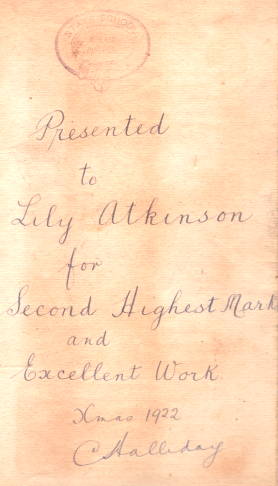
This ill prepared me for the onslaught of Crystal Halliday - year 9 teacher - a very heavy, blond lady who we thought quite old. We learned later she had lost her fiancé during the War which may have been the cause of her tetchy temper which, when aroused was quite terrible, her yells and stamping foot sending the rather timid Headmaster scurrying to take refuge in his office. All subjects were taught by her and through sheer terror I learned fast and thoroughly. Year's end found me with another prize for 2nd in the class a Book Prize, 'Rose Mervyn' by Anne Beale - a tale of the Rebecca Riots in Wales in 1842.
There is a park in Guildford named 'Crystal Halliday Park'.
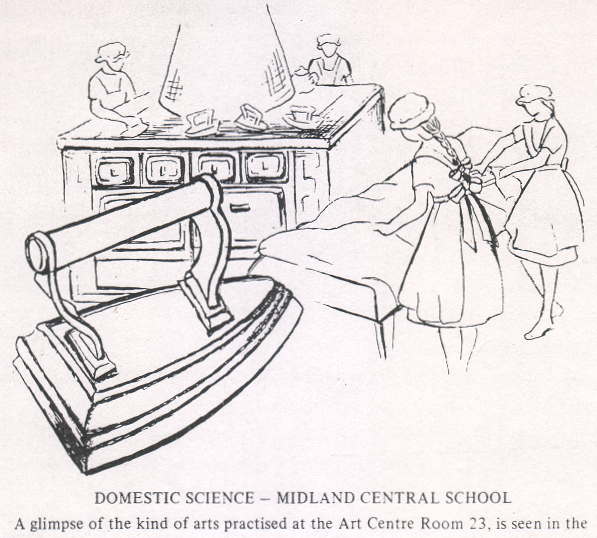
Below: Drawing and article by Lilian Puzey about Domestic Science at Midland Central School in the 1920s. This was written while she was an art student there at the time of the 75th Anniversary of Midland TAFE. Accompanying text:
A glimpse of the kind of arts practised at the Art Centre Room 23, is seen in the [the picture below].Still to be seen in the floor of the main room is the concrete square which supported the massive, blackleaded wood stove, woodbox alongside, together with leather bellows to encourage the unwilling spark.
Here flat irons were heated, then cleaned with bathbrick and smoothed with beeswax. A curved polishing iron was used to scale the peak of laundry achievement: six men's stiff collars, reduced to gooey masses from rigorous scrubbing on a corrugated board, blueing (no beads of bleach then) and heavy starching, must be restored to polished, upstanding dignity - no mean feat for a 12 year old.
Cooking classes provided one shilling meals for staff and to a few students affluent enough to afford them.
But in those pre-women's lib days, the highlight of the year was the unlocking of what is now the painting storeroom to reveal a complete nursery setup with a celluloid baby doll awaiting mothering!

Corner of girls yard, Midland, which is now Midland TAFE