
|
Part 3
Christmas Day followed the English custom featuring church with the Christmas story and the old well-loved carols - always a packed congregation (as on Easter Day)! (Mother was never happy with the C. of E. order of service and years later she joined the Methodist Church with Father and myself. This denomination agreed closely with Mother's Swiss National Church and there she felt at home.) So Mother was content to stay home tending the sizzling fat chook or duck with all the trimmings. Of course the main course was followed by the pudding released from its calico mummification. Mince pies to follow did nothing to relieve the struggling digestive system but nevertheless they were expected and enjoyed.
A few lollies retrieved from the toe of the Christmas stocking were munched or sucked at intervals during the day. Lollie-balls whose colour changed as each layer was licked off were popular. The very centre released a small brown aniseed ball.
As children our year was measured from one Christmas day to the next - or rather from one long holiday of 5 weeks to the next, always called the Christmas holidays and not the summer vacation. The stretch from one 25th December to the next seemed a lifetime to me.
Unfortunately for Dad the Christmas-New Year period coincided with the stone fruit season so there was very little let-up. Cardboard fruit boxes and trays were unknown. All fruit - except gooseberries which we bagged in hemp sacks - went to market in wooden fruit cases. I can see my father, a few of the flat fruit cases nails held in readiness between his lips, assembling and hammering on the side slats and finally the top covering over the carefully graded and packed fruit. We children were the sole gooseberry pickers as I have previously mentioned - and of course there was the family jam supply to replenish. I was allowed sometimes to stencil on with black-lead the growers name on the fruit cases.
Big orchards usually employed a lad whose only task was fruit case making and, as in shearing sheep, there was a rivalry between these workers - how many fruit cases per hour.
Christmas 1922 marked the end of my school days at Midland State School and the end of my thirteenth year. February 1923 I began commercial studies at Perth Technical College.
Birthdays, Easter and other celebrations
Early birthdays were not made much of that I can recall. As I approached my teens I longed first to be old enough to coil up my hair and later to be 18. Eighteen heralded grown-up-dom and, of course, when I turned 12 Eda had already reached this magical milestone and pal Marie 15. I suffered the pain of all youngest in the family, of being left behind.
Palm Sunday, a week before Easter Day, heralded Holy week on the church calendar. Our church was decked with Zamia palm fronds and we Sunday-school children learnt the stirring hymn 'Children of Jerusalem' with its rousing 'Loud Hosanna's chorus'. I really felt part of the excited throng acknowledging the Kingship of Jesus. The sadness of Good Friday affected me deeply, especially one year when a concert in aid of our soldiers 'Comfort Fund' was arranged for Easter Saturday and all of us S.S. children attended. The loved elderly lady wife of our minister was very distressed that we had been enjoying ourselves while Jesus was in the tomb. I felt quite guilty.
Easter Sunday service was always packed and stirring Resurrection hymns joyfully rang around the flower filled church.
On Saturday we had boiled and decorated eggs, dyeing some yellow by adding brown onion skins to the boiling water. Others were dipped in cochineal red - others in blue water from the washing day blue bag. Sometimes we achieved a semblance of our names in hot wax before dyeing. I can't recall chocolate eggs, but remember the very sweet, hard sugar variety. The boiled eggs were regretfully peeled and eaten for breakfast.
Every year we helped decorate the church for Harvest Festival, the Sunday set apart for Thanksgiving for the produce of the earth. Baskets and bowls were piled artistically with the reds, purples and orange of ripe fruits and vegetables surrounding the sheaf of wheat, loaf of bread and glass of water which occupied the centre of the altar. Every windowsill nested little groups of fruit and trailed ivy and burnished bronze vases burst into bloom.
Next day everything transportable was taken for the enjoyment of the children of Parkerville Homes.
It was during one of those Saturday afternoon church decorating sessions that I plucked up courage to open the lid of the organ, felt the bellows wheezing beneath pressure of my feet on the pedals and tentatively picked out my first tune on the keyboard.
There and then I determined that somehow, sometime I would learn to play the piano.
The extent of musical instruments in the family home amounted to one dulcimer and a basic mouth organ, both owned by me. On the dulcimer I banged out simple tunes by ear and also followed the tonic sol-fa instructions written below the piano score and words of old-time Christmas carols. This particular book of carols was well loved by my father and accompanied him from England. Frail, crumbling at the edges, with many a patched tear, the group of Angels still shout their Joy to the World from its faded green paper cover. It must be almost 100 years old and is still in my possession (1995).
The pencil scribbles defacing one or two pages were my very first artistic expression, I believe.
How my two childhood longings of learning to play the piano and to draw and paint were surely providentially fulfilled, I will speak of under 'Hobbies'
Favourite foods and favourite pastimes
Many of the foods we enjoyed as children are frowned on today: fried eggs and bacon; fried bread; bread and rich drippings from the baking dish.
A favourite occasional treat - golden toast, consisting of bread dipped both sides in beaten egg, sweetened and then fried.
Steak and kidney pudding with suet crust - a warming winter dish and sweet suet steamed pudding covered in golden syrup - 'no-nos' nowadays as would be sweet dumplings popped on top of a simmering stew for the last 12 minutes of cooking. All tried and true British recipes dear to Pommy hearts - and tummies. However, vegies, home grown, and fruit were plentiful.
Dad experimented with a great variety of ginger and hop beers as well as wishy-washy grape 'wines'.
Eggs were preserved in kerosene tins filled with 'water-glass' (?) from which they emerged encrusted with a granulated white substance but internally sound.
When I was about 11, we acquired an ice-cream churn consisting of 2 containers one within the other with a space for packing ice between. A home-made vanilla custard was poured into the inner portion and a handle turned occasionally to prevent spoiling the consistency of the 'cream'. Ice could be obtained from the butcher's ice making plant. This fad lost its appeal fairly quickly. The result was often disappointing in the hottest weather, the waiting tedious and the volume small for the effort involved.
Also ticked on a suggested list were:-
bread and dripping, Sunday roast and Monday shepherd's pie, port wine jelly and Nestles reduced cream, lamingtons, watermelon, camp pie, fairy bread, condensed milk, marble cake, ice cream and apple pie.
We attended the first Anzac Day ceremony to be held at the newly erected War Memorial outside the schoolyard after the 1914 -18 Great War. Unveiled was the tablet of names of those who had served from the district, a star beside the names of the fallen.
A local war hero - Major Weston - resplendent in dress uniform with service medal across his chest addressed the crowd. Boy Scouts had marched and a harmonium, brought from the Church of England (I think), was played for the Recessional Hymn and of course the Last Post was sounded from the bugler. Similar services are still held at this spot, although now the school children are no longer at hand - only the lonely original 2 roomed school stands desolate in its corner, (1995) dreaming of lost clatter and laughter of out-of-school generations of children. Gone too the beautiful white climbing dog roses blooming through 80 years along the school fence.
Arbour Day gave us a half-day holiday when we attended a ceremonial planting of a tree and planted annuals in the garden.
Empire day was another special afternoon off. We all had to compete in races, hurdles, egg and spoon and three-legged races etc. Mothers provided afternoon sandwiches and small cakes. In those days I had a savoury 'tooth' and refused cakes in favour of the inevitable ham sandwich. Homemade lemon cordial revived the thirsty.
I was rather good at jumping and can remember the thrill of clearing the ever elevated bar cradled on its wooden supports until the inevitable turn when the bar was sent flying by my bare toes.
Still firmly attached to the apron strings of 'Mother England' as we were, we observed May 1st as May Day, which in the Motherland celebrated the Northern Springtime. We knew all about the decorated floats and the chosen May Queen honoured on her throne while being drawn through the streets and pelted with flowers by the cheering onlookers.
We may live 'down under' in mid Autumn, but we could celebrate with special sports and dancing round the maypole - this last feat the culmination of weeks of practice.
The Sunday-school picnic was an annual special occasion modestly enjoyed locally at the show grounds.
Mums prepared lunch in the big pavilion and special 'fun' sports occupied most of the day: especially remembered are the sack races when one hopped along while encased in a wheat or chaff bag and the bun on a string competition where one had to eat the swinging bun with hands tied firmly behind.
Early October brought Show Week and 2 days school holiday - Wednesday when workers had a half-holiday and Thursday was children's day. There was much sky gazing on the evening preceding Show day for the weather was notoriously fickle, thunder storms and equinoctial gales not uncommon.
This was the time when new spring fashions were paraded whatever the weather and there was one year when crepe material was all the rage. Unfortunately crepe had the embarrassing habit of shrinking alarmingly when wet and there was one occasion when knees (the revealing of which in public except on the beach was a definite 'no-no') were definitely on show.
I took a special delight in the Wednesday half holiday when I first worked in Perth. The train brought me through the spring flower laden bush. One could sit at the window and spy many white spider orchids in the Glen Forrest Area. These sadly have long since vanished together with other prized specimens - victims of suburban sprawl.
Fifth November Bonfire and Guy Fawkes Night was one of great excitement. We waited eagerly for Bob's homecoming with the bag of fireworks. A grass filled Guy based on crossed poles, dressed in Dad's cast off working clothes, was set alight and the noise of explosions and shrieks of those chased by jumping jacks filled the air as showers of sparks lit the sky - hopefully starry, but possibly shedding a light November drizzle. Spirits were not damped, however, although I must admit to being scared of the jumping tricksters. Catherine wheels whirling their coloured sparks were my favourite
During my childhood the family finances certainly would not have stretched to a bicycle. Only one girl, (the same who owned the coveted celluloid baby doll) owned one. However, when I was a mother of three boys and a couple of bikes leant against the verandah posts, I had a spur of the moment idea that a pair of wheels would make me desirably independent. "Nothing to it" assured the family who proceeded to hold the wretched thing steady, helped me mount, ran alongside a short distance and with an encouraging pat and 'off you go' sent me down the drive. Never a truer word spoken - 'Off' I came, painfully. I was not amused, but needless to say the boys were. I decided wheels were not for me.
Swimming was a skill denied us hills dwellers. The ocean was 25 miles away, swimming pools, public and private unknown. However the Crawley Baths on the Swan River were available for competition and private use and it was there that I, at 18, learnt to swim, taught by my later-to-be husband.
There was a long row of change-rooms from which one emerged on to a weather and water worn plank verandah, then slipped into the still river water. There was a tearoom attached to the baths which helped make a short trip by tram from the city pleasant.
School athletics, which I had enjoyed very much, came to an abrupt end at my entrance to Midland High School. Ballroom dancing and some folk dancing - e.g. "The Lancers" and "Quadrilles" - were taught during Primary years. We would walk up Nicholl St. in a crocodile line to the hall. Our favourite teachers of dance were 'Nipper' Paton and his English war bride who settled in Mundaring after World War 1. 'Nipper' was short and nuggety with black curly hair and dark eyes; she a typical English rose, slim, fair, and softly spoken. This couple generously gave their time voluntarily to teach us kids one of the social graces which we practised at school socials, fancy dress balls and some grown up functions.
Later at Midland the girls gathered in the central school hall for movement to music - eurhythmics - which, as far as I can remember, was the only supervised exercise. Boys and girls had separate yards - the boys much bigger than ours where they could kick a football and practise cricket but we girls could hardly swing a skipping rope.
I was fortunate that by then we had moved to McCallum's on the Great Eastern Highway (York Rd) where Dad and Bob levelled a tennis court and we played Sunday afternoons.
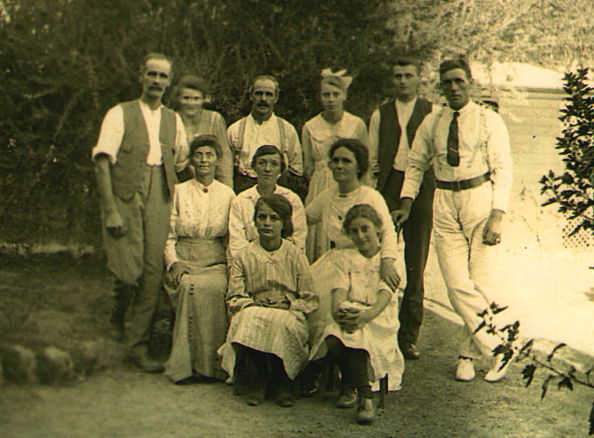

Atkinson Family at 'The Cottage'
Back: Bob, Marie, Eda, George. Front: Lily, Ida
 Self portrait, 1924, aged 15 |
Drawing and music were my enduring Hobbies. From as long as I can remember I tried to capture likenesses of my family in pencil. Much later at Church fetes I would sell profiles for 1 shilling each. I can remember there were murmurs of outrage when the price was raised to 2/- .
As for music, when I was eleven my parents gave me for Christmas a beautiful little 2½ octave piano keyboard. On lifting the lid there was revealed a dulcimer which recorded the corresponding note (or key) pressed on the keyboard. On this instrument I played melodies, my first five finger exercises and scales.
December 1920 closed my primary school years at Mundaring State School. Just after my 12th birthday I entered Midland School. None of my classmates accompanied me. One or two gained entrance to Perth Girls', the rest remained at Mundaring under a correspondence scheme supervised, but not taught, by the headmaster.
I was to go into the Commercial stream - others hoping to be teachers under a different category but actually for the next two years doing the same work. During the first year, commercial students were in the same room as an overflow of Industrial boys. Boys and girls separated for Domestic science and wood and metal work.

On entrance day 1921 the main hall was full of hopefuls waiting to be separated into their chosen groups. I found myself standing next to a girl from Bellevue who was as lost and lonely as myself. She was to remain a lifelong friend. We still correspond (1995). Her name - Mavis Allen (now Christie).
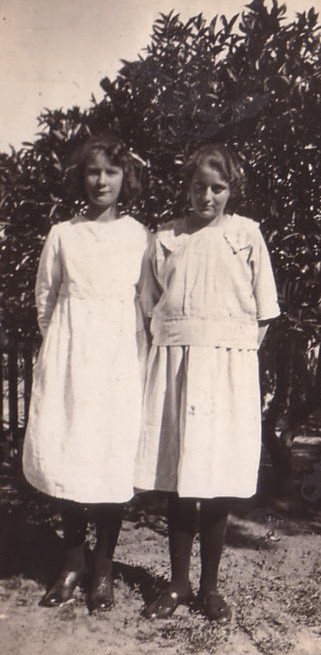 Mavis and Lily |
Best of all elder sister, Jessie, was a talented pianist and, seeing my hungry eyes on her piano, offered to teach me. There followed weekly lessons and evening practices on my table keyboard. My parents, acknowledging my enthusiasm, decided to provide me with a real piano, a wooden framed instrument which sadly went wildly out of tune in hot weather. It was second hand and cost £40. However it was a keyboard and my grateful fingers strummed happily upon it. When Jessie left home for Geraldton my mother found me an elderly lady for a few weeks tuition. Then it was on to Perth Technical School for commercial training.
With new scary situations looming, I pleaded not to have to face another music teacher, foolishly announcing I would be able to carry on myself! Mum wouldn't have a bit of it, promptly catching the train to Perth with the express purpose of finding that very person. She had vaguely heard that St Georges Terrace was the place to explore, so, at her usual brisk pace she reached the area where Perth's professionals displayed their credentials on brass plated upon one of which read:
| Miss M Morrison Teacher of Music and Painting |
I was promptly booked for both - Saturday afternoons.
May Morrison became my best friend, married Harry Farman, a Methodist minister who was posted to Mundaring for 3 years following marriage.
May's niece married my son Vic. Joan and Vic provided me with three grandchildren and 4 great-grandchildren (so far 1995) [Ed: 7 great grand-children by 1998]
Old remedies and old wives tales
Castor oil + one day's starvation for gastric upsets - that fiendish oil clad in that elegant dark blue glass bottle so sought after by collectors among the debris of disused rubbish tips. A few samples may one day be unearthed from the fillings of our 40 ft well at Zamia Poultry Farm!
Other treasures may include flat irons, a bean cutter, apple peeler-corer-slicer, horse shoes, wheat grinder, grindstone, cast iron pots and preserving pan, wire meshed meat safe, the copper wash tub, galvanised bath tub for bathing babies before the kitchen stove, old leather harnessing of Charlie the horse [Ed: or Chum, George Whitely's horse used by Vern with his own harness and cart which I think was at Zamia Poultry Farm together with blacksmithing equipment when Vern bought the property]
These and countless other relics from that pre-fridge, pre-washing machine, pre-electricity age were dumped in the well when the farm was sold.
But I digress!
Senna tea: - an infusion of dried senna leaves in boiling water. A cup of this nasty liquid would rapidly cure the unsettled tummy or else it was back to the blue bottle.
Cod Liver Oil: A spoonful of this tummy-turning liquid daily was necessary to drag the cringing child safely through the darks of winter. The addition of malt made the dose much more palatable - but not enough to entice my little boy Victor from under the table where, at the sight of that brown bottle he had fled and shutting his eyes, hoped to be invisible.
Interesting that in 1996 it has been found that regular doses of this fish oil protects from heart disease and cancer as well a pulmonary disease.
Take a teaspoon of sugar, soak in a few drops of eucalyptus oil and swallow. A head cold is sure to be magically cured.
Parish's Food Tonic: One was sure to feel poorly and depressed once or twice during a winter of snivels and wet feet. 'Shake the bottle and take the medicine three times a day'. This pleasant tasting wine-red tonic laced with goodness knows what, was a must.
Cough Mixtures: One particularly effective one was pepped up with a whiff of chloroform!
Antiphlogestine: A slimy grey goo spread on a piece of cotton sheeting and stuck on to the chest and / or back while still unbearably hot from heating in the upside down lid of a saucepan of boiling water, really did relieve congestion, even if clammy and uncomfortable over-night.
Zambuk (any relation to Waltzing Matilda?) A round tin of this ointment found in every home medicine cabinet together with -
Goanna salve - Both surely Australian.
Fashion - nineteen twenties. Euphoric post Great World War 1.
Life was celebrated with gay abandon. The sacrifices of the Great War had established peace for evermore! Women had heroically 'done their bit' and gained a measure of liberation.
The 'flappers' emerged: bobbed hair - later the shingle - first knee revealing skirt (hardly a mini, but shocking none the less) - make up including red lipstick. The more staid of us thought this last decidedly common and settled for perhaps a dusting of powder.
Long strings of beads jangled as the pre-jive craze, the 'Lambeth Walk', shook the dance floor.
Emergence from High School found me stripping off for the last time those obligatory black cashmere stockings, replacing them with fawn lisle - a type of mercerised cotton - a distinct improvement on those old "blacks". However, my heart was set on the new silk stockings appearing in the shops at an exorbitant price - five shillings (5/-) sterling and quite a slice from my weekly wage of £2 sterling ($4 in today's currency). Eventually savings allowed for a coveted pair of pale, silvery grey luxurious silks. I still remember the thrill they gave me. Nylons didn't appear until World War 2 when GI's (US servicemen) brought them into England for their local girl friends much to the chagrin of the English lads whose 6 'bob' a day soldier's allowance didn't extend to such luxuries.
Stockings were seamed at the back - important for good grooming to keep those seams straight.
The 'flapper' look decreed one must look as boyish as possible, so to compliment short hair, one must flatten the bosom; a straight cloth binder served this purpose, discomfort a willing sacrifice for the 'look.' The more daring sported rolled stockings tops above elastic garters which held up the hose while strangling the blood supply!
A ditty going the rounds encouraged:
Roll 'em girls, roll 'em, everybody roll 'em,A far cry from pre war days when a glimpse of a pretty ankle was all their swains could hope for!
Roll 'em girls and show your pretty knees.
Laugh at those who say that you are shocking,
Paint your sweetie's face upon your stocking.
Roll 'em girls, roll' em, everybody roll 'em.
Roll 'em girls and show your pretty knees.
Between sixteen and eighteen was the accepted time when those of us who couldn't bear to sacrifice long locks 'put up' their hair. This momentous event was impatiently looked forward to and at sixteen, being a working girl in a grown up world, I decided the time was right for me to practise exchanging my long plait for a coiled 'bun' at the back of my head secured by a long hairpin (pre-bobby pins). Late 1920s it was fashionable to part the hair at the back and wear a coil over each ear.
These were pre-deodorant days. BO was kept in check by 'Lifebuoy' soap - hopefully! Honest sweat was no disgrace.
Learning about life ... milestones
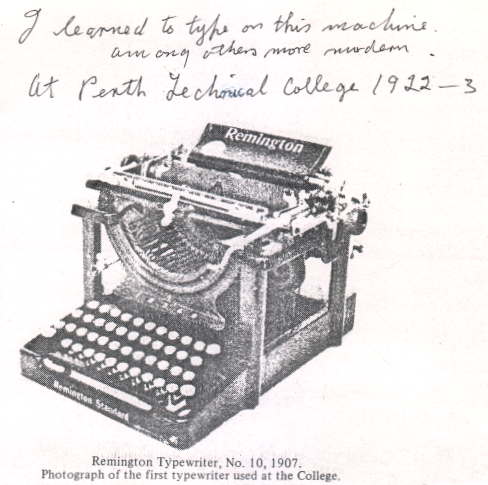 |
About a fortnight after my 14th birthday I commenced Junior Commercial studies at Perth Technical College in St Georges Terrace. Here, later, my son Alan and daughter Greta studied some of their subjects for Manual Arts and Home Economics (then 'Home Science' having been granted superior status to 'Domestic Science') respectively.
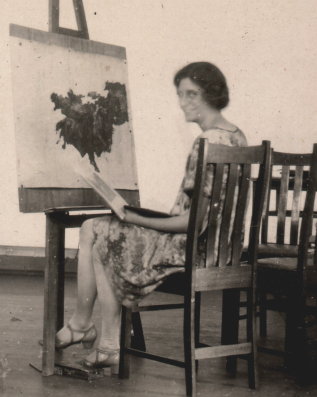
May's studio, where she taught piano and violin as well as drawing and painting, was a large meeting room (or hall) in a building owned by the Theosophical Society. The caretaker was a dour, old spinster lady whose arthritic condition caused her temper to be short and each painful step to be accompanied by a groan. We had the use of a large cupboard in the hallway. Should any article of our equipment be thoughtlessly left outside this locked cupboard it would disappear never to be seen again. Miss K. had been on her nightly tidy prowl! One precious piece of mine thus vanished. Our early attempts at oil painting consisted of copying beautifully coloured reproductions of paintings owned by the National Gallery, London. May kept a stack of these and we chose which one we would meticulously enlarge on to canvas. My choice was 'O Mistress Mine where are you Roaming' from a poem in Shakespeare's 'As You Like It'. (It is also set to music). I think only part of one figure was completed when my copy disappeared. May scoured art shops high and low - only one black and white copy was available.
At that time our little group had been joined by a bubbly chatterbox who loved to regale us with accounts of her boy friends and outings. One Saturday she burst in crying 'I've found it!' It was my picture which she had spied framed at the top of the stairs in a rather posh house in West Perth. The lady of the house graciously allowed us to borrow her picture, the only stipulation being she be shown my painting when it was finished. This obligation was subsequently honoured and my painting hung in my Zamia Poultry Farm lounge for 35 years.
I should point out the framed copy was not my lost one but one identical to the unframed one from which I originally worked.

Four of us Saturday afternooners maintained a close friendship for 7 years until my marriage in 1930. Many others with varying yearnings towards art and music came and went. There was a gentle English maiden lady who arrive hatted and gloved and sun-shaded, setting up her easel at a safe distance from the rest of us chattering teenagers. At 80, sadly her health didn't match her enthusiasm and after 2 missed days enquiries were made to find her quietly slipping away. She left her paints to May who gave some of them to me. 70 years later a few of those slender high class tubes remain in my garage (1996).
There was Ruby, a distraught young mother entangled in a court case over custody of her young daughter. Drama unfolded: father kidnapped child boarding the transcontinental train for the eastern states: police with mother aboard chased the train half way over the Nullarbor: train was stopped, child snatched from father and restored to Ruby's arms.
There was the dark, haunted eyed young woman befriended by May, who had recently been acquitted of the charge of murder. She had shot her father after years of abuse by him of both herself and her mother. The jury found her temporarily of unsound mind.
In lighter vein, there was the dapper little Indian gentleman who arrived, violin case in hand, pleading for May's time to accompany him on the piano - his voice as high pitched and squeaky as the strains he scraped from his fiddle. May was loath to take him on unless someone else was at hand so it was arranged for me to eat my lunch on the verandah over his 'lesson' period. May was not the only sufferer!
After a few weeks this eager little man longed to learn to play the piano. However there was a nigger in his woodpile. (Sorry that word is a no-no). He was a jeweller who kept a shop in Beaufort St. and on his right hand (his bowing hand) the middle finger grew a nail over 1/2 inch long, used to scoop up the gems for setting. With a sigh of relief May told him it would be impossible to play a keyboard with that long nail. His face fell as he left sadly for home.
Surprise, surprise, next Saturday, all beams, he reappeared, proudly declaring he'd made the great sacrifice: All the nails on his right hand were neatly trimmed. So it was to the piano that he directed his ardour. But not for long. One Saturday he failed to keep his precious appointment. Exhaustive enquiries led to the discovery that he had been knocked over and injured by a motorcar and had to close his shop - and also, alas, his music books.
Nearing the end of my 14th year I passed the 'Entrance to Public Service' exam as shorthand-typist but was too young to then take advantage of it.
I was recommended by Technical College staff for a position with Paterson and Co. merchants dealing largely in sandalwood for China and importing cornsacks, chaff bags etc from India. During my 8 years of toing and froing from Zamia to Perth, our business train would frequently meet at Midland a trainload of open wagons laden with sandalwood converging on Midland Junction from the Kalgoorlie line. The sweetly scented wood was prized by the Chinese for the making of joss sticks and incense for their temple worship and the fashioning of intricately carved glory boxes exported back to their country of origin. Fond parents who could afford such luxury would present one of these boxes to hopeful daughters looking forward to love and marriage as all dutiful daughters did in those days. Elaborately embroidered linen from the humble doyley to monogrammed sheets would gradually absorb the scent of sandal-wood. Romantic nostalgia!
The manager of Patersons made regular trade trips to China. Once he brought back a selection of beautifully embroidered and fringed silk shawls and painted ceramic pots of ginger. These could be purchased by staff if finance allowed. I could only admire.
Editor's addition from an oral account
Lily was next employed by MacRobertsons in King St. where sweets shipped from Melbourne to Albany had been forwarded to Perth. She typed invoices to be sent to retailers. Her workplace was a dingy office with no windows, and rarely cleaned except for the occasion of a visit of Mr MacRobertson himself from Melbourne. This led to introduction of a revolutionary "Burrows Adding Machine" to do the work of several employees - staff down-sizing in 1920's!
A number of staff including Lily were sacked. She then worked at Dalgetys in the stock department until she left to be married in 1930.
Lily met Vern through his mother who sometimes travelled with her on the train from Zamia.
Lily and Vern Puzey were married on 1 March 1930 in Wesley Church Subiaco. Their home and livelihood were at Zamia Poultry Farm, on Phillips Road, 2.4 km West of Mundaring and mid way between Zamia and Mahogany Creek railway sidings. There they raised their 5 children:
John (b.1931), Len (b.1932), Vic (b.1935), Alan (b.1941) and Greta (b.1946) [Third generation - Lilian and Vernon].