|
Part 1
My father
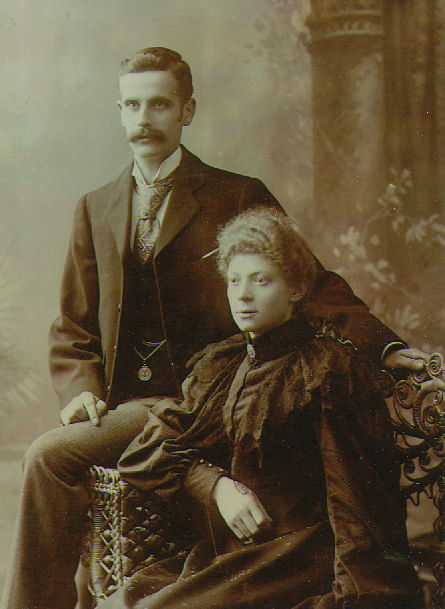
My father, George Jackson Atkinson, a spare, upright, medium height man was born 1875 in Newcastle-on-Tyne, County Northumberland, England, the second of ten children to William Atkinson and Ellen (nee Ainsley), originally of County Durham. One of William's brothers was a choir-boy of famed Durham Cathedral.
The family settled in Newcastle-on-Tyne where William was a clerk - though not a good provider I was told. The eldest boys left school at age 13 to help feed the hungry brood. Dad told how his mother stretched the budget by cooking a big pot of dumplings - of the sustaining suet variety - which were served first, filling enough to leave room for little else.
Dad was an avid reader, acquiring a great store of general knowledge. He became manager of a store - a branch of a big corn chandler business. In those days there was a thriving trade in all kinds of grain, hay, chaff etc for both animals and humans for these were horse and carriage days. It was in the shop that Dad met my Swiss mother (5 years his senior) who was required, from time to time, to drop in orders for the "big house" where she was Ladies Maid to the mistress and any female members of the family.
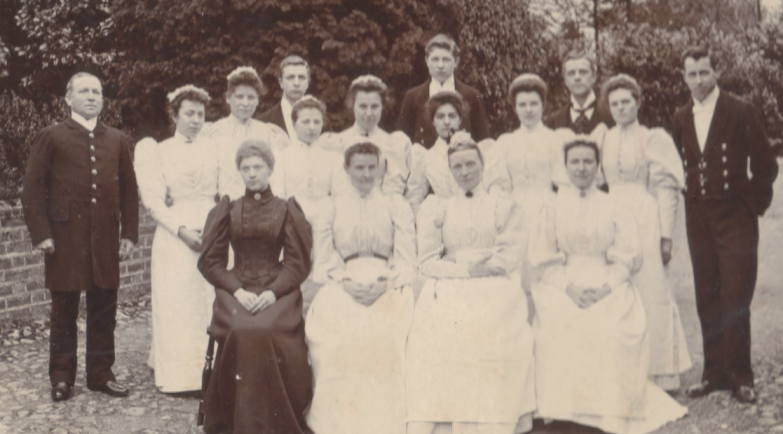
 Handwritten annotation: George Atkinson Manager this shop 1911 |
In spite of long hours - 6 days a week - Dad found time to be a committed member of St Cuthbert's C of E Church, teaching Sunday School at one time. He joined a Harriers club where he won several awards and also served in "Volunteers" - an association similar to our Army Reserve.
Dad was tremendously proud of Mother and her achievements linguistically and as a most creative seamstress and hard working wife and mother. She, who knew only big European cities, was prepared (though unwillingly) to accompany him with their son Bob 14 and three daughters 9, 6 and almost 3 to Australia when he (George) with brothers Tom, Len and Syd and sisters Nelly (Ellen) and Edie migrated in November 1911.
 |
[Tom and Len actually came earlier and Syd later according to cousin Daphne Lowth in Where the People Live]
Len and Syd were bachelors who soon were to enlist in the Australian army for World War 1. Syd eventually married Mary Masterson, aunt of Hazel Hawke. Left behind in England were Will and Louisa. Charlie emigrated to Canada. All émigrés to Australia, except Father, settled in Ajana north of Northampton, taking up recently opened land on the fringe of the wheatbelt.
Dad decided orcharding was for him and, after 3 months on a Bridgetown apple orchard, thought himself proficient enough to manage a 30 acre property - 5 acres of mixed fruit trees and the rest bush, or 'forest' as he called it, at Mundaring. There were two houses on the property.
As a much needed money spinner, holiday seasons saw the whole family move from the 'big house' to the 'little house' while a city family of means occupied the larger house for a few weeks' taste of car-less country wilderness.
Bob quickly found a job in the WA Railways as a clerk. I well remember Dad, stop watch in hand, dictating to Bob as he practised the required shorthand. No women were employed in the railways then and for about another 12 years. Bob travelled 21 miles back and forth by train to Perth.
We girls helped picking fruit, gathering up windfalls and especially picking cape gooseberries in the hot sun. Gooseberries brought the fantastic price of 4 pence (approx 3 cents) per bushel! (approx 36.5 litres) Dad at first trundled his fruit by wheelbarrow 3/4 mile to the station at Mundaring for transport to Metropolitan Markets until he acquired a cart and horse, "Charlie".
Dad and Mother both took jobs as washer-uppers at socials in the Mundaring hall. Dad earned a reputation as a pruner of fruit trees and roses and occasionally took jobs as a ploughman with Charlie while Mother had regular household duties once or twice a week at a couple of rich families' homes. She also did dressmaking with great skill and was adept at recycling grown up dresses into suitable (though not always appreciated by the subsequent wearers) clothes for young girls.
Dad made much of our furniture from butter and kerosene tin boxes, staining the articles with varnish made from blackboy gum dissolved in methylated spirits which yielded a rich red dye. He was skilled also in toy making as was Mother - a very inventive pair. In the early days Dad loved to cook and I remember happy wet weekend days spent before a blazing open wood fire enjoying Dad's Johnny Cakes.
After a few years Dad subdivided his bushland and some orchard into building blocks, bought several old settlers' cottages, dismantled and reassembled them one by one, each on its own block. They were then either rented or sold.
Meanwhile he took a job as general mechanic, engineer and gardener offered by A.C McCallum, a rich coachbuilder and general benefactor of the district. Owner of a stately mansion, a staff of cook and maid as well a general 'hand' besides Dad, and whose car (the first in Mundaring) was chauffeur driven. Mr McCallum himself was haemophiliac, looking rather like Santa Claus with ruddy face and profuse white beard, the latter obligatory as shaving would be dangerous.
We, the family, transferred into a cottage on the McCallum Estate on Great Eastern Highway, then the gravel York Road. Here we soon heard the great news of the Armistice to end World War 1 and would soon welcome home uncles Len and Syd, both of whom remained miraculously unscathed after 3 years in various fields of war.
[The cottage is still standing very close to the highway on the crest of the hill going west from Mundaring township]
I was, as were we all, tremendously fond of my father - always loving, supportive and gentle - a true English gentleman.
| Atkinson family who migrated from Newcastle-on-Tyne | ||
| George (father) | in 1911 | with wife Ida and 4 children |
| Tom | in 1910 | Wife Belle and daughter Dorothy came later |
| Ellen (Nellie) | in 1911 | with husband Allan Rochester and 3 children |
| Edith (Edie) | in 1911 | Married Charles Cornell in Australia |
| Leonard (Len) | in 1910 | with brother Tom. Married Lena Bandy in Australia |
| Sydney (Syd) | after others, came alone | Married Mary Masterson in Australia |
| Charles | went to Toronto, Canada | Married to Kathleen (Kitty) |
| [Edited by John with information from Len's daughter Daphne Lowth, Where the People Live] | ||
| Atkinson family who remained in England | ||
| William | married Polly | daughter Debbie Louisa (Louie) married John Armstrong. Children Ellen and John |
Relations
Alas, I never knew the warmth and loving support of grandparents such as my own children enjoyed. All had died before my birth - my German (Swiss) grandmother alone attaining the age of 70.
My earliest memory of relatives was of visits from Uncles Len and Syd [First generation] in 1915 when on leave from Blackboy Hill army camp in Greenmount. Young single men such as these new farmers still had strong attachments to 'home' and no doubt keenly looked forward to seeing again friends and relatives left behind in England. Meanwhile they relished the warm welcome, home comforts and cooking of our home in 'the forest' and we children clustered round to listen in to the lively exchange between the 3 brothers.
After a few short weeks training, these new 'Aussies' were deemed fit to be shipped overseas to 'fight the foe' - first to Gallipoli where fortunately they were too late to land, then from the searing sands of Egypt to the mud of trenches in France. Miraculously both returned unscathed in 1919.
Early in 1919 I was invited to stay at the home of Mary Masterson where she kept house for her widower father and brothers. Mary was engaged to Uncle Syd [Second generation - Syd and Mary] and before his return she and a few friends took me to Fremantle to swell the crowd welcoming home a troop ship. It was evident as the ship drew slowly into port that many wounded men as well as the fit crowded the ship's rail. I remember being distressed to see many shaking uncontrollably from the effects of shell shock.
During this visit Mary's brother Jim brought home his fiancé Edith Clark (later to become the mother of Hazel Hawke, wife of PM Bob Hawke). Jim and Edith often visited us by the 11 am Sunday morning train for mid-day dinner and afternoon tennis at our now York Road address. In due course baby daughters Edith and Hazel accompanied them.
After the war Uncles Len and Syd returned to Ajana. Len shared farm work with brother Tom and wife Belle - a clever, knowledgeable, forthright woman [Second generation - Tom and Bella]. Syd joined brother-in-law Alan Rochester and sister Nellie [Second generation - Nellie and Allan]. Nellie later opened a little shop on the N.W. Highway at Galena, site of the Galena lead mine near the Murchison River.
Aunt Edie married an established farmer, Charles Cornell [Second generation - Edith and Charles]. Their eldest son, Ted, was destined to slave on the Burma Road as prisoner of war during World War ll. It was said he kept himself and many others relatively healthy on 'Bush Tucker' which, being a resourceful lad of the land, he was skilled at finding.
When I was 12, I was taken to visit the clan at Ajana, staying first with Tom and Belle in their modest pioneer hessian lined (white washed) cottage, which never-the-less housed a piano and the young single girl teacher sent on her first appointment to the one teacher school - her charges from 5 -14 years!
In 1957 I visited, with my husband, cousins in Switzerland -
[* Ed: Or is this the sister of Elise (wife of Ida's brother Ernst?)]
Bertha and Emile (childless); Greti (Marguerita) Rindlisbacher - son Hansuli;
Paul Steiner (wife - Martha) - son Peter; Ernst Steiner;
Alice and Manny (Herman) Eiraiser (childless); Hortense Forster (single),
Maria* (in Biel), sister-in-law of Mother's brother John (wife Rosa).
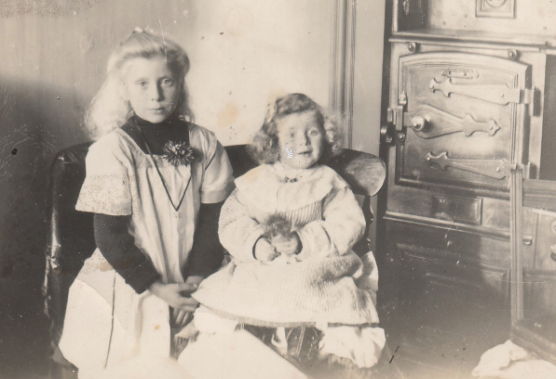 |
I was born at home in a semi-detached cottage at Walker Gate, a suburb of Newcastle-upon-Tyne, Northumberland, England ('Geordie' country) on 22 January 1909, the fourth child of George and Ida Atkinson: brother Bob, 10, sisters Eda, 6, and Marie, 3. A snowstorm raged outside at the time, I've been told, it being mid winter - no time for battling storks with bundles.
First Memories
My first memory (and only one of England) - Age 2½
The little yellow duck had cost a whole precious penny at the Penny Arcade where nothing cost more than this considerable sum. Miscellaneous household items, toys, trinkets, etc priced from 1 farthing to 1 penny were displayed for customers' choice. I had circled the small tables in an agony of indecision urged on by an impatient sister who 'minded' me. Now, a long, dark, high wall frowned down upon me as, running to catch up, I bore my treasure home, impatient to sail the buoyant little duck in the bathtub before the fire.
I am glad to report my first memory was a happy one as I grew up a shy, rather fearful child. How does one explain to a 2 year old the reason for being uprooted from the security of a warm home, lured on to a pitching ship for 5 weeks of the miseries of seasickness, hot, airless migrants' lower deck cabin - unable to share the excited anticipation of my older sisters and brother. Bob's diary said it all: 'Lily howling again!'
My next clear memory, colourful and scary, was of going ashore at Colombo; pausing at a shop; in the doorway a tall basket of golden oranges; the shopkeeper's black face beneath a snowy turban; white teeth gleaming as a black hand extended a pink lolly stick to a cringing little girl hiding in terror behind the orange basket, refusing the gift. After-all, faces were never black, were they?
The fright of this experience was re-inforced 3 months later when my father exclaimed 'look at all the blackboys'. Hundreds of them; rough black bodies; streaming, sun-bleached wild hair; spears uplifted as they marched down the Greenmount Hill to snatch me from the train which was moving so slowly up the rise carrying our family for the first time to Mundaring and 'our selection' - 7 acres of orchard and 23 acres of 'forest' as Dad called the bush. Fright turned to fascination when I learned those savage blackboys were firmly rooted - some centuries earlier - growth rate said to be 1 inch in 10 years!
Scene: Shopping centre within walking distance of our home.
Year: 1911, a momentous year for the Atkinson family when 18 members of the clan emigrated to Australia by P and O Liner 'Osterley'.

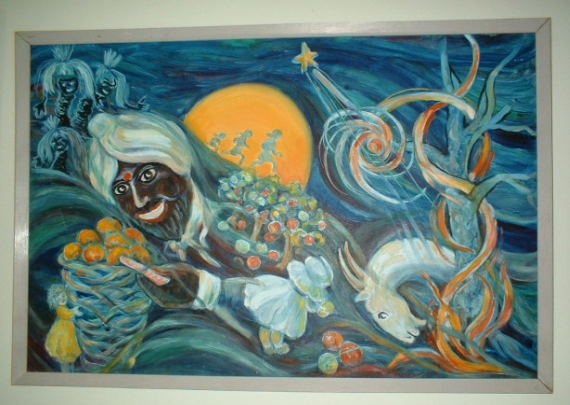
Painting of earliest memories
  |
Living room with open fireplace. Above hung the trio of Swiss ceramic plates, one large, 2 smaller; each with a painted centre of a Swiss scene surrounded by a deep stylised pattern of 3 Swiss national flowers - Edelweiss, Gentian and Alpine Rose - raised in coloured enamels. Two small matching vases stood on the mantelpiece below.
The warm kitchen - the black-leaded wood stove with its wide hobs, where perhaps a corked bottle of hops and potato yeast quietly worked its way to readiness for Dad's yeast buns. More than once it enjoyed a joke, popping its cork and smothering hob and stove with a gush of pungent, gooey bubbles. Here, too, the heavy black enamelled iron stockpot simmered and a brace of flat irons heated alternately on ironing day.
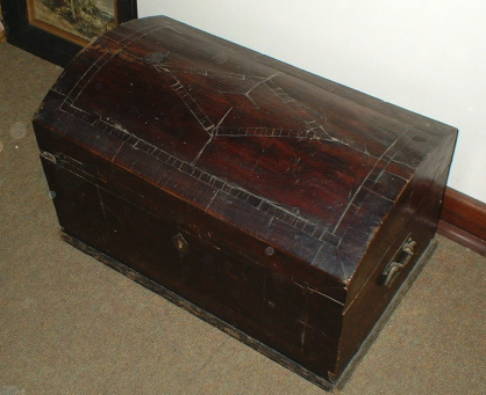
Favourite 'furniture' of us girls were the 2 'black boxes', one very big, one much smaller. These were domed wooden travelling trunks which accompanied the family from England to the new land and which now contained entrancing treasures of nostalgia; a couple of elegant Edwardian gowns of mother's, unsuited now to life in the bush.
A beautiful big, boxed French fan with carved ends of cane. Of fragile silk patterned in brown and gold butterflies and dusted with tiny spangles, the fan head had been given to mother by one of her aristocratic 'ladies' and spoke of the décolletage, rustling silks, bustles and ostrich feathers.
There was a big cameo and other brooches, a silver watch chain with pendant hearts and a number of medals and small trophies won by Father during his Harrier days in Newcastle.
Behind the house, in the garden
Hollyhocks stood tall in the front garden - in season the fragrance of stocks, wallflowers and mignonette delighted 'new chums' lonely for soft scents of home.
A shapely juniper tree grew in the centre of a circular space. I would sit in its shade marvelling at the perfect tiny sandy circles which regularly appeared in the early morning. I was convinced these were fairy rings where little people danced at midnight. Not until I was grown up did I learn that a nasty little black insect - an ant lion - had patiently fashioned each one and lurked just beneath the surface ready to grab the hapless ant which slithered down the sandy slope to his doom.
My favourite spot, however, was inside the enormous orange flowered Buddleia tree which occupied a corner of the yard opposite the kitchen. My father had pruned away the branches until a spacious room was fashioned around the trunk, the drooping branches sweeping right down to the ground. Dad had furnished it with table and low stools. Squirming through the low-cut doorway my sister Marie and I spent long hours playing games, cutting out, reading. An enormous rag doll (Fatty) was my companion. Butterflies may flutter and bees buzz without, but beneath was cosy and cool - even the rain hardly penetrated.
Out-door delights
Hens nesting free range emerging proudly clucking and scratching for fluffy chicks;
In parkland, bushland and quarries
We quickly grew to love the bush, wandering for miles - visiting a shaded pool (Kookaroo) across Gill St where those fortunate to have learned to swim made a joyful noise shouting and splashing. We were content to follow streams - no need to remove shoes (we didn't wear any) paddling long distances, collecting tadpoles, catching gilgies. Mostly we marvelled at the wealth of wildflowers - picking as we fancied (no ban then) and delighting in spotting a great variety of orchids.
A favourite playground was 'The Rocks', a vast outcrop of flattish granite mounds, each surrounded by a fascinating 'garden' of wildflowers. Many species grew only around granite outcrops - a special, was a delicate flannel flower resembling the Swiss Edelweiss which grew only in one spot, accompanied by rock fern where the stream overflowed its banks - a mossy, spongy spot starred by those delicate beauties.
Years later our granite playground in the bush became a lucrative quarry of high class stone; the best in the State it was said. [Ed: Mucciarone brothers' quarry, Coppin Road]
Twenty three acres of private virgin forest was ours for the roaming, although this was gradually reduced as my father bought small settlers' cottages, demolished and re-erected them for renting or sale.
We played 'houses' on great jarrah logs or outlined the rooms of a 'house' with small matched stones on cleared spaces. One of the latter, visited years later, was still traceable.
Our street
Gill St, nothing more than a cart track really, was our 'street', although a steep climb the long length of the orchard stretched between road and house.
My earliest memory of life on the orchard was of helping my sisters gather windfall apples into kerosene tins. Apple trees grew right down the slopes to Gill Street which was the end of the world to me. Blue sunbonnets shielded our English complexions, but I well remember the weight of our burdens as we toiled uphill and the heat on bare feet. The low land at the bottom was moist even in summer and vegetables thrived. A gorgeous grove of Christmas trees blazed their orange trusses nearby - a truly festive sight looked forward to each year.
The other exit was a track alongside a post and wire fence, a few hundred yards long, leading on to York Road (now Great Eastern Highway), then a gravel road between towering Gum and Jarrah trees. In winter crystal streams sparkled alongside, tempting school children to lie on their tummies and drink - no traffic worries then. An occasional horse and cart might trundle by or maybe the Baptist minister stationed at Mundaring in his pony drawn trap with its tall yellow hood.
Drawing was an absorbing interest from earliest days. When I was about eight I drew in oily crayons small pictures on every smooth-sided post down our track - a flower, cup and saucer, star, tree, house, doll, wheel-barrow, etc. Many of these weathered for four or five years.
Our neighbours
No gossip over the fence for us - our nearest neighbours were out of sight.
Poultry farming family Wood lived in a children-crowded house facing Coppin Road. Their girls, with Marie and me roamed the rocks, bushland and as far afield as Stoneville and Parkerville. Mother Wood seemed frequently to send a child to borrow a cup of sugar, oatmeal or whatever. I have clear memories of seeing my mother stretch to reach the required container from above the stove mantel-piece.
When Dad sold his first ½ acre of orchard and bush on Gill St, the Ockerby family erected what seemed to me a mansion, but which now would be considered a humble asbestos bungalow. These were town business folk on a quest for health for the wife's single sister who suffered from T.B. Hills air was the extent of treatment for tuberculosis then. There was an only child, a girl, older than I, who attended a private school near Perth. I was too shy to accept an invitation to 'play'.
Later at the York Rd Cottage supplied by A.C. McCallum for Father and family, our nearest neighbours lived across the road. The Knieps consisted of a highly eccentric public servant father, much younger attractive wife and 3 children (boy and twin girls). While father's firm hand held the purse-strings his head was lost in a cloud of classical music (via extensive gramophone records) and poetry readings with a select group of town friends. Father did all shopping, including one bolt of dark serge material with which to clothe his wife and kids. His manually unskilled wife fled, bolt and all across to mother for her help with cutting and sewing. Indeed mother was Mrs Kniep's sole contact and confidante, her cup of tea in our warm kitchen a frequent consolation.
Other neighbours were the Sagars, a lovely Jewish family. Father, a chemist, provided his daughters with bicycles (the only ones in the district I believe). Barbara, my age, also owned a baby size celluloid doll costing one guinea - a never to be afforded treasure for such as I.
Our town
Mundaring: 20 miles from Perth; 5 miles (8 km) from Mundaring Weir - source of water for Kalgoorlie;
Our home approx. ¾ mile (1.2 km) from centre of township.
Mundaring township in 1912 consisted of a small Agricultural Hall, one general store owned by Jim Wells, a tiny Post Office, a butcher's shop, a milk vendor, a bakery, a boarding house, a two room weatherboard school (about 120 pupils, 2 teachers) with headmaster's cottage, a stone Anglican Church with vicarage, a big corrugated iron (painted red) Baptist church, a Roads Board (pre shire) office, a Police Station and Railway Station with station master's dwelling.
Townships in those days clustered around the railways. Trains (passenger) ran weekdays to Perth from Sawyers Valley at 7.30 am, 10 am and 3 pm. On Wednesdays and Saturdays a train extended its run from Mundaring to Mundaring Weir. Trains from Perth arrived at 10 am, 3 pm and 6.30 pm.
Goods trains catered for orchardists' produce, gravel and timber, poultry and eggs. Milk and meat were brought to the door by horse and trap via gravel roads.
The population consisted largely of gravel carters, timber cutters, orchardists and poultry farmers and some commuters by train to and fro (week days and Saturday morning) to Perth business houses. There was a fair sprinkling of wealthy people in roomy houses and several prominent public servants owning week-end and holiday homes.
On the Weir Road a vineyard owned by Bodinner (the milk vendor) flourished. Milk was produced by Bodinner's own dairy herd. High class granite for buildings and tomb-stones and iron stone for buildings were also procured in the outskirts of Mundaring.
Shops
Two general stores, first J Wells in Jacoby St. and later Millar's in Nicoll St.
Early pleasant memory of Jim Wells' store was of the sweets counter where one could buy for 1 penny a choice of a great variety of colourful sweets scooped and weighed from his big glass jars. Best of all however were times when 1 penny 'prize packets' made their appearance. These were small bags containing a few sweets and a trinket similar to those wrapped in more expensive Christmas bon-bons, though of a pre-plastic era.
The 'West Australian' was available here daily among all manner of hardware, software, groceries, butter and bacon cut to size required.
Jim Wells was considered one of the most affluent of citizens; his motor car, I think, the second in the district after A. C. McCallum's. From this store east, past the district Agricultural Hall, across the street to Jacoby's hotel, then half way to the tiny P.O. there stood Sherrington's butchers shop.
The P.O. was a cramped box like affair with small living quarters at the rear. Mrs Parsons, wearing black in mourning for her husband, a victim of 1914 war, presided behind the tiny counter. Here she lived with her daughter Elsie, an only child, who was held in awe by most of us girls. She wore shoes and each day appeared with fat bobbing Shirley Temple curls, the result of mother's nightly wetting of each strand, rolling in paper and pinning. I wonder if the discomfort was really worth the enviable result.
In autumn we loved to shuffle with our bare feet through the fallen leafy carpet shed by the avenue of Plane trees each year from the hotel to the P.O. where after school we collected the mail; maybe a letter from England or Switzerland out of date now after its 5 or 6 weeks sea journey. One of mother's relatives would address her - 'Frau I. Atkinson-Steiner'- in the German-Swiss manner. This was highly suspect when we were at war with Germany in 1914 -18 and mother was questioned regarding her nationality. She had to ask her relatives not to so address her in future.
Traders: Milk was delivered daily from Bodinner's Weir Rd. dairy by horse and trap. Fresh milk was ladled from big cans into our own containers - usually a 'billy-can' reserved for the purpose.
Later Painters' butchery provided twice a week 'cutting cart' of meat. One ordered the size of joint required and it was cut and delivered at the door.
In the late 1920s, depression closing in, all manner of jobless men did a round on foot after taking the train to a chosen station. They may have offered wire toasting forks, coat hangers - perhaps sharpen knives and scissors - anything to avoid the dole.
One man carried on, over many years, a regular commercial travellers' one man business. He would arrive by bicycle, large suit-case on the carrier. Treasures revealed on opening this case would charm a magician - everything from pills and potions to cure all ills to colourful fripperies to delight feminine eyes. Only encroaching illness and age forced retirement on this tough character.
Rides on back of Charlie the horse and in the spring cart on trips to Mundaring station with fruit;
5 November Bonfire Night when Bob brought home from Perth a brown paper bag with its magical contents of Catherine wheels, rocket, jumping jack, crackers etc;
Two goats and frisky kids. Must admit to being scared of the rough and tumble of kids charging for fearful me.
Facing York Rd, well back in bushland, stood a little one man cottage where lived an elderly ex-miner from Kalgoorlie, Irishman Jack Eigan. He used to visit and yarn with Dad. I kept out of sight, visitors being uncommon and I being extremely shy.

The Cottage painted before age 20
Same Cottage photographed March 2004
[Atkinson Family Centenary] [First generation] [Second gen - George and Ida]
A Life Album: [Preface and contents] [Part 2] [Part 3]