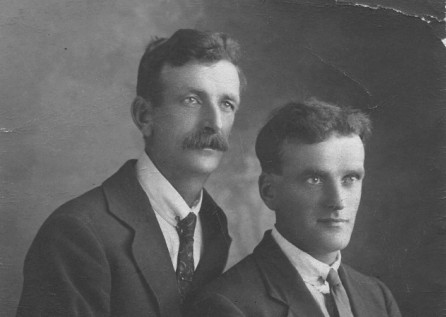
Tom and Len, 1920
Where the people live
Daphne Lowth
| It used to be a tiring, fifty-two kilometre trip to and from the town of Northampton. The road between was little more than a sand track and very corrugated. The old T-model Ford rattled and bounced along taking one and a half hours each way. As the first farmhouse at Ajana came into view over a rise and his own property was in sight, a big smile would sweep over our dad's face and he would say |
| This is where the people live |
| Years later, when he drove a new Holden car, when the road was bitumen, when he came over that rise, he still used to say, "This is where the people live". I am quite sure that he spoke from his heart. He thought all the people of Ajana were a very special breed. Here lived his friends and relatives and they all loved their paradise. It was home sweet home. |
Chapter One - The Beginnings
My dad was Leonard Hugh Atkinson. His parents were William Dobinson Atkinson and Ellen Atkinson (nee Ainsley). They were married in November 1872 and by 1895 had ten children.
My dad, Len, was the seventh child and born in Newcastle-upon-Tyne on the fifth of November 1889, which was Guy Fawkes Day. When Len started night shift as a telegraph clerk in his early teens, he had only spent four years at school.
By 1910, Len and his brother Tom, who was twelve years older, had decided to try their fortune in Australia where they believed they could make a better life if they could become farmers. Tom was then working for Stewart's Tea Company in Newcastle-upon-Tyne. He and his wife Isabella had a daughter Dorothy, who was only four years old.
Because of Dorothy's tender age, it was decided that Tom and Len would go alone to Australia. Isabella and Dorothy would follow as soon as the brothers were settled in the new land.
Tom and Dad left England on the "SCHARNHORST" and arrived in Fremantle on September 11th 1910.
They caught the steam train to Perth and took a walk down Hay Street in the city centre. A complete stranger tapped Tom on the shoulder and then asked where they had come from and whether they had a job to go to. They told him that they intended to work on farms and then buy one of their own.
After introducing himself as Ed Houghton, he explained that he was going north to take up land at Ajana where he intended to grow wheat and raise sheep. He then asked them to work for him.
The two brothers agreed to go, thinking they were lucky to find work so quickly as they only had six shillings (60 cents) in their pockets.
From Perth to Ajana was 380 miles (610 km). The brothers boarded the train with Mr Houghton, two other settlers and their horses, along with all their supplies. The supplies included drays, fencing wire, axes, mattocks and hammers, as well as nails and sawn timber to build a humpy.
The horses were taken off the train at Geraldton, fed and watered, and then put back on again for the trip to Northampton, at that time the terminus of the railway line. From Northampton there was still thirty three miles (or 53 km) to travel along the stock route to reach Ajana. Mr Houghton had a wagon and six horses and also hired a man with two wagons to help carry all the equipment.
They were three days and nights on the stock route and finally camped alongside Barrel Well at Ajana. The mouth of this well, which had been dug and reinforced with stones by convicts, was as round as a barrel, hence its name. Convicts also prepared the stock route they travelled, on which the sandy parts were paved with cobblestone.
At that time, what is now Ajana was part of Mount View Station, so some wells had already been dug to water the sheep. Houghton's block was at the southern boundary of Mount View Station, so they followed the survey line from Barrel Well for about four miles (6.5 km) to reach the block.
Beside a well that held good drinking water, Ed. Houghton built his humpy with the sawn timber and other materials that had been brought from Perth. It looked quite smart with its corrugated iron roof. However the walls were made of hessian tacked to the frame because the local timbers such as Sheoak and Jamtree were only fit for bough sheds, fences and sheep yards. Later, a better house with weatherboard walls was built and it was then that Ed Houghton's wife was able to join him.
To get stores and equipment, Ed Houghton used to drive his dray and horses the thirty-three miles into Northampton. This would take three days, the first to get to Northampton, the second to shop for supplies and the third to return to the farm.
On November 5th, 1910, my dad turned 21. To celebrate, Ed Houghton brought a bottle of wine to the tent that was to be my dad's home for twelve months. Dad and his brother Tom never went into Northampton during the first two years they were in the Ajana district.
In January 1911, the two brothers took up two thousand acres (810 ha) to start their own farm. They built a dwelling alongside two hills and sank a well. As Newcastle-upon-Tyne was the place they came from, they gave the farm the name of "TYNEDALE".
In 1912, Tom's wife Belle and daughter Dorothy came out from Newcastle-upon-Tyne to join the brothers. Dad stayed with them but they soon realised that their limited capital made it necessary for one brother to find other work.
Tom worked the farm and dad first worked clearing land for roads around Ajana, Binnu, Galena and Mount View. He then took another job clearing firebreaks, starting nine miles (14.5 km) east of Ajana and continuing to the coast about forty miles (64 km) to the west along the Number Three Rabbit Proof Fence. This work lasted twelve months.

During 1911 and 1912 other members of the Atkinson family came to Australia:
Syd Atkinson first worked on Rochester's farm and later married Mary Masterson. On the boundary of Tynedale farm they then obtained 2.5 acres (1 ha) in the Ajana townsite. Here they opened a fuel agency to supply local farmers, mainly with kerosene and petrol in four gallon tins. Syd used to collect the empty tins, cut them open, flatten them and solder the flat sections together.
When Syd and Mary finally built the home, exterior walls were clad with the flat, soldered sections that Syd had made from the empty tins. The house had a strong timber frame, an iron roof and interior walls of hessian. Some of the floors were pine boards made from the packing cases in which the fuel tins came. Besides the fuel agency, Uncle Syd and Aunty Mary also ran a poultry business.

As early as 1849, mining had been going on around the Ajana region. By 1912, mineral prospecting had established further extensive reserves of lead and copper at Galena on the Murchison River about twelve miles (19 km) north of Ajana. As a result of this and also to service the newly developed farms, the railway line was extended from Northampton to Ajana and opened in 1913.
In 1913, the first Ajana School was built. Until this time there had not been any real entertainment in the new community. A tennis club was soon formed. To build the courts, dirt was scraped from a patch of land near the Rabbit Proof Fence on Ruffin's farm. After the Second World War new courts were built at their present site alongside the latest Ajana Hall.
On July the seventh 1914, Harry Leonard Atkinson was born to dad's brother Tom and Belle. Because there was no midwife available Tom and Belle delivered the baby on their own. The first time dad touched the new-born's fingers he called him Bill and, since then, Harry Leonard has been known as Bill Atkinson.
Not long after Bill's birth, dad found a job cutting firewood around Mundaring where he stayed with his brother George.
When World War 1 started soon after, he became the first Ajana man to enlist. He trained at Blackboy Hill with a transport unit but later transferred to the Sixteenth Infantry Battalion.

Dad was sent to Egypt with the Battalion and from there sailed with the horses and transport gear to Gallipoli. He told us the horses could not be landed on the Gallipoli beaches so he and his mate tossed a penny to see who stayed on board. Dad stayed and saw his mate shot dead while he was still in the little boat heading for the beach.
Pat once asked dad how he kept the horses quiet with all the gunfire noise. He replied, "I used to sing to them." Much later the horses were landed at The Nek in the Dardanelles.

Following the Gallipoli campaign, the Sixteenth Battalion moved to The Western Front in France. While at the Western Front dad was wounded twice. The first time, in 1917, he soldiered on. The second time, in 1918, he put his head up above the trench and was wounded in the neck. As a result he was sent to England to recuperate. While on leave he was able to stay with his sister Louisa and her family. This was the only time that dad ever went back to England.
After serving four years in the army, dad returned to Ajana. He found that while he was away a ball had been held in 1916 to open the first Ajana Hall.
 |  |
| Ajana Hall opening, 26 December 1916: Ball program | |
After World War 1 social life in the region increased markedly. The districts of Ajana, Binnu, Galena, Hutt and Ogilvie regularly held tennis tournaments. People from each district took turns at holding dances. This often meant dances in consecutive weeks. Because horse and buggy transport was so slow, dancing usually went on all night and the dancers made early morning tea and then went home at first light.
Married couples took their families with them to any social event. The children usually slept on a rug on the hall stage or under the hall seats or, in summer, out in the buggies. Dad told us how once a horse broke the tether rope and wandered six miles (10km) down the road towards its stable with the children still sound asleep and none the wiser.
After his return from World War I dad once again lived with Tom and Belle. He and Tom took up another two thousand acres (810 hectares) on the eastern side of the Tynedale hills. Here Tom built a three-bedroom house and their own tennis court where they played very often.
My mum, Eleanor Elizabeth Bandy, was born on the 24th of March 1896. All through her life she was called Lena. Her parents were Joseph and Elizabeth Bandy.
Joseph was a keen horseman who, in 1883, at the age of 28 left Perth and came to Northampton looking for suitable farming land. With the help of a couple of drovers and some Aboriginal stockmen, Joseph managed to round up some wild cattle in the Murchison River area and sell them at the Northampton Saleyards. With the money from the sale he purchased farming land eight kilometres north of Northampton where he called his farm "Alma".
When Joseph married Elizabeth Williams in 1887, they moved into a house on the farm. It was in this farmhouse that each of their eight children was born. A new school was opened at Alma in 1905 when my mum was nine. As a result she had only three years at school but this was not uncommon in rural areas in those days.
During mum's early teenage years her dad and elder brother Herbert each bought land along the Hutt River. The properties had a common boundary and, about 1910, the whole family moved from "Alma" to Hutt. It was here that mum spent many happy years with her brothers and sisters. Each one rode horses or drove horse and buggy combinations and so was able to get around the district enjoying the company of others. The Bandy family was very close knit and mum often told us of pleasant evenings spent in the backyard dancing with friends to the sound of gramophone music.
Even after members of the family married and took up their own farming properties they settled close-by. Herbie, who married George Atkinson's daughter Marie, stayed on the Hutt property as did Tom, who married Dorothy Day, and Charlie, who married Edna Seymour. Mum's younger sister Grace, who was called May, married William Wight, a farmer at nearby West Binnu. Her older sister Margaret, who was called Maggie, remained a spinster and moved to Northampton with Joseph and Elizabeth when they retired from the farm.

Prior to her marriage, mum worked at Mount View Station for Mrs Bert Mitchell, in Northampton for Mrs Arthur Mitchell and in Geraldton for Doctor Boyd.
When dad married mum in 1924 there were no churches in the district so the ceremony took place in the Hutt Hall. They were quite a handsome couple. Mum was five feet one inch tall, weighed eight stone four pounds, and had thick lustrous black curly hair and very dark-brown eyes. Dad was tall and thin, with black curly hair and blue eyes. I treasure their wedding portrait very much

For their honeymoon they travelled by train to Perth. At the age of twenty eight this was my mother's first trip to the capital city. When they returned from their honeymoon, there were now three Mr and Mrs Atkinson living at Ajana, so the locals decided not to use the Atkinson name but to refer to them as Mr and Mrs Len, Mr and Mrs Tom or Mr and Mrs Syd.
When they were first married, mum and dad boasted that they had the best house in the Ajana district. The materials came from houses built by Mr Mundy and Mr Houghton who, by this time, had sold his farm to a Mr Lee. Mr Lee leased the property to Tom and dad, who hoped eventually to buy the property. Unfortunately that farm was sold to Mr Ruffin in 1940 so, happily, mum's wish to have their house built near the well on Mr Lee's property had never been realised.

The house was built of weatherboard and galvanised corrugated iron. There were verandahs at the back and front, two bedrooms, a kitchen and a sitting-dining room. As well as tables and chairs, they had four cane chairs and a padded sofa as well as bedroom furniture. The ceilings were unlined but the walls were lined with hessian, which is a material made from jute and hemp. Lime and cement were mixed with water and painted on the hessian walls. When dried the mixture became stiff and white and called whitewash. Some years later a product called kalsomine was used and came in many colours.
I was born in Geraldton in Western Australia on the 21st of April 1928 and christened Daphne. My sister, Patricia Margaret, had been born two years earlier on New Year's Day 1926.
My memories go as far back as 1932, when I was four. Mum had gone to hospital in Northampton, and Pat and I were staying with our Aunt May and Uncle Billy Wight on their farm at West Binnu. They had three children. Dorothy, then aged seven, had started school in Northampton and boarded with our grandparents, Liz and Joseph Bandy. Laurie was six and Ted was five. We were playing at catching tadpoles in the creek with Laurie and Ted when Laurie shouted, "There's a camel coming! Its coming to get you!" We ran back to the house in tears and Aunt May comforted us. She told us it was not a camel but was Uncle Billy bringing home a bag of wheat on his back for the chickens. That was my first big fright.
When we were taken home to Ajana in Uncle Billy's horse and sulky, we found Mum had arrived home by train with a little baby boy. I sat on the floor and nursed my new brother. Charles Hugh, who was born on the 10th of June 1932. Shortly after this event, the Wight family left the farm and moved into the town of Northampton where Pat, at the age of seven, boarded with them to attend school. In those days every one started school at the age of seven. I remember how well she learned to speak. Posh was how Mum described it. Pat would recite "The little brown cow went around and around and around".
All parents can tell tales about their children as toddlers and when repeated many times we don't forget. When aged two Pat one day sat on the toilet and was bitten by a red-back spider. Mum called Aunt Mary who had some knowledge of nursing. By evening Pat became feverish, so they decided to take her in the old Ford truck to Northampton hospital. Half way there she seemed better, sat up and asked, "Where am I going?" So they turned back and went home. It would have taken them nearly two hours to go to town. In the early hours of the morning Pat got worse, so again Aunt Mary went with them to the doctor for treatment.
As a toddler I was called "lazy-bones". I always had to be carried by dad because I had a "weg-ache" and I did not want to walk anywhere.
The wife of the Methodist Minister, Mrs Trenamen, took us for Sunday School lessons during the church services. She sat us all on the back of the truck outside the hall and once asked if any one of us could sing little hymns. I said I knew lots and lots of little hymns and then sang every nursery rhyme I knew. She could not stop me. I was only three and a half years old! When Pat was a toddler she once found a 'daddy long legs' spider on a wall and wanted to "cut his legs off with the scissors."
Charlie did not crawl on his hands and knees. Instead, while in a sitting position, he put his hands flat on the ground in front and pulled his right leg under himself and moved along that way. He wore out lots of pants in the dirt yard. He also insisted on keeping his dummy until he was three years old. One day dad told him, "Throw it away to the chooks." Charlie raced up to the fowl yard and threw the dummy in among the chooks. As he could not find it later on, that was the end of the dummy.
Charlie's birth in 1932 coincided with the depression. Mum said she could not afford to pay the ten-dollar doctor's fee and so the Matron was the midwife. However when the ladies of the hospital auxiliary offered her baby's clothes, mum was too proud to accept their offer.
During the depression, the mortgage on the farm was heavy. The Stock and Station Agents, Elder Smith & Co., held the mortgage and in 1932 allocated only sixty pounds ($120.00) for the family to live on for the year.
By the end of 1934 dad and his brother Tom realised that Tynedale Farm would not be able to support two families. In a quiet and earnest conversation, Tom said, "I will go Len. You have young children to consider."
The children of Tom and Belle had grown up and had left the farm. Bill and Phyllis were away working. Tom's other daughter Dorothy had married Tom O'Halloran and they, with their six year old daughter Peggy, were now living in Geraldton. And so papers were drawn up to dissolve the twenty-three year old partnership and dad and mum were left to work the farm.
Tom and Belle walked off their farm with very little. In Geraldton they took over a boarding house which had rooms to let and allowed use of the kitchen and dining room. Unfortunately Tom developed heart problems and became restricted to light duties, while Belle cleaned the premises of a dentist and The Sailors' Club to earn extra money.
For about a year after Tom and Belle left, Father let their house to Joe Willis and his family. Joe was employed by the Agriculture Department to repair the rabbit proof fence. When the Willis family left, Dad and Uncle Syd pulled the house down and re-erected it as an extension of our farm house. This meant we now had two more bedrooms, a verandah facing west and a large area called a vestibule the end of which was closed in to make a bathroom. Mum bought a brand new, full size bath-tub but we still had to heat bath water on the stove or in the copper and carry it in a bucket to the bathtub. Cold water also had to be carried in.
The two new bedrooms were lined with hessian and whitewashed, however there was no ceiling. You could lie in bed and look up at the corrugated iron roof, which was very draughty, and, when it rained, was very noisy as the raindrops rattled on the roof. Some years later ceilings made of sisalkraft were put in. These and the hessian walls were painted over many times and looked just like plaster walls and ceilings.
