
Sandalwood loaded on railway waggons
Where the people live
Daphne Lowth
Chapter Six - The Thirties and Forties
The nineteen thirties were also the years of the Great Depression and during that time a great number of men had to leave their families to search for work. They carried a billy can for making tea, a water bag, a small bag of food and a change of clothes rolled up in a blanket known as a bluey. Nationwide these men tramped from job to job.
Known as tramps or swagmen, they asked for work and if there was no money to pay them for the odd jobs they did then they were happy to accept food and drink to get them to the next job. Mum was afraid of these men so she packed bread, meat and tea to give them and told them there was no work on our farm so that they were quickly on their way.
During the summer of 1938 a man with a big beard walked up to the house. He was not a young man and when he said he was walking sixty kilometres across that dreadful track to get work at Murchison House Station, dad tried to stop him. At that time Murchison House had no telephone and so they could not be told to look out for him if he did not arrive within a reasonable time. Some time passed before it became known that he had not arrived at Murchison House Station. The police took along an Aboriginal tracker but by the time the man's body was found he had been dead for several days. He was buried on the spot because it was not possible to tell who he was or where he came from.
Gypsies were another group of people who wandered along the main roads. Their covered, decorated carts were drawn by two horses and they usually had riding ponies tied to the back. They often camped at Croton Well and went around the farms selling their goods. They dressed in typical Romany costumes and had very dark skin.
Mum bought a pretty square of silk cloth from the gypsies and draped it over the cabinet wireless. She loved that little cloth with a fringe around it. She did not have many pretty things and was very upset one day when it slipped off the wireless and the acid from the battery burned a hole in it.
During the Thirties and early Forties Northampton did not have a chemist, the nearest being in Geraldton about a hundred kilometres away from our Ajana farm. If you visited the doctor in Northampton, he gave you medicine from his own dispensary. However, for many years representatives of a company called RAWLEYS travelled the outback selling many different types of medication and toiletries. There was eucalyptus oil which was taken "three drops on a teaspoon of sugar" to cure coughs and colds; there was Vicks Vaporub to rub on to clear the nose, the chest or relieve a sore throat; there was Zambuc Ointment for aches and pains , curing anything from a sore toe to a broken heart; and there were Doans Liver Pills to sort out the kidneys and Beechams Pills to sort out the bowels. Rawleys also sold scented soaps, lotions and make-up.
Also a favourite with the farming community were WATKINS PRODUCTS. Mum used to buy their lemon lotion, talcum powder and face powder to keep her skin nice, using them with Ponds Face Cream. Watkins were very versatile, providing medications not only for people but also for animals. For example, poultry often suffered a complaint called 'roup' which made their cackles sound like children with croup. For this, Watkins Roup Powder was just the thing. Last but not least, I must mention Buckley's Canadiol Mixture that apparently no cough or cold could withstand
Mother's brother, Tom Bandy, had four daughters. The eldest daughter Shirley was born the day before Pat and Betty was born the same year as me. Pat and I used to take turns to stay at the farm of Aunty Dot and Uncle Tommy at Hutt while Shirley and Betty used to stay on our farm during school holidays. Betty and I used to love catching tadpoles and frogs that we kept in jars of water. However we were puzzled at how they used to disappear from these jars. Eventually we found out that my dad was the culprit.
Another of mum's brothers, Uncle Herbie, Aunty Marie and their four children lived next door to Uncle Tom and many times both families came to visit together. All of us loved to see the Bandy's old blue farm truck coming up the hill to our place.
About two hundred metres from our farmhouse was a rocky granite outcrop about five metres long and two metres high. We called it "The Big Rock Candy Mountain" after a song we used to play on our gramophone. We built a cubby house beside it using tree branches and furnished it with boxes for a table and chairs. Year after year we rebuilt that cubby house and played for hours on The Great Rock Candy Mountain. We had no idea what a mountain was. As we grew older, we were allowed to light a fire at our cubby house in order to boil the billy to make a cup of tea. I had a small china tea set for playing house and often mum would come for a cup of tea and bring some freshly cooked cakes for us to eat.
Uncle Syd and dad had a small hand held rope-maker and somehow they used to take a ball of binder twine, hook it on to five hooks on this gadget, turn the handle and make great lengths of rope. From this rope they made harness and reins and, best of all, swings for us to play on. They also made little wheelbarrows and billy carts for us to play with. For fun we sometimes harnessed lizards to match boxes filled with sand and made them race.
At other times we would play for hours riding stick horses which consisted of a long tree-branch with the leaves for a tail and string for reins. I must have been fourteen before I was able to ride a real horse. This came about because before mum was married she witnessed an awful riding accident. Her brother's girl friend was killed when her foot caught in a stirrup and she was dragged for a long distance. After this experience mum never rode a horse again and when we were young would never allow us to learn to ride. This was particularly so because we never had a gentle quiet horse to learn on. Even dad had great difficulty riding either 'Bandy Boy', the hard mouthed monster ,or Brownie, the shy one.
When I was six years old, I won a raffle in which the prize was a shoe box made up to represent 'The Old Woman Who Lived In A Shoe'. Included were one medium size doll (The Old Woman) and several tiny dolls ('so many children she didn't know what to do'). I am sure that these were my first dolls. Then when I was eight and Pat was ten, mum bought each of us a celluloid doll which Aunty Maggie dressed in long pink taffeta frocks, white pants and slips. I called my doll Elizabeth after Princess Elizabeth. We loved and cherished those dolls but unfortunately one of our pups bit through the nose of my Elizabeth and also put a dent in her celluloid head. Elizabeth was the only real doll I ever had and I gave it to my daughter Sheryl when she was three years old.
On the farm there were always pet lambs, cats, dogs and birds to look after. When I was ten a nanny goat, given to me by Uncle Syd out of his small herd of goats, became my favourite pet. I named her Nan. Uncle Syd also had a billy goat so over the years Nan produced several kids. When these kids grew to the right age it saddened me that each had to be slaughtered to provide meat for us to eat. Nan also provided us with lots of milk and it was I who milked her. Whenever I was sick, dad used to milk Nan, a job which he hated because, as he used to grumble, "I can't get hold of those teats!" Mum and I also used to help dad milk our two cows, a job that I grumbled about on cold winter mornings and evenings.
Nan always let mum know when I was coming home from school because she used to run bleating to meet me when she heard me call, "Hello Nan", as I came up the track towards the house. After seven years as my favourite pet, Nan was bitten by a snake and died. I buried her in a grave beside The Great Rock Candy Mountains.
Comic books were few and far between during the thirties and early forties and we did not have any of our own. However Betty Cornell used to lend us her Phantom comics. Each week dad used to buy the Western Mail and in that we used to read the Tim Tyler's Luck comic strip and read the articles and look at the pictures of other places that seemed so far away. Each month mum bought the Home Journal. Among its many interesting articles it used to contain patterns of dresses for girls and ladies. Mum made good use of these and always made us a new dress to go to both the Northampton and Geraldton Agricultural shows. Everyone had new frocks and shoes for the show. Hats and gloves were also worn as, for rural people, show days were the main social and daytime fashion outings of the year.
Mum and dad were enthusiastic card players and often relatives used to come for dinner and to play cards afterwards. They taught us to play and card games helped pass away long evenings for us. We also had Chinese Checkers, Fiddle Sticks and other games to play. Mrs Bert Mitchell bought the first radio in the district in 1936. She was a widow who, with her sons, owned the Ajana Store. This grocery store was built on the end of her front verandah and it was here that the radio was placed. So on a Friday night while waiting for the train from Geraldton to arrive Ajana folk gathered in the shop to listen to the music or cricket or whatever that was on the radio.
During the thirties Afghan traders were a welcome sight around the district. They visited the sheep stations and farms around the Murchison and Ajana districts but not on a regular timetable. Adults and children alike were excited by their visits because these hawkers carried in their covered wagons supplies of materials, sewing needs, laces, cheap jewellery, pretty silk slippers and such. They also sold pills and ointments.
Sava Singh was one of these Afghan traders. I remember him particularly for the big bunches of glorious grapes he used to sell for five cents a bunch. These were a real favourite because fresh fruit was a real treat for us. When he was trading around the farms of Ajana he drove a horse drawn spring cart. Slung under the cart was wire netting covered with bags on which his two big kangaroo dogs used to ride. However, when he traded around the sheep stations Sava Singh used camels because 'roads' between stations were still really only bush tracks. Mounted on one beast, he had several other camels linked up behind him carrying all his goods and it was a most impressive sight.
Another old identity of the Ajana district was a farmer called Tom O'Brien who lived alone. We were half scared of this old Irishman who always looked dirty and we were sure had never had a bath in his life. His clothes were ragged and dirty, and he wore a wheat bag on his shoulders over an old coat. His farm was about four kilometres from Ajana rail station and he usually carried his home grown vegetables on his back to the station to send them by train to the markets in Perth. Occasionally a passing driver picked him up. He finally died of a stroke and left his estate to the Church.
Mrs Mitchell's eldest son, Herbert, never married. He owned Yandi Station on the Murchison River north east of Ajana where he had two full blood aborigines, Emily and Billy Weir, working for him. Emily always had a white cockatoo on her shoulder, spoke only a little English and giggled when we spoke to her. We used to think she was a lovely person. Emily and Billy were the only full blooded Aboriginal people we ever saw in Ajana.
Mrs Mitchell was a wonderful woman and a great asset to the district. Her name was Adelaide and she was called Adie when she was not around. However, so great was the respect for her that even our parents always called her 'Mrs Mitchell'. She owned a piano and also played the piano in the hall for Church services which were held on the first Sunday of each month with the Methodist and Anglican Ministers taking turn about. We attended both services because we children were Methodist and mum and dad were Anglican. This came about because for some time there was no Anglican Minister visiting the district.
Mrs Mitchell's house and shop were only a few metres from the Ajana Hall and on dance nights she hung a kerosene lamp on her gate so that we could find our way to the refreshments she provided. In her dining room she set up tables and chairs and on her extension table laid out the refreshments. Our favourite was a 'spider' which was a soft drink topped up with ice cream. Mrs Mitchell made her own ice-cream. She had her own cow and had to scald the milk before making it. Many a time she burnt the milk and so the ice-cream had a burnt taste but we still were grateful for this rare treat.
From the ice works in Geraldton Mrs Mitchell bought ice that was packed in a wheat bag, surrounded by straw in a box and sent on the hundred-kilometre train trip to Ajana. When it left Geraldton it was a large block of ice but by the time it arrived in Ajana seven or more hours later it was considerably smaller. However there was still enough ice to enable Mrs Mitchell to make the ice cream. When the train arrived her son Sam used to race over to the station with his wheelbarrow to pick up the ice, race back and hammer the ice into small pieces and put them into the ice cream churn. Ice cream had to be made from ice cold ingredients. The rest of the ice pieces were packed around the urn to keep the ice cream frozen for the Saturday night dance.
Years later mum told me that Mrs Mitchell made no profit out of selling the ice cream and cool drinks but did it for the pleasure of the children of the district. A small serve of ice cream was called a Penny Lick, which in today's terms would be called a Cent Lick. The next size cost threepence (two cents), and a double-scoop cost sixpence or five cents. My favourite, a spider, also cost sixpence while a bottle of soft drink cost a shilling, that is, ten cents.
At this time there was no electricity in Ajana and kerosene refrigerators did not appear until the early forties. Because of this and particularly for the hot summers, every family owned a Coolgardie Safe. This cooling safe consisted of a wooden frame covered in hessian with one side hinged to make a door, and shelves inside. A large tray was mounted both on top and underneath the safe. The top tray was kept full of water. Flannel strips with one end in the water and the other end draped to touch the hessian on the sides of safe acted like wicks and drew the water onto the hessian, which quickly became damp. The safe was usually kept on a verandah so that the breeze speeded up the rate at which the water evaporated from the hessian. The evaporating of the water cooled down the contents of the safe and so helped preserve perishable foods as well as chilling cool drinks. So at the dances our soft drinks were never very, very, very cold but were such a wonderfully cool treat.
The dances in the Ajana Hall were always a gala affair. The hall committee organized a busy bee at which the floor was made slippery by mixing sawdust and kerosene, scattering it over the floor and then rubbing it in by dragging half a bag of sand over it all. The floor was then swept clean. Streamers were hung from the rafters together with some balloons. Music was provided by Bob Harvey pedalling the pianola, or either by Dot Bandy or Jessie Simkin playing the piano. Admission was "two bob for gents, ladies with a plate of supper free". The supper was a lovely spread of home made sausage rolls, cream puffs, cream sponges, cakes and sandwiches. Outside the hall two large cans of water for making tea and coffee were boiled on an open fire.
Ladies dressed in long frocks and men in suits. We loved to watch them dance The Lancers, Gay Gordons, Maxina, Quickstep and Foxtrot and take part in the Progressive Barn Dance which gave everyone the chance to say hello. Learner dances were held to assist younger people learn the dance steps. We girls loved to dance and although some young men learned, others would not try. In the back room older men who did not dance played cards. The weatherboard, iron roofed structure was hot in summer and very cold in winter but that was not a worry to people who were enjoying themselves.
Dances were held for many reasons such as to welcome a teacher or a new bride to the district, to send off a soldier going to war, to celebrate a twenty-first birthday or for a night's entertainment to raise money. The people of the Galena, Hutt and Ogilivie Districts used to come to our dances and we used to patronise theirs. Every family in the district attended the dances. We children ran all over the floor between dances and loved to slide and pull each other over the slippery floor. The seats were long forms placed end to end around the hall and when we became tired we lay on a rug under a seat or on the stage and went to sleep. The toilets were up a bush track and had a lantern hung outside but as it was a foregone conclusion than one pan could not cope, most of us used to squat behind a bush.
For their children, the parents of each district held a Christmas Party in that district's hall. In the Ajana district, families used to arrive at the hall late in the afternoon for the children to enjoy games and foot races and then have a tea party. On the stage was a big tree from Pine Thicket decorated with balloons, tinsel and streamers. After tea Father Christmas arrived with his bag in which there was a gift for each child. When I was older I learned that each gift was chosen and paid for by the parents. Over the years I remember receiving books, clothes, party games, a tea set and a teddy bear purse.
The present from Father Christmas was the only present we received each year. Birthdays came and went with a 'Happy Birthday' greeting but we never received presents or had a birthday party. The Christmas Party was always followed by a dance.
Galena is situated on the Great Northern Highway near to the Murchison River, nineteen kilometres from Ajana. Lead mines made the district boom with copper mining also playing a part. As a result Galena became quite a settlement with a hall, school and teacher's house, boarding houses for miners, tennis courts, Post Office and General Store. During the hot summer months the people of Ajana and Galena enjoyed picnics and swimming at the deep Seven Mile and Ten Mile Pools of the otherwise dry river. Each winter the Murchison River usually came down in flood and for us it was a real thrill to drive to the Galena Bridge to see the river coming down in flood. When World War Two started in September nineteen thirty nine a number of young men from the district left to join the armed forces. As a result the mines shut down and the people of Galena moved on.
Rita Teakle was our teacher at Ajana School from February nineteen thirty-nine to September nineteen forty. She was replaced by Miss Ivy Coady who stayed until December of that year.
After World War Two started we kept a 'DAY BY DAY REPORT' at school of the events of the war. By now most families in the district had purchased a radio and each day the students reported the news they had heard. Pat was our best reporter. Rita Teakle wrote the news on the board and we copied it into our report books. We also learned to knit scarves and covers for hot water bottles. These were sent to the Red Cross, who then passed them on to military hospitals for use by sick and wounded Australian soldiers.
Rita Teakle boarded with Aunty Mary and from there used to ride her bike to and from school. When she left Miss Ivy Coady also boarded with Aunty Mary and taught us from September to December of nineteen forty. Miss Coady used to walk the six kilometres to school. Many times Uncle Syd took pity on her and picked her up in his little van. Pat, Charlie and I were lucky on those occasions as we also had a ride. It was a bit of a crush with the three bikes and us all jammed in the back of the van. Miss Coady must have found we Ajana pupils a difficult lot because she often used to say, "You are all irritable! You need a good holiday beside the seaside."
About this time, Leonard was three and a half years old and had a pet lamb. We came home from school one day and saw that he had tied it to a wheelbarrow with a short rope. The barrow had tipped over and as a result the lamb had strangled. We asked Leonard why he had tied up the lamb and he replied, "Oh, he's alright, he's been sitting up like that all afternoon."
About the same time I got into serious trouble for letting the dogs loose when I had been told not to. In order to get rid of foxes that were killing lambs, Dad had poisoned a sheep carcass and left it in the paddock. Of course the dogs smelled the carcass and took off for a feed. By the time I caught up with them and brought them home it was too late. Our best sheep dog, Bob, and a kangaroo dog both died from the poisoned meat. I was a very sad and sorry girl who learned an important lesson the hard way.
Dad was given young dog to replace Bob but I made such a fuss of him that he would not go with dad to round up sheep unless I went with him. Finally dad gave him away in disgust and obtained another dog. I was then given a pet dog of my own which I named Shep after the dog in one of Tex Morton's hit songs of the time. Shep's mum was a fox terrier but his father was a mystery. He was white with a brown head and a long tail but was oversize for a fox terrier. He was my pride and joy. At times Shep used to go walkabout in search of female company. When he had not come home for three or four days then I knew he was at the Murphy's farm about seven kilometres away where the Murphy boys used to tie him up and bring him to the Ajana station on the next train night. Murphys had a lovely black and white Border Collie female dog and my Shep was always hopeful.
We always tied our dogs up at night so it was a worry that Shep roamed, particularly as occasionally he chased a sheep and dragged it down but fortunately never killed it. If he was not home by the time I went to bed, I left my bedroom window open for him to jump through on to my bed. However if dad heard him come in I was smartly ordered out of bed to go and tie him up. Shep was my constant companion for eight years until he died after eating a poison bait on a neighbouring farm.
Beside our garage there was an old tractor on which we played for years. Another old one was left in a paddock where it broke down and thereafter that paddock was called 'The Tractor Paddock'. I do not know when dad last used those tractors because I always remember him using a team of horses to pull the farm machinery. It seems that in the years of the Great Depression and the subsequent war, horses were cheaper than the cost of fuel and parts for tractors If father was cropping near the house, I was often left on my own for a couple of hours to plough the paddocks with a team of six horses. This gave dad a break and also gave him time to prepare the feed troughs with chaff and grain for the horses, cows and pigs.
We all helped on the farm but did not consider it to be work. Pat was more prepared to help mum in the house whereas I wanted to be a farmer. A certain amount of crop was cut for hay. A binder machine cut the crop, tied it into sheaves and then tossed each sheaf onto the ground. We all helped to stand theses sheaves on end with about twelve to a stook . These stooks then stood in the paddock until they had dried out enough to be carted by horse and dray up to the stables. Two horses pulled the dray with Diamond in the shafts and Brownie in the lead. Dad walked alongside the dray pitching the sheaves up into the dray where Pat and I stacked them tail to end. The dray had a crate around the sides so it became a high load. Back at the stables Pat and I tossed the sheaves onto the ground ready for dad to build the hay stack. A ladder was used by dad to stack the sheaves high enough to complete the haystack.
Every Sunday morning was taken up with cutting enough chaff to provide feed for a week. Uncle Syd and dad removed the engine from the old Ford car and located it near the chaff shed where it drove a belt connected to our chaff cutter. I had two jobs. The first was to control the throttle lever on the motor to set the required speed and the second was to toss sheaves of hay to Pat or mum. They in turn passed each sheaf on to a tray from where dad fed it into the chaff cutter. The chaff then travelled down a chute into the chaff shed which had to be at least half full at the beginning of each week.
Each of the horses had its own feed trough which was made from a forty four gallon [200 litre] fuel drum cut in half longways. When the horses were working at such times as cropping, harvesting or fallowing we had to cart buckets of chaff morning and night to each horse's feed trough.
Not long after World War Two began, petrol rationing was started. As the war continued, the fuel allowance was reduced more and more. As a result horse drawn vehicles became more popular and gas producers were fitted to many vehicles. We did not have the need for a gas producer on our vehicles because we used to travel by train to Geraldton for the day or saved up our petrol coupons for a trip to Northampton.
To further conserve petrol, Uncle Syd and dad made a horsemobile by using the tray of an old Ford truck. They fitted the tray with four wheels, tyres and a hand brake. A bar was fitted to the front from which chains were hooked to the horses' collars. Bridles and reins were then used to guide Diamond and Brownie. While sitting on a bag stuffed with hay we used to use the horsemobile to carry things around the farm. With a good sized tank on board we used to cart much needed water from the wells to water tanks at the farm house when their levels were low.
Once a year after shearing, sheep dipping took place. A mob of sheep was held in the yard which had a race leading into the dip which was a long narrow trench dug into the ground and lined with stones and cement. The dip was filled with a mixture of water and a very smelly powder called Coopers Dip. A flap made from a hessian bag was then tied across the entrance to the dip so that the sheep could not see the water. Dad then used to chase the sheep from the holding yard, up the race and through the flap. As they swam through we pushed each head uder the water with fork sticks so that all parts of the sheep were properly treated.
One hot summer day we ran out of water from the well near the dip so mum, Pat and I drove the horsemobile to the mill and stone tank by Uncle Tom's old place. We filled the portable tank using a pump and then, in order to cool off, decided to have a swim in the stone tank. Pat and I took our clothes off and mum stripped down to her pants and singlet. After we had cooled off Pat and I climbed out but mum found that she could not get back up on to the top of the tank. We girls thought this was hilarious. We had to leave mum there and bring dad back to help mum out of the tank.
When we helped with the mustering we worked on foot, except for dad who was the only one who rode a horse. As the sheep were usually scattered in all directions throughout a paddock, this was a time consuming and tiring task. Drafting ewes from wethers was also a job which we all had to help with. At mating time ewes were put in a separate paddock with the rams.
About this time dad developed a serious back problem which caused him a great deal of pain for about four years. I am sure that he never visited a doctor but rubbed his back with liniment and wore a flannel shirt under which he put a cure-all for back pain called Warne's Wonder Wool. During this period before my brothers were old enough, dad had to employ farm workers at busy times for ploughing, cropping and harvesting. He had always employed two shearers as he did not shear sheep, but he still had to do the mustering and the shed work like sweeping, carrying the fleece and baling the wool.
Occasionally dad used old hand held shears to crutch a sheep that had missed out during a muster. One day he was crutching a cranky ram which knocked him over and drove the blade point of the shears into his leg just below the knee. By the time he limped to the house his boot was full of blood and it was pretty certain that the blade had severed an artery. Aunty Mary came up and rendered first aid but dad would not go to the doctor. He was sure the wound would heal up in time. He seemed to be lying on the bed in the vestibule for days on end, for if he did get up to walk the wound would start to bleed again. Of course the wound should have been treated and stitched.
Now an odd thing happened, for when the wound did heal, dad had also recovered from his back problems. I am sure it was the bed rest that did the trick but dad always preferred to say that he got rid of all his bad blood and made a new lot.
When we were children our parents nursed us through all our illnesses to the extent that I was fifteen before I first visited a doctor and that was for a general checkup.
A dentist started visiting Northampton and held surgery in the middle hotel once a month. I was ten and Pat was twelve when we both had a tooth extracted. Pat fainted and frightened the life out of me because I thought she was dead. If we needed a filling then we had to go to Geraldton, so we were not able to go very often.
Conditions did change over the years and gradually we were able to dress and eat better. Once a month we now looked forward to a box of groceries mum ordered from Frank Green and Son and sent by train from Geraldton. For a special treat there was always a packet of ginger nut biscuits which were placed in a very pretty china biscuit barrel and stored in the dining room cupboard. Once or twice I was caught sneaking one of these ginger nuts because, no matter how hard I tried, the lid used to make a loud PING! against the rim of the biscuit barrel.
Other than the episode of the ginger nuts, we never helped ourselves to biscuits, cakes, bread or fruit. Meal times were eating times and that was that. A piece of cake, home baked biscuits or sandwiches for morning and afternoon tea were divided equally. Before going to bed, supper was a cup of warm milk or cocoa. Dad had a piece of cake with his drink but mum did not and neither did we.
Many times on cold winter days we were given a dish of hot marmite soup or buttery soup for afternoon tea. Marmite soup was a teaspoon of marmite dissolved in hot water while buttery soup was a teaspoon of butter treated in the same way but with pepper and salt added. Each mixture was then poured over a slice of bread in a soup bowl. We loved it. For breakfast we now had oatmeal, Granose or Weetbix. When we went to Northampton mum used to buy sausages and corned beef from the butcher and sometimes bread from the baker. Once a fortnight dad's brother George sent a flat case of fruit from Mundaring. Uncle George and Aunty Ida had an orchard and they picked the fruit, made up the case of fruit and railed it to Ajana for a cost of two shillings and sixpence, that is, twenty-five cents. Mundaring is on the outskirts of Perth and six hundred kilometres from Ajana. In later years, we paid fifty cents for a dump case of apples to be railed from the orchard of D. V. Farley of Donnybrook. In fact D. V. Farley became the supplier of fruit in season for everybody in Ajana.
Everyone now bought Lifebuoy soap for personal use and Persil soap powder for the laundry wash.
Mum and dad set high standards and they insisted on tidiness and cleanliness. Dirty clothes went immediately into the laundry and clothes to be mended were folded and stacked by the sewing machine. Clothes off the line were damped down and put into a box for ironing, and all other clothes were put away neatly.
No one came to the table without having a wash and with hair combed. Clean clothes were put on to come to the table for the evening meal, even if you preferred to 'top and tail' before tea and have a bath before going to bed.
Visitors could always be seen coming up the road to our place and this gave us time to rush round and put on clean clothes if we were dirty. One day during my early teens when I was alone in the house I saw the parson coming. I dashed about, washed my face and hands, combed my hair, and, because all the others were in the wash, put on my best dress, met him, made him a cup of tea and showed him the birds and the garden. I thought I was doing well. Then lo and behold, I nearly died of embarrassment. My feet were covered by a worn out pair of sandshoes which had my toes poking through. They did not go too well with my pretty blue floral dress.
The ministers of the Church often visited we country people to conduct a Sunday service, sometimes staying overnight with a family. More often the minister would stay for a midday meal after which we would attend his service in the hall. After the service afternoon tea was prepared and enjoyed by the congregation. We then changed into our tennis clothes and went about a kilometre across to the courts to play.
Ladies were now wearing shorts for tennis with men wearing either shorts or long white pants. Hats or sunshades were also worn. To quench our thirst we drank cool water from big canvas water bags or took the short walk to Mrs Ruffin's shop to buy a glass of soft drink or a penny ice-block. We had to cross Croton Creek to get to the shop and as the creek used to flood in winter, Uncle Syd built a pontoon bridge from old railway lines and wooden sleepers for us to walk over.
We tried hard to earn pocket money. We walked all over our property looking for dead sheep. The carcass had to be dead a long time so that we could pluck off the wool and put it in a sugar bag. Sam Mitchell used to buy "dead wool" but we preferred to wait until the wool buyer came to our farm because he used to pay a higher price than Sam Mitchell did.
Trapping rabbits and foxes was another way we earned pocket money. A rabbit had to be skinned in a special way so that the fur came off in one piece. The fur was then turned inside out and, to dry it, stretched over a wire frame which we used to make from fencing wire. The wool buyer also bought our rabbit furs some of which no doubt helped make Akubra hats. Because foxes were classified as vermin, for each combination of fox scalp and tail the local Roads Board used to pay us a bounty of two shillings and sixpence, that is, twenty five cents. During the early forties, this was enough to buy more than five hundred grams of butter, so it was well worth our time to trap these animals.
In weeks when we did not have any hard-earned pocket money then on Sunday we were given a penny, that is one cent, as pocket money. We used to spend the money at Mrs Ruffin's store where she had a large box of various lollies each costing a penny. We used to stand for ages trying to decide which lolly to buy. Fortunately Mrs Ruffin was very patient and helpful. As we grew older and were able to help more on the farm and in the house then our pocket money increased.
Christmas Day was always spent at our grandparents' home in Northampton. All the Bandy families brought food. Tables were put together in the big dining room where the adults sat down to a hot meal. We grandchildren, and there were a lot of us, ate our dinner on the back verandah. Aunty Maggie made the Christmas pudding and the highlight was her pouring brandy over the pudding and setting it alight. Each family member tasted each other family's Christmas cake.
Grandma Bandy gave each grandchild a new handkerchief as a gift. No one else gave or received Christmas gifts. Christmas Day was a wonderful family get together and we really did have a merry time.
On Boxing Day either Ajana or Ogilvie held a tennis tournament which was usually a clock tournament and so a lot of fun. Some times a few players from Northampton also took part. After the tournament concluded events such as tug-of-war, three-legged race, egg and spoon race, married ladies' race and sack races were held, and these were followed by a picnic tea. Following tea, families disappeared to have a quick wash and change into fresh clothes to go to the evening dance in the hall. Some people brought a basin and towel and cleaned up in the hall kitchen. As there were no showers then 'top and tail' was the best they could do.
On New Years Day there was usually a picnic held at either the Seven Mile Pool or the Ten Mile Pool down the Murchison River from Galena. No one worried about the flies or ants as they were part of the bush scene.
For many years only one train a week came to Ajana. It left Geraldton on a Friday at 10.00 a.m. and was due to arrive in Ajana at 5.30 p.m. It was a 'mixed' train, which meant that it combined the carriage of people, mail, stock and goods. Being also steam trains there had to be several stops for the engine to take on water. There were several sidings approximately thirteen to sixteen kilometres apart where goods trucks could to be either shunted off or picked up. For example, during wheat harvesting season empty trucks were left for farmers to fill with bags of wheat or during cropping season trucks filled with bags of fertiliser were shunted off at the siding nearest to the farmer's property. Or it might leave stock trucks or trucks with drums of fuel or trucks to be loaded with sandalwood or lead and so on. Because of all the shunting needed to do all these things the train was often up to two hours late arriving at Ajana.
Train night was also a social gathering. Everyone came to 'meet the train' even if there were no goods to collect or passengers to meet. While waiting, people used to catch up on the week's happenings around the district or listen to yarns told by older members about things that had happened over the years. Many of these tales were quite funny and kept us enthralled until the train arrived.
The Ajana mail bags were taken off the train, loaded by the postmaster onto a wheel barrow and pushed to the Post Office to be sorted. As our copies of 'Home Journal' and 'The Western Mail' came by mail we often waited up to an hour for the mail to be sorted. However on wet, windy, winter nights we usually went home and came back next morning to collect our mail.
During the Second World War our small communities were asked by the Red Cross to raise money for the War Effort. So 'meet the train' evenings became 'Pie and Coffee Night' to raise funds. The ladies finished cooking pies just before the train was due, put them in boxes which were then wrapped in blankets to keep the pies hot and brought to the station waiting room.
The waiting room was really only a three-sided weatherboard shed open at the front where a trestle table was placed. On this table a primus stove was used to boil the water for making pots of tea and coffee and for laying out the cups and saucers. On nights when the train was late or the days were short, a Tilly pressure lamp hanging from the rafters provided a cheerful and beckoning light. 'Pie and Coffee Night' snacks proved a very popular fund raiser with even the train guard and engine crew joining in.
Another fundraiser was a series of community concerts organised by the Ajana, Binnu, Hutt and Ogilivie districts and held in the Ajana Hall. It was great entertainment at which adults sang solos, put on skits and where we all enjoyed community singing to the accompaniment of a piano. A singing and reciting competition for children of school age was also a feature and for this we practiced at school. Because the school had no piano we used to sing at the concerts without a piano accompaniment. To choose the competition winners at each concert, the audience voted by using a show of hands. To us it sometimes seemed that the winner was the one who had the most relatives and friends in the audience. Prizes were, in our view, big money and were five shillings for first prize, two shillings for second and one shilling for third.
As well as taking part in the competition we were asked to also put on an item of our own. I can remember singing a parody of 'The Road to Gundagai'; Pat and I acting out a skit about George Washington never telling a lie; and, with my cousin Peggy O'Halloran, singing as a duet the Andrews Sisters hit song 'Pistol Packing Momma'.
Fancy Dress Balls were also held for which some people hired costumes from Perth while others made their own. Prizes were awarded, usually for the best costume. The theme for one fancy dress night organised by Uncle Syd was called 'A Night in Cairo'. Hazel Ruffin, Betty Cornell, Pat and I dressed as harem girls in pink and yellow harem clothes. Uncle Syd made us a cart which was covered and decorated with coloured paper and which we filled with paper flowers. Betty and I pulled the cart while Hazel and Pat passed out the paper flowers to all the ladies at the ball.
To help entertain the children at the ball, Uncle Syd had borrowed Betty Cornell's donkey and trained it to walk around the hall on a lead rope. His idea was to give each child a ride reminiscent of that given at Gallipoli by that wonderful man Simpson. He even cut four sandshoes in half and put the heel section back-to-front on the donkey's hooves so that it would not stumble on the slippery dance floor. Unfortunately on the night, once around the dance floor was enough for Betty's donkey.
The people of Ajana very much regretted the day late in 1940 when Uncle Syd and Aunty Mary moved to Perth where Uncle Syd found a job at the South Fremantle Power Station building site. After the completion of the power station, Uncle Syd worked there until he retired. We missed them very much.
During the early forties a lot of our entertainment came from listening to radio plays, serials, music and sport, mainly during the evenings. Each weekday at half past five there was a session for children called 'The Argonauts' that we did our best never to miss. At times stormy weather interfered with reception, sometimes making it impossible to hear the session at all. Country and Western music was very popular with all we young people even to the point of several of the boys and girls learning to yodel. I even practiced yodelling while out in the bush checking on windmills or bringing in the cows. The cows did not seem to mind!
As well as a Tilly pressure lamp we now had a lovely Aladdin kerosene table lamp which had a mantle producing a brilliant white light. Complete with a colourful light shade, it was placed at one end of the dining table so that dad could sit in his cane chair and read his Western Mail paper. Mother's 'Mrs Potts' irons had been replaced by a methylated spirits fired Aladdin iron with which she often used to iron at night. This was quite a boon on a hot summer evening because it was no longer necessary to keep the kitchen stove burning to heat up the old 'Mrs Potts'.
A new teacher, Mavis Wilson, started at Ajana in February 1941. She boarded with Cornells and from there rode her bike to school each day. It was in her year that Ajana underwent the greatest social upheaval of its short history. Quite a number of aboriginal people lived and worked on Murchison House pastoral station where they were not receiving any schooling at all. To overcome this problem the Commissioner for Native Affairs moved the families with school age children into Ajana to attend school.
The family of Ada and Ernest Drage were one of the first to arrive and they moved into the house down the hill from us which had been left vacant by Aunty Mary and Uncle Syd. In all there were fifteen children in the family but fortunately two elder girls had married and three elder boys remained to work on Murchison House Station. Of the remainder, five children aged from six to thirteen were to start school. Also one of Ada's grandchildren started school at the same time. Mrs Mitchell boarded two of Old Tom Pepper's children so they could also start school. Other Aboriginal families moved into Ajana where the Native Affairs Department built basic homes on a Native Reserve close by the rail siding. All this led to the Ajana School enrolment increasing to sixteen in 1941.
Ernest Drage cut a track through trees on our farm to make a short cut for the children to go to school. However they still had five kilometres to walk while we had six and a half kilometres to ride on our bikes. The Drage family had a pet camel called Phyllis on which the five youngest children used to ride as far as the boundary fence where Phyllis was tied up under a shady tree and everybody then walked the remaining distance along the main road to school. After school Phyllis was collected and the youngest rode home with the eldest girl again leading the camel.
The Drage children also walked Phyllis to our well and carted water in four kerosene tins that stood in a crate that was strapped to her back. The family had rainwater tanks for collecting drinking water but no water for washing clothes or bathing. The families on the Native Reserve obtained their washing water from Croton Well at the rail siding.
Pat and I often double dinked the little ones on our bikes and we mixed freely with the aboriginal children at school where we found them shy in the classroom but very happy people in the playground. They bought eggs and meat from us and we gave them milk. There was never any trouble with stealing. Farmers never felt the need to lock their homes even if they went away for weeks at a time. However the Aboriginals were never invited into our homes, or to join any association such as the Red Cross, nor did we visit them very often.
In fact there had been a very strong racial conflict over the admission of Aboriginal children to the school. The people of Ajana just did not want them in 'their' district. This was a problem in all rural regions during the forties and fifties. However the farmers soon found the men were eager workers and employed them for seasonal work such as cropping, harvesting or general stock work, while some became expert fencing contractors or shearers.
The Aboriginal people were not encouraged to join anything in Ajana. They came to the hall if there was a dance on but stood outside to listen to the music and watch. They were not invited to play tennis or any other sport and it was only at school that they were able to join in such activities.
This prejudice rubbed off on us and at times we were cruel to those who wanted to take part in our day to day lives. We did not understand that all they wished was the opportunity to participate in society. It seemed that parents were worried that their sons would marry Aboriginal girls. To me that seemed to be the crux of the matter.
I was a child who suffered a lot from colds and bronchitis with 1941 being no exception. Mum decided that I should rest from school on Wednesdays and so only go four days a week. Of course I did light housework and my usual work of helping dad with the animals. However he needed help putting in new fence posts and running kilometres of wire through them. Dad won the argument with mum and I spent my 'rest' day on hands and knees taking sand out of postholes with a jam tin after he had dug with the shovel. We then rewound rusty old wire from the old fence and picked out the best of it to reuse along with new wire. I thought this was more interesting than learning about Alfred the Great or the climate of other countries. No matter what dad did he always had to stop and light his pipe so I used to wander off and collect seeds and nuts from bushes while he smoked.
Aunty Dot Bandy persuaded mum to let me stay with her at Hutt from October 17th to December 19th and attend the Ogilvie school. The teacher was Edna Martin who drove the children four kilometres each day to and from school.
There was another Atkinson family at the school that was no relation and the pupils were all girls and either Atkinsons or Bandys. I found these girls all loved to knit and hardly ever played games. Everyone, including the adults was knitting for the Red Cross so I learned to knit berets, hot water covers and scarves.
To have a well full of water near the house was a long time wish of our parents. Early in the piece dad and his brother Tom had started digging and blasting a well in granite rock without finding water. This unfinished well was outside the front gate of the farmhouse where it was kept covered with planks and old sheets of roofing iron. Every time a little spare money came along the well was blasted a few feet deeper. I do not know when the well was started but it must have been when I was very young.
Tom and dad would chisel holes at the bottom of the well, put in the sticks of gelignite with detonators and fuse wire, light the fuses, climb up the two joined ladders and run for cover. Eventually along came a man with a lot of common sense who showed dad and Tom how to light the fuses from the top of the well. He used a kerosene soaked rag tied with wire to a long rope. He lit the rag and then lowered it down the well and lit the combined fuses. Thereafter mum no longer had to worry about whether she would become a widow.
Sometime in 1941 a big damp patch appeared in the well so father hired a lad for six weeks to chisel more holes and so deepen the well further. It was slow hard work, taking all day to chisel out a dozen holes. After blasting these holes, the rubble had to be cleaned out of the well. Instead of going down the ladders to the bottom himself, father decided to send me down in a bucket which was tied to a very strong wire rope attached to the windlass that straddled the well. The bucket was made from a twenty-seven litre oil drum from which the top had been removed and an iron handle fitted.
I used to put one foot in the bucket and dangle the other over the side so that I could stand when the bucket reached the bottom of the well that by this time was about eleven metres deep. Going down I held on like grim death to that rope. I filled the bucket with stones, dad winched it up, emptied it and lowered it down again. While the bucket was being raised I used to stand in one corner of the well hoping that the rope did not break and that I did not get a bucket of rocks on my head. We did not find water after all, so the well was covered again and this time we forgot about it.
As it cooled down in the evenings, our house roof used to creak in a way that sounded like footsteps going across the roof. Mum and dad used to joke about this saying that it was Mrs Houghton's ghost moving around. Fortunately she was a friendly ghost and so we were not afraid of her.
The story was that, before our parents were married, Mrs Houghton disappeared. Mr Houghton told everybody that she had gone away on the train for a holiday. However the locals said that as she had disappeared during the week but trains only came on a Friday, his story could not be true. She was never heard of again but about that time Mr Houghton filled in the well near his house. Everyone believed that Mr Houghton buried Mrs Houghton in that well. Dad had used the iron and timber from that farmhouse after Mr Houghton sold his farm, so Mrs Houghton's ghost walked on our roof.
For many years sandalwood has been gathered from the rich red soils of the Murchison River Basin for export, mainly to China, where large quantities have been made into joss sticks. The burning of these in Joss Houses releases the pleasant and distinctive aroma of sandalwood oil. By using a distillation process on the wood the oil is also extracted and widely used as perfume in the cosmetic industry, particularly for soaps and perfumes. Anyone interested in working in the Sandalwood Cutting Industry has to be registered with the Forests Division of the Western Australian Department of Conservation and Land Management, apply to collect a specific tonnage of sandalwood up to a maximum of one hundred tonnes and then specify the area from which the wood is to be cut. A Ranger then has to approve the area before a licence to cut will be issued. Each tree has to be at least one hundred and twenty five millimetres in diameter at ground level.
All trees had to be grubbed out of the ground so that the tap root, all lateral roots and branches down to a diameter of four centimetres were collected. The tools used for grubbing were shovels, mattocks and crowbars. The rich red soil was also very hard and it was usually necessary to dig a hole up to three metres deep to grub out the taproot. As well, it was necessary to remove all the bark and sapwood from the trunk and branches. Laying the logs down and swinging an adze to strip them did this. A tomahawk was used to strip bark from the roots and butt.
In the early forties there were still quite a few sandalwood trees on Tynedale, so dad applied for a licence and was granted a thirty tonne order. At that time our farm covered four thousand acres [1600 Hectares] and we all scouted around looking for suitable trees. Dad employed two men to help with the cutting. When the men finished cutting for the day we all used to help clean off the bark and sapwood using the adze and tomahawk.
The order was never fully supplied because we never found enough trees but what we did supply brought in some well earned cash for our family.
Viv Mitchell was one of several men who also had a licence to collect Sandalwood but his area was on Crown Land about one hundred kilometres north of Ajana. He bought a large truck to carry what he and his men cut and offloaded the logs at the siding near his mother's home. Here it was stripped of the bark and then loaded onto rail trucks bound for Fremantle. We often collected Sandalwood chips from his heaps and used them for kindling wood. They burnt very well and gave off a beautiful aroma as they burned.
While looking for Sandalwood we often found a beehive in the hollow of a gum tree. Billy Carline, who worked for us, would rob the hive and it used to fascinate us how he just quietly put his arm into the hollow and pull out the honeycomb without being stung by the bees, even though the bees crawled all over his arms, face and neck. Billy used to let the bees fly off in their own good time. On the other hand, dad was allergic to bee stings and would swell up alarmingly around any spot where he was bitten. Because of this he would take a burning stick from a fire and use it to smoke the bees out of their hive before taking the honeycomb.
Finding a hive in a fertiliser box on our seed drill was one of our more exciting moments. Some months after using the machine to plant the crop we opened the box and there was a dripping honeycomb large enough to fill a bucket. Mum put the comb in a calico bag, hung it on the verandah and allowed the honey to drain and strain through the calico bag into a bucket placed underneath it. After all the honey was strained through the calico mum took the honeycomb, melted it and let it set to make a block of bees wax. When we were ironing we used to rub the hot Mrs Potts iron over the wax making the face of the iron smooth and so much easier to use. Bees wax was also combined with shellac to make an excellent polish for our wooden floors. The really wonderful thing however was fresh bread, scalded cream and honey.
Bush turkeys were considered to be a gourmet meal whenever we could catch one. There were not many around the farming districts but when the grasshoppers were thick on the ground they came to feast on these pests. On one such occasion while driving around in the old Rugby ute to see how the crops were growing, dad shot a bush turkey but only wounded it. I grabbed the crank handle from the ute, chased the turkey through the crop, eventually caught up with it and killed it with the crank handle. That bird became a different and delicious roast dinner for us. Today bush turkeys are a protected species and correctly called bustards. Anyone who kills one now will be in for a heavy fine.
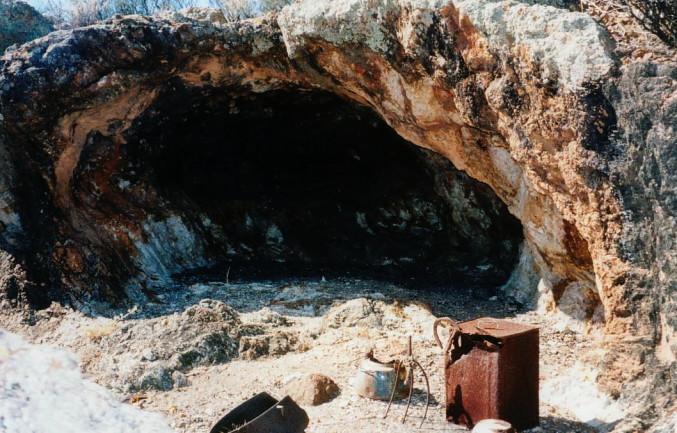
During the thirties and early forties one of my greatest friends was Peggy O'Halloran, the grandaughter of dad's brother Tom. Peggy was the same age as me and often spent time with her grandparents on the farm until they left Ajana in 1934. We used to play cubby houses in the little caves in Tynedale Hills just at the back of Uncle Tom's house. After Uncle Tom and Aunty Belle left Ajana I spent several school holidays staying in Geraldton with either Aunty Belle or Peggy's mum Dorothy so that the two of us could be together. During other school holidays Peggy loved to come to stay with us on the farm. Once she was on the farm while the lambs were being tailed. They were put in an iron cradle to be earmarked and then have their tails cut off in order to reduce the chance of them being fly-blown. One of the shearers used to love barbequing the tails over hot coals and the taking them home for tea. He had tied his cooked tails together ready to leave for the evening when Peggy grabbed them and took off. She ran laughing and squealing in and around the hay stooks with the shearer yelling and chasing after her. Eventually he caught her and managed to retrieve his tails. Always full of fun, Peggy was beaut company.
For twelve years, Peggy was an only child and then Christine was born in 1941. To keep Peggy company while Dorothy was in hospital, I was invited to stay in Geraldton with Uncle Tom and Aunty Belle. The O'Halloran family each rode a bike as they did not own a car, so I rode Dorothy's bike. Each day Peggy and I rode the four and a half kilometres from Uncle Tom's Geraldton home to Peggy's Bluff Point home to feed the dog and generally tidy up. As a farm girl the vehicles used to scare the daylights out of me. When riding to school from the farm I had no fear of vehicles - there just weren't any.
On December 7th 1941 Pearl Harbour was bombed by the Japanese Forces and so began a more frightening and personal part of World War II. A great number of Northampton and Ajana men had enlisted and when Singapore fell during 1942 many were taken prisoner. For almost four years no-one knew whether these young men were alive or dead. It was a terrible period for the members of their families. Our cousin, Ted Cornell, was a prisoner and every day his sister, Betty, used to ask us if there was any news on the radio. It was not until the war was over and the ship carrying the ex-prisoners docked at Fremantle that families knew for sure. It was learned then that Donny Sutherland had been killed in action.
1942 also became a year of major changes as far as we were concerned.
In January, Miss Myrtle Chapman arrived to become the Ajana school teacher. Until she arrived to board with us Pat and I had shared a double bed in the second bedroom but now that this room became the teacher's room we had to move into the third bedroom with Charlie and Leonard. Here Pat and I each had a single bed while the boys shared a three-quarter sized bed.
Daylight Saving was also introduced for the first time in the January of 1942 as a wartime energy saving measure. For us it became a very controversial move because putting the clocks ahead one hour meant that our school finishing time of 3.30pm now coincided with the hottest time of the day which in Ajana's summer meant we were going home in extreme and probably dangerous conditions. Sensibly the Education Department decided that teachers in such extreme conditions could make the school day from 10.15am to 4.15pm for the duration of the daylight saving period.
In March of that year the school had eighteen students which meant a very overcrowded classroom. As a result the School Inspector recommended that the school be transferred to the Ajana Siding. The new school opened in the Ajana Hall on May 31st. The Education Department paid the hall committee an annual rent of twelve pounds and also provided a new rainwater tank. Included in the rent was the use of the hall piano. Myrtle was an accomplished pianist and made full use of the piano.
Another major change for me was going into grade 7, the first of the high school years leading to the Junior Certificate Examination at the end of grade 9. In one-teacher schools like Ajana the local teacher was responsible for teaching students from Grade 1 to Grade 6. The local teacher supervised students in grade 7 to grade 9 but school lessons were provided under a correspondence system run by the Education Department in Perth. We did the lessons under supervision and the sent our answers to Perth each week for marking. Pat was setting out to complete Grade 9 and sit for the Junior Certificate Examinations but for some reason there was an awful delay of three months at the beginning of the year in despatching Grade 9 Correspondence Lessons. As a result, even though Myrtle Chapman assisted as much as her time allowed, neither Pat nor Jim Murphy stood a chance of catching up with the backlog of lessons. Both of them, extremely disappointed, left school at the end of second term.
The final change of 1942 had a major effect on me personally. Betty Cornell and I set out to complete a two year certificate course which covered grades seven and eight. This was also an Education Department Correspondence course but, unlike the Junior Certificate Correspondence Course, the student work was not sent back to the Education Department but was marked by the local teacher, in this case Myrtle Chapman. Betty also left at the end of second term, leaving me as the only white girl in the school except for a much younger girl. I became very lonely at school and also very unhappy with the way Myrtle Chapman was marking my work. She continually accused me of writing my answers directly from the book instead of using my own words. This was not true. I really was trying hard to write my own answers. This battle with Myrtle and the loneliness became too much for me. Finally I broke down with uncontrollable weeping and refused to go to school. I was allowed to leave school at the age of fourteen and a half years on September 18th, 1942.
When Pat left school she went almost immediately to work at the Rosella Private Hospital in Geraldton. She used to come home by train for her holidays and it was so great to see her. She and Charlie were a very good tennis doubles team and during her holidays they used to play together in Ajana tournaments. They won several trophies while she nursed at Rosella. I was a rather shy and nervous girl and played in a lower grade.
It was always Pat's ambition to train as a nursing sister at one of the Perth training hospitals but she was caught up in the wartime manpower regulations that prevented people in essential occupations such as nursing from leaving their current place of work. As a result it was 1944 before Pat was allowed to apply for nursing training at the Mount Hospital in Perth. Mum and dad went with her by train for the interview and that was the first time since their 1924 honeymoon they had been to Perth.
By the end of 1942 the war had become very alarming. The Japanese had invaded islands in the Pacific, the Battle of the Coral Sea was being fought and on December 12th two hundred and forty people were killed in a bombing raid on Darwin. At about the same time several Catalina seaplane reconnaissance aircraft were destroyed at their moorings on Roebuck Bay, Broome, a naval base at Onslow was bombed, and Japanese forces were moving rapidly towards New Guinea. Also, Japanese miniature submarines had sunk ships in Sydney Harbour and Newcastle Harbour had been shelled.
Although compulsory evacuation only occurred from Darwin, many children were evacuated from cities and towns that were considered to be likely targets. We had two children at our school who had come from Fremantle to stay on a relative's farm at Ajana. Even children from Geraldton were sent to relatives on inland farms. Perhaps displaying the most caution was St Patrick's Boys' College at Geraldton which closed and all resident students were transferred inland to Tardun Agricultural College some eighty miles (130 kilometres) from the coast..
Even in our remote farming district we had to obey the Australia wide blackout regulations which decreed that after dark no lights were to be visible from outside the house or any other building. A Black curtain had to be pulled across windows and even doors which were likely to be opened.
But this did not stop us from leading as normal a life as possible. We were allowed to put our car headlights on but only as a thin narrow beam. To make this beam possible a black cloth hood was fixed over the headlights and then a narrow horizontal slit about five centimetres wide was cut below the centre of each headlight so that light only shone downwards on to the road. There was also a thirty two kilometre an hour speed limit which was strictly enforced in towns.
One of the more difficult wartime restrictions for us to get used to was the rationing of clothing. During 1942 we were issued with a Clothing Ration book which contained tickets assigning a value to essential clothing in both points and money. The book contained tickets which were to last for a year. Food rationing was introduced during 1943 but as we grew or raised a lot of our own food it was not as difficult for us as for people living in towns. A serious shortage of paper also occurred and restrictions were placed on wrapping paper. This lead to the situation where you carried your purchases out of the shop unwrapped.
There are many other war time events that come to mind.
Petrol rationing had been introduced in 1940 and by 1942 petrol was hard to come by. One of the local farmers, Frank Porter, built himself a gas producer to run his truck. Gas producers were an invention brought about by the petrol shortage. Frank's gas producer was a forty-four gallon drum fixed to the side of his truck in which he burned charcoal to produce gas. How it worked was a complete mystery to us but about halfway to Northampton on a hill near Ogilvie the drum had to be cleaned out and filled with fresh charcoal. To this day that hill is still called Charcoal Hill.
Ajana people became dependent on Frank Porter to take us to pictures, dances or balls in Northampton. He would pick us all up about four in the afternoon and we each took a rug to wrap ourselves in while we rode on the back of the truck. The trip each way was very slow and we used to arrive home in the small hours having enjoyed a fun night out.
It was about this time that the West Australian Government Railways decided to start a diesel rail car service to Ajana, running twice a week. The service, known as 'The Diesel', arrived at Ajana at 9.30pm on a Monday evening, left for Geraldton at 7.00am on Tuesday morning and arrived again at 9.30 that evening in Ajana. This meant that once a week we could take a day trip to either Northampton or Geraldton for business or pleasure. In the days of fuel rationing this was a huge bonus. Further to this we now had three trains a week which meant more deliveries of fresh food, mail, papers and machinery parts.
The Royal Australian Air Force established a pilot training base at Geraldton where they flew Tiger Moth, Lockheed Hudson and Douglas DC2/DC3 planes. About the same time the United States Army established a Catalina Flying Boat base on Geraldton Harbour. The people of Ajana were asked to identify all aircraft that flew over our community and pass the details on to the authorities in Geraldton. During the daylight hours the Ruffin family at the Post Office did the spotting where they had a telephone. Volunteers stationed at the Ajana Hall did night spotting. However to report in a sighting they had to walk about four hundred metres from the hall to the phone at the Post Office. It very quickly became obvious that this was neither satisfactory nor feasible so night spotting was left up to the volunteers in Northampton.
As well as having bases around Geraldton, the army established a base in Northampton. These units did a lot of training in manoeuvres near the mouth of the Murchison River. As they travelled in convoys of jeeps and trucks to the mouth the soldiers drove past our school at the Ajana Hall. When they drove past we cheered and waved to them and they used to whistle and wave back. For we children these were moments of great excitement as well as constant reminders that we were at war.
We were very grateful for the work the Army did to upgrade the road from Ajana to the mouth of the Murchison River. From Junga, half way between Ajana and the mouth, they carted gravel and spread it over the sandy sections of the road, making the road much easier to drive over. Unfortunately, petrol rationing did not allow us to drive over to the mouth for holidays during the war.
Also at this time a volunteer force, the Volunteer Defence Corps (V.D.C.), was formed to assist fight the enemy should they attack the region. A section was formed from people of the Ajana-Binnu-Ogilivie district. Members were issued with uniforms and weapons and carried out their training, including rifle shooting on a Sunday morning. Dad, who had been a sergeant during World War I, decided that he did not wish to be the section leader and opted to become a corporal in the section. Jack Morrisson was made the sergeant and proved to be a fine leader.
A young Major, who had been wounded in action and assigned to light duties, came to organise the V.D.C. sections in the Geraldton region. As he had many other sections he came to train our section once a month. On these occasions he often stayed the weekend on our farm. We loved having him because he was always a perfect gentleman. The major's name was David Brand and not long after the end of the war he became the Premier of Western Australia.
Major David Brand issued mortar equipment to the V.D.C. and on occasion we were allowed to watch demonstrations. The section was sometimes taken on Frank Porter's gas-powered truck to Northampton for more advanced training. After this initial training the district V.D.C. was left to Sergeant Jack Morrisson and dad. The issued rifle was a .310 single shot known as 'the three ten'. With the extra rounds issued for practice, dad taught me how to use this rifle. My targets were jam tins which dad placed on the side of a hill in one of the paddocks. Using the weapon while lying down was easy but to stand up and fire from the shoulder was very difficult because the weapon was too heavy for me.
On the farm we also had a 12 gauge shotgun and a .22 rifle which I liked to use. With the shot gun I shot galahs which we used to make tasty stews, and with the .22 rifle I shot kangaroos, rabbits and, when they were wreaking havoc in the grain crops, black cockatoos. Once when out shooting with Charlie and Leonard we found a big bush spider sitting on its web. With the .22 I shot it and it just went out of sight. My family thought this was a big joke and has never let me live it down. On another occasion mum screamed out to me from the backyard to come and kill a big black snake. I grabbed the 12-gauge shotgun, loaded it and shot the snake dead. The young guys at Ajana started to call me 'Annie Oakley' because about this time the film "Annie Get Your Gun" was screened in Northampton.
Sometimes the spent cartridge cases jammed in the breech of the old .22 rifle so I used to carry a hairclip to prise them out. There was an occasion when Charlie and I were out checking the rabbit traps that we found a baby fox caught by the leg in a trap. It looked so pitiful, just like a small pup. I thought about letting it go but its leg was badly broken. A spent cartridge had jammed in the rifle and I had left my hairclip at home. I sent Charlie back home to get it. I could not just stay there and watch this little fox nor bring myself to kill it with a stick as I would with a rabbit, so I walked away and checked a windmill. Charlie ran all the way to and from the house to get the hairclip so after clearing the breech I was able to put the fox out of its misery and cut off its scalp to get the vermin bonus.
Uncle Artie Bandy joined the army, as did his second daughter Nona. His eldest daughter Elaine joined the air force. Aunty Doon had taken their youngest daughter Paula to Melbourne for two years to attend a special school. As a result, Uncle Artie leased his farm at Binnu and asked dad to look after and make use of his horses. There were several young horses in his mob and we asked our neighbour Stevie Drage to break them in, and it was most interesting watching him gentle the horses and make them used to being ridden. We ended up with a favourite called Billy on whom I learned to ride but not very well. I'm sure it was the fear of horses that mum had instilled in us that made me a nervous horse rider.
Father had his fair share of experiences with those horses as well. He was riding Brownie in the back paddocks when the horse threw him off and galloped home. Mum lamented, "Four thousand acres and I don't know where to look!" So we set out on foot in the direction from which the horse had come. Fortunately father suffered no more than a few bruises and he was running home when we found him. On another occasion he set out to take the team of horses out to plough a paddock. With their bridles and collars fitted, dad rode Old Bess while leading four horses behind him and driving four horses ahead of him. He got off Old Bess to open a gate and when he remounted she bucked him off. After that he never rode her again even though he had ridden her several times before without any trouble. When dad told Uncle Artie the story, Uncle laughed and said that Old Bess had never had a saddle on her back in her life, even though for weeks dad had found her as quiet as a kitten.
Several times Artie's horses broke down a fence and went home to the farm at Binnu, thirteen kilometres away. As we had to take some of our own horses down there to lead them back to Ajana it was not an easy job.
From Murchison House Station dad bought a mare called Jean who had a young foal that we called Bandy Boy. His sire was a racehorse and Bandy Boy was not only hard mouthed, but had a will of his own, was intelligent, and a devil. He loved to tease the other horses until they ran away, which was what he wanted because he then chased them around the paddock. He chased his mum and tormented her, unfortunately once too often, for she got tangled up in a fence and choked to death. He could undo a wire-and-post gate by moving the wire loop with his nose along the post until the loop dropped off the post and the gate came open, letting all the horses out. Dad could ride him, as could men who worked for us but we children were not allowed to.
Bandy Boy was a rare horse. Dad was bringing in a mob of sheep and a little lamb was not able to keep up. Bandy Boy picked the lamb up in his mouth and carried it, something that we have never known another horse to do. Yet the same horse one day got out of the paddock, upended a bag of wheat that had been stacked near the fowl-house, gorged himself and then drank a lot of water which made the wheat swell. As a result his stomach became distended and he was in considerable pain. In those days there were no veterinarians in the Northampton district so dad gave him an enema to try and clear his stomach. Unfortunately he still died and we were quite distressed because he was really a lovable animal.
It was sad to see animals die. Horses got old and useless and had to be shot. Cows died, one was struck by lightning and another died from toxic paralysis after calving. Dogs died from poison baits, or they too had to be shot because of injury or old age. That's the way it was.
Another tragedy happened to a horse that we called Farber, who fell into the well from which we collected our drinking water. The well wasn't very wide and Farber walked on the sheet of iron that covered it and slipped backwards into the well. As it was a Friday evening many people were at the siding waiting for the train and so volunteers came across to help. Some one went down the well ladder with ropes and reins, tied them to the horse and then the ropes were tied to the truck. Ropes, men and truck pulled old Farber out of the well alive but a few hours later he died. The well had to be emptied of dirty water but soon made fresh water again.
Nineteen forty-three started with a major problem for our school. After Myrtle Chapman was transferred in December 1942, mum decided that she did not wish to board any more teachers. Unfortunately no one else volunteered to do so. This meant that the school did not open for the New Year, as there was no teacher accommodation. As a result Charlie had to board twenty-four kilometres away with Aunty Marie and Uncle Herbie Bandy so he could attend Ogilvie School. All the other Ajana school children, including Leonard, were not able to start school.
Mum felt obliged to provide board and lodging for a teacher and Mrs Imelda Bagley arrived to open school on the third of March at a time when Leonard and I had caught chickenpox. Imelda had recently married but her husband was away in the air force. She was a mature twenty four-year old who got on very well with our family, with mum especially enjoying her company. Each month Imelda ordered six books from the Geraldton library which dad and I also read. About this time mum started to have trouble with eyestrain so she read less than we did. The arrival of a full time teacher meant that Charlie was able to return home at Easter and go to Ajana School again.
During nineteen forty-three I experienced my first eclipse of the sun. All the white sheets hanging on the line appeared yellow and the daylight dimmed and things felt eerie. I was told that I could look at the eclipse if I used a piece of beer bottle over my eyes as a shield.
After I watched some of the eclipse I was very disturbed to find that whenever I read I had black spots hiding parts of words. The situation improved slightly so that there was one major spot in my right eye but the condition never went away. I could see to read but there were spots blacking out letters in words so I could never again read quickly. No longer could I use my right eye when aiming the rifle and so had to learn to fire from my left shoulder and aim with my left eye. An optician in Geraldton examined my eyes, told mum there was nothing wrong and said that some girls in their teens got an idea that they would like to wear glasses. He did not understand my problem and it was not until several years later that an eye specialist confirmed that as a result of my viewing the eclipse I had a burn spot in my retina.
The Northern Highway linking us to Northampton was now upgraded to a gravel road across the sandplain sections. The Northampton Roads Board maintained the road by grading it after rain. This removed the corrugations for a short time but the road soon deteriorated so a trip of 50 kilometres into Northampton could take an hour and a half, while a return trip at night would take considerably longer. Dad and I loved going to the pictures but mum was not so keen because she was fearful of the drive home at night. To go to the pictures we sometimes stayed overnight with Aunt May and Uncle Billy Wight who, with Aunty Maggie, had moved into my grandparents' big home in Essex Street after they died.
Northampton teenagers were quite a happy group and I had come to know quite a lot of them. At the pictures in the town hall all the young people sat in the gallery where, out of sight, we could sit and talk with the boys. For the Christmas holidays of nineteen forty-three our family rented a cottage at Horrocks Beach from a friend. The young people used to get together during the day to swim and in the evening sat on the beach to sing songs and tell jokes or just talk. Nobody ever needed to lock a cottage in those days and so we girls had a lot of fun sneaking around during the day and short sheeting the boys' beds. Of course they did the same to the girls' beds when they had the chance. It was during these holidays that I had a 'crush' on a tall, dark handsome guy and I must say that these were the happiest three weeks of my fifteen and a half years.
We passed our spare time in many ways. Betty Cornell and I often spent weekends together, sometimes at her home, sometimes at mine. Dad taught me how to drive the old Rugby utility around the farm. Mum was quite happy about this because she had never learned to drive and it was now possible for me to take her visiting or shopping at Mitchell's store. These outings did not take me onto the main roads but driving so young was not unusual on farms. Dad was not a good driver so I was lucky to have Uncle Artie teach me the way to use the gears correctly, particularly when crossing Croton Creek where he showed me how to stop the ute, change into low gear and drive slowly up the steep creek bank. Dad's method was to put the utility into second gear and try to charge up the bank. Quite often the utility would stall and roll backwards down the steep slope into the creek bed. This used to terrify mum.
It was now possible for me to drive mum out to the paddocks to take dad his lunch or just drive out to bring him home at the end of the day. We did not have to worry about bringing the horse team home because their natural instinct for finding their own way always brought them back to the farm yard for their evening feed.
Ajana ceased to hold concerts and community singing in the Ajana Hall but ran dances instead. At these we danced to records provided by Tom Wilshusen who was not a dancer but quite happy to control the gramophone from the stage and act as the Master of Ceremonies. The Hall Committee paid him for his services. Occasionally someone played the piano and we welcomed guests from Ogilivie and Northampton. We loved to go to Ogilvie for dances because Aunty Dot and Uncle Tom Bandy, she playing the piano and he playing the drums, provided the music.
In July nineteen forty-four Miss Pat Carmody replaced Imelda Bagley as teacher. Pat was only nineteen and was a bundle of fun around the farm. She rode horses and also enjoyed rifle shooting. She and I used to walk for miles with our rifles. Night shooting was something she also loved to do. Sometimes mum, dad and the boys came with us. We used to build a mia-mia near a drinking hole and then hide in it until dark when the kangaroos came in to drink. We would then shoot one for its meat and skin. One was all we would get because rarely did kangaroos return that night.
Pat Carmody could joke about anything. When making supper one might mum discovered the milk was sour, so armed with a jug and hurricane lamp we persuaded the resting cow to stand up and move to the cow bail. However no way would she go into that bail at nine thirty at night. Pat stood there feeding her some hay while I milked her to the tune of Pat singing "He Holds The Lantern While His Mother Chops The Wood." Pat was transferred at the end of nineteen forty four.
During that year Charlie sat for the Secondary School Scholarship tests and was awarded a scholarship for nineteen forty five. The scholarship assisted with the payment of boarding fees at the boys' hostel in Geraldton.
Dust storms in our farming areas had to be seen to be believed. Before planting the crop hundreds of acres used to be ploughed ready for cropping so during the dust storms life was very miserable. Our farmhouse was frequently covered in red dust as the doors and windows were ill fitting and not sealed. We tried to keep dust out by putting bags against them. The roof also let in heaps of dust so beds, clothes, furniture, and floors, virtually everything was smothered in dust. The dust storms could last several hours or even days and then we were left to sweep up buckets of gritty red earth. At times the summer easterly winds could blow for weeks at a time creating clouds of dust. There was nothing we could do about it and like everybody else we learned to live with dust storms. Sometimes a summer thunderstorm came to settle the dust and we all rejoiced. Mum used to clasp her hands together saying "Thank God." Dad would burst into singing "Count your blessings, Name them one by one".
Dad loved to sing. He always helped cook breakfast and he sang as he did so. He would call us out of bed with ditties like "Come on you lazy lubbers, shake a leg" or "Rise and shine on the White Star Line", which were ditties he learned on board ship while coming to Australia. While a lad in England he learned a lot of songs in the music halls and also learned many more when in the army during World War I.
Mum also sang around the house especially with the gramophone playing. We played the same tunes over and over. We often saw mum singing and waltzing around the dining room when she was ironing. She danced very well and was a very popular partner at the dances.
Nineteen forty-five started with Isabelle Stokes replacing Pat Carmody as teacher but she did not board with us. I decided to go to Geraldton to work as a housemaid at the Dellahale Protestant Girls Hostel. Both primary and secondary school girls from farms and pastoral leases together with small boys up to the age of ten boarded at Dellahale. The hostel was fondly called "Proddy Home". Some of the girls were my age that is seventeen. Three of the girls were my cousins.
My Aunty Maggie was the cook and another cousin, Lillian Bandy, was a housemaid. Lillian and I shared a room with Aunty Maggie who incidentally snored very loudly all night. The hostel had twenty-two bedrooms, two very wide passages at the entrance, a huge dining room, a big common room, several bathrooms, a kitchen with a wood stove, a large verandah and the matron's quarters. The cook cleaned her kitchen and the pots and pans. We two house maids set tables and washed the dishes with the girls who were rostered to do the wiping up. On hands and knees we polished all floors, usually doing two or three rooms a day, and swept and mopped the rest. We ironed clothes for all children under the age of twelve and the older girls ironed their own. We started work at 7.00am and finished at 7.00pm with ten minutes for lunch and five minutes for morning and afternoon tea. We had one day off a week with my day off being Saturday. Weekends were a little easier as we did not polish or do ironing, however we did have to wash windows.
On Saturday afternoons the children were taken to the pictures and if matron did not wish to go she put Lillian and me in charge. The students had to walk in two lines down the street to the theatre. On Sunday mornings they went to church with matron and if it was a nice afternoon, Lillie and I could take them for a walk or to the beach. The students were well behaved and it was no trouble keeping them under control.
On the farm I was given a small allowance to go to dances and pictures but mum bought my clothes. At Dellahale I was paid twenty five shillings ($2.50) a week and keep so I was keen to earn my wages as I had never before had money to spend as I wished. Matron however kept strict control over Lillian and me. We had to tell her where we were going and were not allowed out at night except to the community concerts on Sunday evening with Aunty Maggie.
At the beginning of nineteen forty six Ajana school did not open because no family was prepared to board a teacher. This resulted in the school remaining closed for the whole year. Fortunately Charlie started at Geraldton High School as a boarder at Forrest Lodge Hostel for boys where he stayed for 1946 and 1947. Leonard had to conduct his schooling as a correspondence student.
While I was at Dellahale mother wrote to me each week expressing how lonely she was, how she needed me at home to help Leonard with his correspondence lessons. By this time I had been at Dellahale for twelve months and had made a few friends in Geraldton but did not get a chance to catch up with my friends in Northampton who were very dear to me. So I went back to Ajana.
Now that we were not providing board for a teacher I had my own bedroom all to myself. However soon after arriving home I became very ill with measles which kept me in bed for four weeks. It is very likely that the measles developed into pneumonia but I never saw a doctor. Charlie also caught measles and was sent home from school.
Although it was in 1945 that we welcomed the end of World War II with victory in Europe (V.E. Day) in May and victory in the Pacific (V.P. Day) in August, it was several months into 1946 before most of the men and women involved were released from prison camps, discharged from hospitals or discharged from the armed forces.
So during 1946 as personnel returned home, several "Welcome Home" dances were held in each of our small districts. Finally a great General Ball was held in the Northampton King's Hall to welcome home every man and woman from the Northampton Shire who was involved in the forces. As Betty Cornell, Hazel Murphy and I had now turned eighteen years old, we were thrilled to be able to wear our first long formal frocks at this ball. Pat was also home on holidays from her training at the Mount Hospital so was also able to attend. Clothing coupons still decided how much material we could buy, so mother made Pat's and my dresses by using white cotton mosquito net over a satin slip for a total cost of three dollars each.
During the winter of 1946 I went to Northampton Balls nearly every month. They were usually held on a Wednesday night so I went to Northampton on the 7.a.m. Diesel train and stayed with Aunt May Wight and family, then returned on the Friday night train to Ajana. A truck load of Ajana folk often went to the Balls in Northampton as well.
Eventually petrol rationing came to an end and people were able to move about in their own vehicles as they wished.
1946 was the year in which Leonard did his schoolwork by correspondence. I supervised him and sent his papers to Perth to be marked. But I must admit I did half his work for him, particularly his so-called homework, so that he would be free to go shooting or for long walks with me.
On one occasion, our dogs bailed up the biggest rock python snake we had ever seen. It crawled under a clump of dead bushes and lived on in peace, although the dogs were reluctant to leave it alone. Leonard laughs now about his correspondence work and said he did not learn anything. I am sure he is not wrong, because I felt the same about my effort on correspondence before I left school.
I still spent weekends at Cornell's. Betty had never left the farm and loved to ride her horse and shoot with her big brothers. We still killed emus for the bounty on the beaks. We pegged out kangaroo and rabbit skins to dry before they were sold to the wool buyers.
The man who did the maintenance on the vermin fence had erected several traps along the fence line which were small netting yards. The emus could run in but the way the traps were constructed, they could not find a way out. One time Betty and I found a dozen emus in a trap near her place. She shot several and wounded the rest. We screwed their necks, then cut off their beaks. All this was part of living on the farm and we did not think twice about it. Betty married and left the district at the end of 1946. She was only eighteen years old.
On the twenty third of March 1947, Mr Alex Esson reopened the Ajana School. He lived in Mr Ruffin's vacant farmhouse with his sister. Mr and Mrs Ruffin had moved into his parents' house at the siding and now had the post office and shop.
Alex Esson taught at Ajana in 1947, 1948 and 1949. In 1950 Mr Savage succeeded Mr Esson and taught there until August 1951. The Public Health Department then reported that the hall had become structurally unsound and on October 17th 1951 closed it to the public. So for the start of the 1952 school year, the school's stock, furniture and water tank were moved to Galena, nineteen kilometres away. The Ajana children were taken to Galena school by bus and since then Ajana has never had another school. Galena School closed in the early 1960's, and now the school bus takes the Ajana children to Binnu School.
A new Ajana Hall was built in 1953, near the tennis courts. Some of the good timber from the old hall was used for the construction of the new one. It was painted inside and out. With water now laid on for the kitchen, a septic system constructed and with a generator providing electricity, the hall became a popular place in the district.