
Railway barracks for train crew
Where the people live
Daphne Lowth
Chapter Three - Rail, Wheat, Wool and Lead
In 1913 Ajana had become the terminus of the railway line from Geraldton. A siding was built with a loading ramp, a goods shed, a turntable so the engine could be turned around and extra line for the shunting of goods trucks and carriages.
An overnight barracks for train crew and a two-roomed hut for a stationmaster were also built. During the 1930's I remember old Mr Scott as one of the stationmasters. As well as growing his own vegetables he grew a fig tree. When those figs were ripe we were very friendly towards Mr Scott.
On the eastern edge of the siding was a stock well called Croton Well. Here the government built stockyards to simplify the loading of stock brought in from surrounding pastoral properties.
The well water was also used for camel teams carting wool from Murchison House Station and donkey teams bringing lead from the Galena mines.

The annual crop of wheat grain was also railed out from the siding. Each farmer's grain was put into bags straight out of the harvester grain box. Using a bag needle and twine the bags were sewn up by the farmer, his wife or another family member. During harvest time I often helped with bag sewing during the weekend and after coming home from school. It was hot, tiring and dusty work.
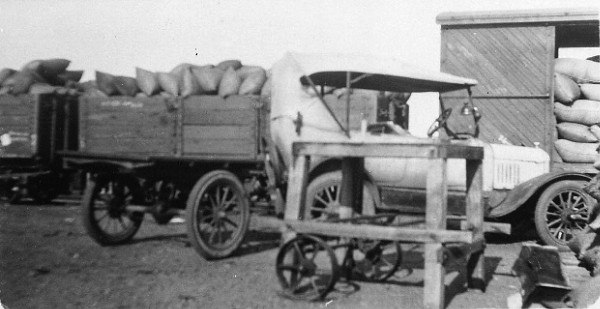
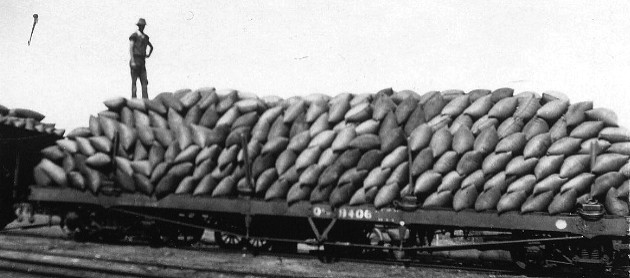
Each bag was manhandled up onto a horse drawn dray or wagon, or a motor truck, which, when loaded, was taken to the siding. Here the bags were again man-handled onto the loading ramp. As each bag weighed about one hundred and eighty pounds or eighty-two kilograms, many people suffered from strained back muscles. My Uncle Sydney was employed by the Wheat Board to handle each farmer's bags of wheat once it was man handled onto the loading ramp. His job included weighing each bag, entering its weight on the farmer's tally sheet, carrying each bag, often on his back, into the railway truck and stacking it ready for delivery to the Geraldton port.
As a result of all these activities and the needs of the farmers and miners in the district during the nineteen thirties, Ajana Siding also had two general stores, a post office, tennis courts and a hall.
Ajana Siding was one kilometre north of our farmhouse. Because our place was on higher ground, we could see most of the comings and goings. Although vehicles appeared quite small at that distance, mum had little trouble telling us who had just arrived at one of the stores.

On the horizon, about three kilometres north of the siding, we could see the top of a tall stone chimney. This was part of the lead smelter built for the Geraldine Mining Company back in 1854. An experienced tradesman from Newcastle-on-Tyne called Francis Pearson supervised the construction of the smelter by thirteen ticket-of-leave convicts under his control. Mr Pearson and his family became the first permanent settlers at the mine.
The smelter was built into and on a hill so that the hill could act as an oven. At the base of the chimney a large opening faced in the direction of the prevailing westerly winds, thus creating a natural bellows. Firewood and lead ore were stacked into the opening and ignited. The molten lead flowed out at the bottom and down a bricked channel where it cooled. The lead was then carted through the scrub by horse teams to Port Gregory.
In recent times, the old chimney has been restored by the Historical Society as part of the historical record of the Murchison District and its original name of Warribanno Chimney has been revived. It is now both a tourist attraction and a local landmark for the Ajana District.

During our childhood we used to play on a small old railway locomotive near the Ajana Siding. There were also portions of a small gauge railway heading north and across Croton Creek towards the Galena lead mines. It turns out that, by 1923, a two feet gauge tramway had been built from Ajana to within four miles of the Surprise Lead Mine.
