
Daphne (l) and Pat (r) in 1948, on holiday in Perth, with Mary and Syd Atkinson
Where the people live
Daphne Lowth
Chapter 7 - Leaving "Where The People Live"
In 1947 I applied for a job as a nursing assistant at Northampton Hospital and started work two weeks later. Mother made my uniforms and cap and with my first pay I bought a pair of nursing shoes.
Matron was a young lady and very nice to all the staff. My cousin, Janet Williams, had been nursing for 12 months and showed me what to do. She was very good to me and, for my first dead body, sat with me most of the night. I did night shift on my own after being there only two weeks. We assisted at the birth of babies and helped in the operating theatre. Like most country hospitals, it was one nurse on evening shift, two on day shift and one on night shift.
Domestic staff and nurses mixed socially and we all got on well together. We went out in groups to pictures and dances with our boy friends. If we were off duty at weekends we went to Horrocks Beach to swim or by car or truck to dances at Ogilvie and Geraldton. The young folk were a happy group and I soon knew every one in the town.
Janet shared my room during the week and went home at weekends. She had a job as usherette at the pictures every Friday and Saturday night, so never worked at the hospital at weekends. Our quarters were next to the hospital and were very comfortable.
Night shift was a lonely shift, with rounds every half hour. Some people had to be washed and beds made before breakfast. Some nights the stillness was broken by the Dunny-man. Many homes still had pans in their toilets and these were collected and changed once a week by a man with a horse and cart. The horses hooves rang on the gravel road. I often thought he and I were the only two people awake in town. I liked working in Northampton, l liked the friends I had made, I had a nice boy friend, but I had never been to the city and thought I would like to try it for a few months.
In January 1948 Betty Bandy, my cousin from Hutt, was to go to Teachers' Training College in Perth and was to board with my Aunt Mary and Uncle Syd Atkinson who now lived in Leederville. Betty and I went to Perth by train and sat up all night. The train had sleepers, but we could not afford to buy a ticket. I had a very nice holiday with Aunt Mary and Uncle Syd. Aunty Mary took me every where by train, trolley bus or tram. I was so very scared of the traffic and hated crossing the streets.
Pat had now almost finished her training at the Mount Hospital. She had friends nursing at Westminster Private Hospital in Adelaide Terrace so I applied for a job there and was asked to commence duty in four weeks time.
Pat sat for her final exams but was then devastated when she and another girl failed. They could not find out where or what they had failed in and had to work for another six months and sit again. She was due for holidays so we went home to Ajana and we decided to travel back to Perth together.
While Pat was on holidays, a phone message was delivered from the Ajana Post Office to say there had been an accident in Northampton. My boy friend was dead and my cousin Laurie Wight was seriously hurt and was flown to Perth. He died three days later. The bottom fell out of my world. My cousin was like a brother to me, and to lose two such close friends was heart breaking.
I returned to Perth with Pat in March 1948 and began work at Westminster Hospital. The work was easy on day shift, in fact we could not find enough to do, but night shift was busy. There was one Sister and myself to bathe a lot of the patients before the day staff came on duty.
The nurses' living quarters were located across the street from the hospital in a group of flats. Nurses who had been there some time took two bedrooms, so another girl and I had to sleep in a sleep-out. It was very draughty and cold with a cement floor and no floor coverings at all. Also there were no heaters in the sleeping areas, although we had an electric heater in the sitting room. I was glad to move into a bedroom when one girl left.
After board was taken out of my week's pay I received thirteen shillings and sixpence ($1.35) plus my meals. My friend who was over the age of 21, received two pounds and ten shillings ($5.00). That was the amount of money I was getting in Northampton. Board and lodgings were considered to be worth two pounds and ten shillings ($5.00) a week.
One day I broke a thermometer and its cost was deducted from my pay. I also had to pay for medication for my bad back. I had taken out a Life Assurance policy which cost two shillings and sixpence (25 cents) a week, so that week my pay was nil. It was so unbelievable, I just sat down and cried!
To visit Pat I used to walk from Adelaide Terrace up to the Mount Hospital at the top end of St. Georges Terrace. We would go shopping on our days off or go to Kings Park. Some times we had a meal at a little place called The Lattice. I then walked back on my own and was very nervous, as there were crowds around the dance hall at Anzac House and near Government Gardens.
I used to catch a trolley bus to Leederville to visit my friends. Aunt Mary and Uncle Syd often took Betty Bandy and I to the outdoor picture theatre in West Leederville. It cost a silver coin such as threepence (2 cents) or sixpence (5 cents) to get in.
On April 21st 1948 I turned twenty and was given a surprise party for my birthday. The hospital cook baked goodies for supper and the nurses, sisters and their boy friends packed into our sitting room at the quarters. We played games and had a great time. It was my first ever birthday party.
Pat passed her exams and, with a friend, went to work at Mullewa Hospital. Wages were good and they needed two nurses, so my friend Olive Billinghurst and I decided to go. We had been working at Westminster for five months.
Mullewa is 95 kilometres east of Geraldton. We travelled over night on the train from Perth and it ran five hours late due to some engine trouble. Pat was on duty, so we were met by the hospital secretary Bill Bardon and a schoolteacher, Max Lowth, whom I later married.

The hospital living quarters were disappointing. Trained staff already occupied three rooms, so Olly and I found our beds and wardrobe were in a sleep-out to be shared along with two other girls. There was no covering on the cement floor, canvas blinds covered the flyscreened louvred glass windows. Every one coming into the quarters walked through our sleep out, so we were often woken up about 6.30am by staff showering before going on duty, or the 11.00pm staff coming and going. We just had to learn to live with it.
From the bathroom water flowed outside into an open drain where we sometimes saw lizards and goannas drinking. There was one large racehorse goanna that came for a drink about 2.00pm every day. We would sit on the verandah and read in the sun and watch it come in for a drink and waddle off again. Between the quarters and hospital, a windmill squeaked as it drew water from the well. An engine was used if there was no wind during the day so when on night shift, which was for seven nights at a time, we were lucky to have four or five hours sleep.
A male orderly called Don Haytley worked at the Mullewa Hospital. His role was truly that of a 'jack of all trades'. He maintained the windmill and its engine. All interior floors in the hospital were bare wood and these he polished with floor polish. The verandahs he mopped with a mixture of kerosene and O'Cedar oil. It was his job to fill and light the primus stoves to boil the operating theatre instruments, and to autoclave the theatre linen. He wheeled the oxygen cylinders on a trolley to the theatre, labour ward or general wards as and when we needed them. He cleaned the toilets in the hospital and emptied the pans in the native quarters where there was no septic system. This man was also the town's gravedigger. When he knew a patient was about to die, he would dig the grave at the cemetery in his spare time. The ground was so hard that he often had to use gelignite.
At 4.00am one morning, when I was on night shift, he walked into the kitchen where I was preparing morning teas. He was covered in dust and dirt having come straight from the cemetery. He had called in to have a cup of tea. He was such a character and reminded us of Pa Kettle.
Midwifery cases were admitted along with their suitcases. Husbands went home and were notified when the baby was born. In Mullewa the anaesthetic then used in the labour ward was chloroform. In the operating theatre ether was used. Both were administered a few drops at a time on a pad over the patient's face. That was the matron's job, while trained staff assisted the doctor. We nurses were there to scout.
Aboriginal babies were delivered in the mother's bed in the native wards. There were electric lights but no electric bells in those wards. The mothers rang a large hand bell like the type used around the necks of camels. They usually had a natural birth and did not have an anaesthetic.
The summers in Mullewa could be very hot. Sometimes when the temperature rose to around 48 degrees Celsius the ether bottles exploded in the stock cupboard. One very hot summer's night while on night duty, I was sitting in the office enjoying a cup of tea with the hospital secretary, Bill Bardon. A twenty-eight parrot fluttered in through the open office door and then fluttered straight out again. Bill, who had had a few drinks, looked at me in total disbelief saying, "Did that happen? Did I just see a green parrot fly in and out of this room?" I will never forget the look on his face for he thought he was seeing things. The poor bird was no doubt exhausted from the heat and was, I guess, looking for water. We often laughed about that incident.
A big 200 watt light shone off the main hospital to light our way to the native quarters. We carried a torch to do our rounds and it was very annoying to come on duty and find the batteries flat. We were never afraid of the aborigines, even though some that came in from the far out stations could not speak English. They had the greatest respect for nurses in uniform and they were good patients. We delivered their babies and treated them like any other patients. We set their broken bones and treated their ills. The hospital employed a part aboriginal laundry lady and a wardsmaid. As I had been at school with aboriginals and associated with them while working on the farm, I was quite relaxed when nursing them.
Mullewa Hospital was usually short-staffed. Trained staff often only stayed a few months and then moved on. I had four matrons in the two and a half years I was there. At times we had no trained sisters, just assistant nurses and the matron who had to be on call at all times. When this was the situation people needing major surgery were sent to Geraldton while we did minor operations.
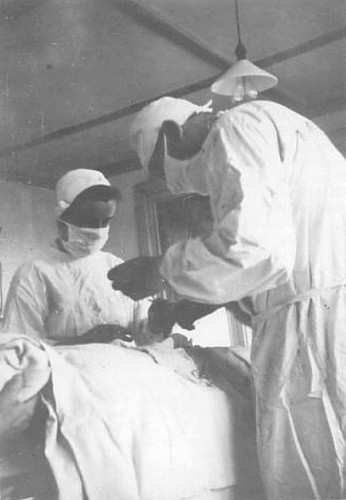
The operating theatre was a room built at one end of the front verandah. In it was an operating table over which a strong light bulb hung from the ceiling. There were two storage cupboards, a hand basin and a couple of small trolleys loaded with instruments and other operating gear. The room had glass louvres with fly screens that were very old. Two doors led into the theatre that was also used as the outpatients' clinic. Outpatients came in from the front verandah, where they had forms and old chairs to sit on and wait their turn, and we came in from the other door.
This room was turned from outpatients' clinic to instant theatre by a simple means. Covers were thrown over the cupboards, the floor was mopped over with Lysol disinfectant, the windows sprayed for blow flies, primus stoves set going to boil instruments, and sterilised gowns, sheets and surgical gear made ready.
The maternity wing was down a covered ramp and consisted of a labour ward, an X-Ray room, a four-bed ward and another two-bed room used as the matron's room.
The native quarters were apart from the main hospital. It was a building some fifty metres across the yard. It was divided into two wards, one female and one male. There was also a separate ward for native isolation cases. To the right of these there was a small mortuary.
All food was cooked on a wood stove and so the kitchen was very hot in summer. The kitchen staff used a fan that stood on one of the cupboards. Nursing staff had a small fan in the office. There were no ceiling fans and only the very sick had the use of the two little hospital fans.
We did not have fans in the quarters either. As I have mentioned the temperature would climb as high as 48 degrees Celsius and I recall one such day when I worked a double shift on my own. The sister who was to relieve me had a bad migraine, so I worked from 7 am. to 11.pm looking after twenty three patients and four babies. The hospital had long rambling verandahs. At one end there were seven beds for male patients as well as a four bed ward. There were two women's wards with two beds in each. There was another ward with one bed.
We could help ourselves to tea and toast at any time. As our evening meal was at 6.00p.m., we were always glad to have supper with the night staff.
Mullewa was a railway junction and so was home for a lot of railway workers who played an important part in the sporting and social life of the Mullewa District. Railways had their own football team that played the Towns team and other districts. There were also three hockey teams, Towns, Railways and Devils Creek. I played a few games for Towns, but with no previous experience and no proper coaching, it was impossible to play and enjoy the game.
The hockey field and football fields were just dusty or muddy bare ground, as was the race course. However the tennis courts were bitumen. We played a lot of tennis and the club had a large number of members.
The Mullewa Agricultural Show was held every spring, followed by the Show Ball. The local dressmaker worked hard to make the gowns, for we always had a new dress for the Show Ball. Dances and pictures were held in the Town Hall. No one at the hospital owned a vehicle, so we often walked to the pictures and dances. Bill Bardon, the hospital secretary, was very good to us and any one off duty went for a drive with Bill. He took us to dances out of town in his little utility, or sometimes to Geraldton for the day.
I liked to go to Geraldton at every opportunity because I could catch up with my parents when they came down for the day. My brother Leonard attended Geraldton High School during 1949 and 1950 and boarded at the boys' hostel, Forrest Lodge. If I was off-duty and could get a ride to Geraldton at the weekends, I would take him shopping or out for a meal. At the Hostel his pocket money allowance was two shillings (20 cents) a week, so I always gave him a little more. He hid this in his socks with any other extra money he had saved.
Leonard became ill with measles and was put into hospital. This left him with ear problems and he lost most of the hearing in one ear. At that time, Pat was nursing at Rosella Hospital and had him transferred from the Government Hospital so that she could nurse him. He then developed asthma and the doctor said the sea air caused it. He became well again after he left school and returned to Ajana. Because of this, he did not complete his second year away.
Pat nursed at Mullewa Hospital for eighteen months, then went with a friend to Warragul Hospital in Victoria for seven months. She said the hospital was air conditioned but the quarters were not. Under those conditions, she became very ill with pneumonia and endocarditis. Warragul is a very cold place to live. She returned to Geraldton and once again nursed at Rosella Hospital. It was during this period in 1950 that she nursed Leonard. After several months at Rosella, Pat went to work at the Bunbury District Hospital.
My friend Ollie stayed sixteen months at Mullewa and then returned to her home in Busselton. Two nurses were now local girls who lived at home. After a trained girl left, I was lucky to obtain a room to myself so I was happier.
Max and I had been going out together for some months, so I asked him home for my twenty-first birthday which was on 21st April, 1949. I was home on holidays, so Max got a lift to Northampton in a truck. Father and I met him in the new family car and brought him to Ajana. My party was held in the Ajana Hall. Every one in the district came to twenty-first parties. The record player and a couple of musicians on the piano provided the music. I received a lot of nice presents and made my first public speech. My pink floral dress was made by our dress maker in Mullewa and I wore ankle-strap high heel shoes that were then the fashion. I now had the fashionable short curly cut hair style. Up till now I had worn my hair long down my back. I packed my presents away into a Glory-Box for mother to look after for me.


Not long after returning from holidays, I was assisting our doctor one day with a minor operation and something went wrong. The minor operation turned into major surgery. With no trained staff available at the time, I had to do the theatre sister's job. I dashed around and helped the orderly sterilise more instruments, set up the trolley, scrub and gown again and, with a 'carry on' from matron, I assisted the doctor with this major surgery. Matron kept the patient under anaesthetic all this time.
After going off duty at 4.00pm feeling excited, scared and tired, I had a rest and came back at 11.00pm to do night shift so that I could sit with that lady.
The next day, Matron gave me a crash course in theatre procedure.
I learned the name of all the instruments, needles, cat-gut and nylon threads and how to make up a theatre parcel of gowns, gloves, towels and sponges, and so on. From then on I was theatre-assistant for the doctor with most operations, including tonsillectomies, hysterectomies, appendicectomies and other minor surgery. We had one nurse on our staff who was trained as a midwife but not as a general sister. She would not assist in theatre and so I had to assist the doctor while she was the scout. It made no difference to our friendship. We all got on well together.
My term as theatre-assistant lasted eight months and during that time I was relieved of night duty. However, as well as my day and evening shifts, I was on call at all times. In fact I did a lot of broken shift work, such as coming on duty from 7.00am to 11.00am and again from 6.00pm to 11.00pm.
We had a couple of nurses not capable of giving out drugs and injections, so this was one reason Matron put me on the late shift.
One day Matron told my father that she could go to bed and sleep if I was on duty. I thought that was a feather in my cap. Being theatre-assistant was an interesting experience and gave me great confidence. I was given a pay rise in addition to the disability allowance that we received when we did not have trained staff. Our hours were long. A forty-eight hour week applied, but our shifts were often nine hours and not eight hours. On top of that, overtime had to be worked. We had no official meal break. If a bell rang, it was answered at once.
The variety of patients made nursing interesting. One elderly Chinese-Afghan was always scratching himself and saying "I'm Itchy! Itchy! Itchy! Itchy!". The poor guy had a rash all over his body, but it was difficult to identify the rash on his dark skin. Then there was the old man who, when he crossed his legs in bed and could not uncross them, would call out, "Damn it! Damn it! Damn it!"
One middle-aged patient was being treated for Delirium tremens (D.Ts). He had drunk himself silly drinking cocktails of tomato sauce, Holbrook sauce and methylated spirits. He was hallucinating and always fighting with the black stripes on the cream blankets that he thought were snakes! To pacify him we pretended to kill the snakes and sweep them out the door. Fortunately we were able to find him plain blankets!
Among ourselves we had to laugh at such predicaments, otherwise we would have become very depressed.
But there were the sad stories too.
Kenny Dan, a little ten year old native boy who had his leg in plaster, was our patient for several months. Because he was an aboriginal, the rules of that time did not allow Matron to give him a bed in the main wards of the hospital. He was supposed to be put in the native quarters I told you about earlier. However Matron put him in the isolation ward which was that one room on its own near the main native quarters. It made us very unhappy to know the boy was out in the back yard all by himself. Laws were laws, that's how it was in those days.
Kenny's leg was replastered but was not improving. The hospital had been given a gramophone and records, so we set it up in little Kenny's room. With tears pouring down his face because his leg was hurting, he played one record over and over. The song was "You Are My Sunshine, My Only Sunshine".
Kenny was finally taken to Perth where his leg had to be amputated. We had grown very fond of our brave little Kenny and were very sad that the fight was lost.
Another sad case was that of Bronco, a native baby brought in from a sheep station suffering from severe malnutrition. Bronco was kept in hospital for eight months because he had a weak heart and developed other symptoms. We grew fond of him and he called us all "Momma". He went home to his mother but was re-admitted two months later in a bad way. As I was bathing him one day, he died in my arms. Matron and I shed tears.

An orphan boy from Tardun Agricultural School came in with head injuries. He had been kicked by a horse and his scalp was cut from ear to ear. I had the awful job of cleaning the sand from the wound before doctor stitched it. This lad, who was about eleven years old, called back at the hospital some months later just to say hello to me. I was very touched.
A station phoned one day to say they were sending in a man who had been bitten by a snake. Doctor ordered the ambulance to meet them. The rule was to have a first aid attendant accompanying the volunteer driver. As the driver could not find a first aid attendant, I was asked to go. Having just finished my shift, I was very tired, but agreed to go. We met the truckload of station hands about eighty kilometres along this dirt road. Although the man did not appear to have snakebite we took him back to hospital for doctor to examine him. The problem turned out to be a scorpion bite, which can be very painful too.
In those days, applying a poultice of Antiflogestine, which is a thick grey paste, often relieved pain. The paste was spread on to a large piece of sheeting with another piece of sheeting placed on top. The poultice was then warmed in the oven, applied to the problem area, covered with a big pad of cotton wool and bandaged. The poultice had to be reheated every four hours.
Poultices were also used on patients with chest infections, sprains, swelling, or arthritis. In fact, poultices relieved anything from a sore toe to a broken heart.
When women were admitted to maternity wards, all were given castor oil and orange juice to drink. Just mention oranges to me now and I still smell castor oil.
After ether was used in the operating theatre, its smell hung around the hospital and the nurses for hours. Even after soaking and scrubbing in a bath we could go to a dance at night and be sure some one would say, "Hello. You have been in theatre to-day!"
It was not uncommon for doctor to send a patient to hospital and phone us saying he wanted X-Rays taken and developed. I was often asked to take X-Rays with or without doctor or matron in attendance. The only safety precaution was to stand behind a screen wearing a rubber apron. We developed the X-Rays in the same little room using a very dim light to see what we were doing.
We took great pride in nursing a premature baby into a healthy one. Matron made a makeshift oxygen mask from cardboard and shaped it into a funnel. She taped a tube from the oxygen cylinder onto the mask and over the baby's face. She fed it four-hourly with a tube to the stomach. Throughout the night we fed the child with an eyedropper every half-hour. We did not have a humidicrib, just used an ordinary cot. We used Sunshine powdered milk to feed her and she grew into a lovely baby.
Many people find it hard to believe untrained nurses had to do these things but at that time, country hospitals were very different to city hospitals. We did our best and learned from experience.
Early in 1950, our Matron left, so there were no trained staff at all. The Hospital Board was going to close the hospital. Our doctor, however, persuaded them not to and to go on advertising for a matron. Doctor only treated patients with minor complaints and sent others to Geraldton.
I was the nurse with the most experience, so was put in charge. The three other nurses and myself kept the hospital running for six weeks before a new matron arrived. A few weeks later, another sister and nurse arrived together. They were travelling around Australia and only staying a few months at any place, so were not much long-term help to Mullewa. However, the new matron stayed for many years, was a very dedicated person, and later married our hospital secretary.
Late in 1950, our Doctor Pope left Mullewa to take up practice further south in Morawa. Doctor Scott of Geraldton then drove ninety kilometres each way, one day a week, to hold out-patient clinics and attend to our hospital patients.
When there was no doctor in the district, matron could admit people to hospital. One girl was admitted with a mystery illness. Doctor Scott diagnosed the illness as hepatitis. Hepatitis then spread through the town and many people were admitted to hospital. I was the only one of the staff to suffer the complaint but as it was just a mild dose, I only had a few days off work but I had to watch my diet for many months after that.
There was no veterinary doctor in the district and Doctor Scott was asked by a farmer to treat his wounded horse. The horse had fallen and a broken tree branch had pierced its upper front leg. The horse was anaesthetised using several large bottles of ether, the stick was removed and the wound stitched up. All this was done outside the nurses' quarters with the patients and staff all looking on.
Although Doctor Scott provided a very good 'part time' service to our hospital, we were grateful when young Doctor Rudyard and his family came to live at Mullewa.
The town of Mullewa did not have a chemist. We issued Doctor prescribed medication from our stock cupboard. It was always double-checked by another nurse, even if an off-duty nurse had to be called. All medication was recorded, for outpatients as well as hospital patients.
All Government Hospitals were 'free'. Patients did not pay for treatment or medication at all. If doctor needed something tested, it was sent to Perth by train and the results were sent or phoned back. Where there is a will, there is a way.
I decided I needed a break from nursing and went home to Ajana for three months. Matron phoned me and asked if I would come back, so this I did.
In February 1950, after teaching two years in Mullewa, Max was transferred to Pindar, thirty kilometres away. He started school in February 1950. At every chance he came in to see me and, with no transport of his own, he came by train. When I was on night shift at weekends, he kept me company at the hospital and caught the 3.00am water train back to Pindar.
In September 1950 we became engaged. Doctor Rudyard and his wife gave us an engagement party at his home. We planned to marry in May of the following year. Pat was now nursing in Bunbury and was to be my bridesmaid. She applied for holidays to do so.
At the beginning of 1951 Max was transferred to Pingelly. I applied for a job at Pingelly Hospital and was asked to start as soon as possible. We went to Max's parents' home in the town of Williams and they drove us to Pingelly.
A new teacher's house was almost completed at Pingelly and Max applied for it. His answer was a transfer to Mt.Barker Junior High School to start after the Labor Day holiday. The Education Department sent a teacher with a family from Perth. We were disappointed to say the least.
Pingelly town had very good bitumen tennis courts and all hospital staff were honorary members of the club. It was my only bit of exercise. I stayed another few weeks, then returned home to prepare for our wedding. Max went to Mt. Barker to teach and stayed at Mrs Graham's boarding house.
We still went ahead with wedding plans. I applied for a job at Mt. Barker Hospital and we were to live at the boarding house until we found a house. We only stayed there a week and were able to move into a flat of our own.
We were married in Geraldton at the Methodist Church and our reception was held in the lovely R.S.L. Hall, Birdwood House.


Daphne and Max Lowth -- just married, 5 April 1951
I had changed my name from Atkinson to Lowth.
It was like writing my name at the head of a page to a new life.
I no longer lived at Ajana
"WHERE THE PEOPLE LIVE"